Science questions, chapter 11
Nama / NameKelas / ClassTarikh / Date
Stars and galaxies in the universe
44 marks. Use Practice to check each answer as you go, or Exam to answer everything against the clock first.
Section A: objective questions
12 marksChoose the best answer for each question.
1
Question 1
What is a galaxy?
Show answerHide answer
B
A galaxy is a set of millions of stars with gas and dust particles. A cloud of dust and gas is a nebula; the Sun and its planets form the solar system.
2
Question 2
To which type of galaxy does the Milky Way belong?
Show answerHide answer
D
The Milky Way is a medium-large spiral galaxy. Andromeda is also a spiral galaxy.
3
Question 3
Where is our solar system located?
Show answerHide answer
A
The solar system lies at the edge of one of the spiral arms of the Milky Way galaxy.
4
Question 4
From which object is a star formed?
Show answerHide answer
C
Stars are formed from nebulae, which are large clouds of dust and gases such as hydrogen and helium.
5
Question 5
Which process makes a protostar shine?
Show answerHide answer
B
When the temperature and pressure in the core are very high, hydrogen turns into helium in a nuclear reaction, which releases heat and light.
6
Question 6
A star has a surface temperature of 4 200 K. What is the colour of this star?
Show answerHide answer
C
3 500 K to 5 000 K is the orange range. Red is below 3 500 K and yellow is 5 000 K to 6 000 K.
7
Question 7
What is the main reason a black hole is called a black hole?
Show answerHide answer
A
Light and any matter that enters a black hole cannot escape, so it appears black. A black hole does have gravitational force.
8
Question 8
Which of the following will the Sun become when it dies?
Show answerHide answer
D
The Sun is a medium-sized star. It becomes a red giant and then a white dwarf. Neutron stars and black holes come from large and super-large stars.
9
Question 9
A star goes through these stages: nebula, super-large star, red giant, supergiant, supernova, P. What is P?
Show answerHide answer
C
A super-large star that explodes as a supernova becomes a black hole. A large star would become a neutron star and a medium-sized star a white dwarf.
10
Question 10
The table shows the surface temperatures of four stars.
Which star is bluish-white?
| Star | Surface temperature (K) |
|---|---|
| P | 2 800 |
| Q | 5 500 |
| R | 14 000 |
| S | 30 000 |
Show answerHide answer
A
Bluish-white stars are 11 000 K to 25 000 K, so R (14 000 K). S is above 25 000 K (blue), Q is yellow and P is red.
11
Question 11
Star X and star Y have the same size and surface temperature. X looks brighter than Y from Earth. What is the most likely reason?
Show answerHide answer
D
Brightness depends on size, distance and surface temperature. With size and temperature equal, the nearer star looks brighter.
12
Question 12
Hakim says, "One day the Sun will explode as a supernova and become a black hole." Which evaluation of his statement is correct?
Show answerHide answer
B
Only super-large stars become black holes. The Sun is a medium-sized star, so it becomes a red giant and then a white dwarf, without a supernova. The Sun is a star, not a planet.
Section B: structured questions
32 marksAnswer all questions.
13
Question 13
Galaxies come in different forms.
[3 marks]
(a)Name the three types of galaxy.
Show answerHide answer
Tick each point you got.
14
Question 14
Stars are born from nebulae.
[1 mark]
(a)What is a nebula?
Show answerHide answer
Tick each point you got.
[3 marks]
(b)Explain how a nebula forms a star.
Show answerHide answer
Tick each point you got.
15
Question 15
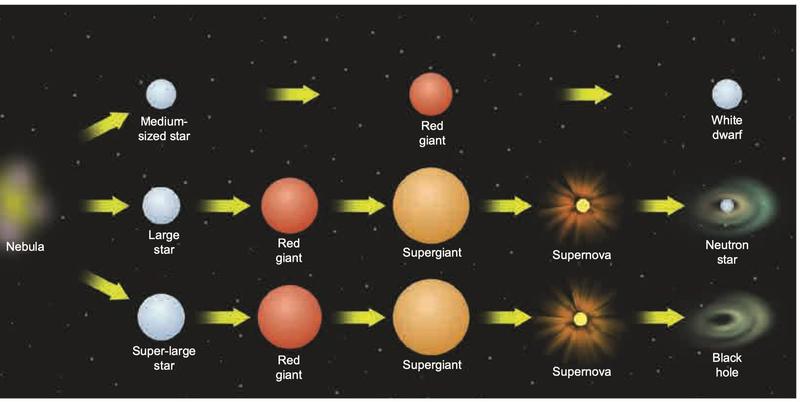
Diagram 2 shows the life cycle of stars.
[1 mark]
(a)Name the stage that comes immediately after the red giant in the life cycle of a large star.
Show answerHide answer
Tick each point you got.
[1 mark]
(b)Which size of original star becomes a neutron star?
Show answerHide answer
Tick each point you got.
[2 marks]
(c)State two similarities between the life cycles of a large star and a super-large star.
Show answerHide answer
Any 2 points
Tick each point you got.
[1 mark]
(d)State one difference between the end products of a large star and a super-large star.
Show answerHide answer
Tick each point you got.
16
Question 16
Astronomers measured the surface temperature of three stars.
| Star | Surface temperature (K) |
|---|---|
| P | 2 800 |
| Q | 5 500 |
| R | 28 000 |
[3 marks]
(a)State the colour of each star.
Show answerHide answer
Tick each point you got.
[1 mark]
(b)Which star has the highest surface temperature?
Show answerHide answer
Tick each point you got.
17
Question 17
Star M and star N have the same size and the same surface temperature, but star M is much nearer to the Earth than star N.
[1 mark]
(a)Which star looks brighter from the Earth?
Show answerHide answer
Star M
The nearer star looks brighter.
[2 marks]
(b)State two factors that affect the brightness of a star.
Show answerHide answer
Any 2 points
Tick each point you got.
[1 mark]
(c)A supergiant star that is very far away can look dimmer than a small star near the Earth. Explain why.
Show answerHide answer
Tick each point you got.
18
Question 18
A group of astronauts wants to travel to the Andromeda galaxy, which is near the Milky Way, in a spaceship. Andromeda is a spiral galaxy.
[2 marks]
(a)In your opinion, will the mission be successful? Give one reason.
Show answerHide answer
Tick each point you got.
[1 mark]
(b)Name one device that helps us to study distant galaxies without travelling there.
Show answerHide answer
Tick each point you got.
19
Question 19
The Sun is a star, not a planet.
[2 marks]
(a)Do you agree with the statement? Give a reason.
Show answerHide answer
Tick each point you got.
[1 mark]
(b)Why does the Sun look bigger and brighter than other stars?
Show answerHide answer
Tick each point you got.
20
Question 20
Choose the correct term for each description.
[1 mark]
(a)A large cloud of dust and gases where stars are born.
Show answerHide answer
Nebula
[1 mark]
(b)The final stage of a medium-sized star.
Show answerHide answer
White dwarf
[1 mark]
(c)A very bright explosion of a big red giant.
Show answerHide answer
Supernova
21
Question 21
A student makes a poster on how a super-large star is born and dies.
[3 marks]
(a)Write the stages in order as a flow chart, starting from the nebula and ending with the final product.
Show answerHide answer
Tick each point you got.