Sound waves
What this chapter covers
- Describe vibration as the source of sound and explain that sound needs a medium and travels at different speeds in solids, liquids and gases (10.1)
- Show that sound can be reflected by hard, smooth surfaces and absorbed by soft, rough surfaces (10.1)
- Relate amplitude to loudness and frequency (in hertz) to pitch, and explain the Doppler effect (10.2)
- Explain echo, the applications of reflected sound such as sonar and ultrasound scans, the hearing limits of humans and animals, and devices that overcome them (10.3)
10.1Characteristics of sound waves
Sound needs a medium
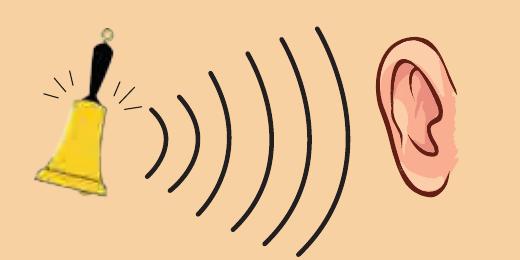
Sound travels as waves and it needs a medium (something made of particles) to travel through. It can pass through a solid, a liquid or a gas, but not through a vacuum.
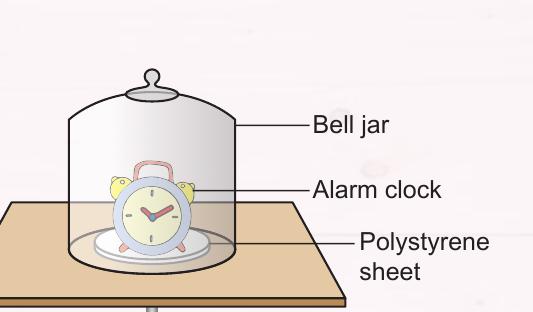
Textbook Figure 10.1, p. 224
- Observation: the sound fades as air is removed. Inference: sound needs a medium (air particles) to propagate.
- This is why astronauts cannot hear each other's voices directly in space.
Textbook Figure 10.4, p. 226
Speed of sound in different media
| Medium | Arrangement of particles | Speed of sound |
|---|---|---|
| Solid | Very close together, so one particle quickly knocks the next | Fastest |
| Liquid | Closer than in a gas but looser than in a solid | Slower than in a solid |
| Gas | Far apart, so there is a delay in passing the vibration | Slowest |
Reflection and absorption
Like light, sound can be reflected and absorbed when it hits a surface. How much depends on the surface.
| Surface | What it does to sound | Examples |
|---|---|---|
| Hard and smooth | Good reflector | Marble tiles, a wall, a metal sheet, glass |
| Soft and rough | Good absorber | Carpet, softboard, a towel, curtains |
Textbook Photographs 10.3 and 10.4, p. 228; Activity 10.1(B), p. 225
In Activity 10.1(B) a ticking stopwatch is heard through a cardboard tube after the sound bounces off a wooden plank. Replace the plank with a metal sheet and the ticking is still clear; replace it with a towel and it becomes very faint. A glass sheet is hard and smooth, so it is a good reflector.
Show answerHide answer
10.2Loudness and pitch of sound
Frequency — the number of complete vibrations (waves) in one second. Its unit is the hertz (Hz). It decides the pitch of the sound.
| Change | Wave on the C.R.O. | Sound you hear |
|---|---|---|
| Output power increased (frequency fixed) | Amplitude increases (taller wave) | Louder; same pitch |
| Frequency increased (output power fixed) | More waves in the same time (closer together) | Higher pitch; same loudness |
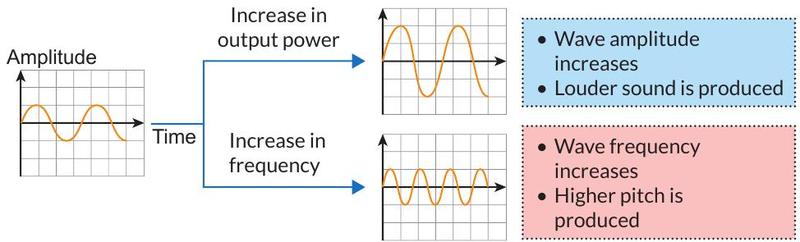
Textbook Figure 10.7, p. 230
- A bigger amplitude means the vibrating object carries more vibration energy, so the sound is louder.
- A cow's moo is a low-frequency sound (low pitch); a rat's squeak is high-frequency (high pitch).
- Tighten a guitar string and the pitch rises (higher frequency). Pluck it harder and it is louder (larger amplitude), with the same pitch.
- Men's vocal cords usually vibrate more slowly than women's, so men's voices are generally lower in pitch.
The Doppler effect
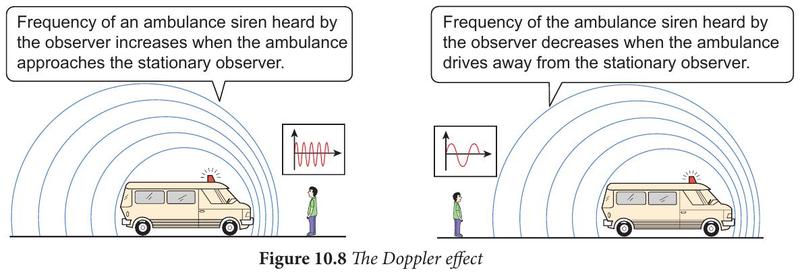
Textbook Figure 10.8, p. 231
- Ambulance approaching a stationary observer: frequency heard increases (higher pitch).
- Ambulance moving away: frequency heard decreases (lower pitch).
- The siren itself does not change. Someone riding in the ambulance hears no change because they do not move relative to the siren.
Show answerHide answer
10.3Reflection of sound waves: phenomena and applications
Echo
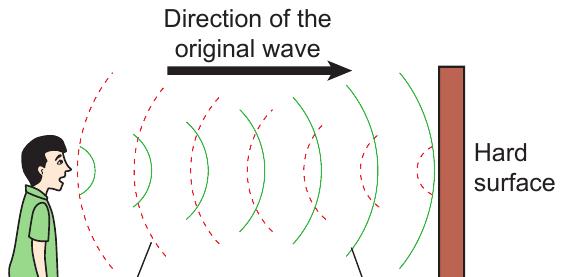
Textbook Figure 10.9, p. 232
- Echoes are heard in enclosed halls, empty rooms, caves, tunnels and gorges, where hard surfaces reflect sound.
- A farther surface gives a longer delay before the echo returns.
- Speed of sound also depends on temperature: it is faster in warmer air.
- Furniture, carpets and curtains absorb the sound, so an empty room echoes more than a furnished one.
Applications of reflected sound
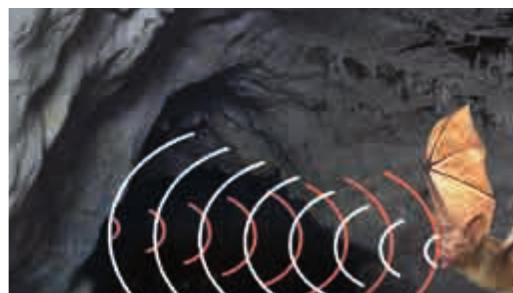
Textbook Figure 10.10, p. 232
| Sector | Use of reflected sound |
|---|---|
| Shipping | Sonar finds the depth of the sea and detects underwater objects such as rocks or wrecks |
| Fisheries | Sonar finds the position of shoals of fish |
| Medical | Ultrasound scans (sonograms) make images of a foetus and organs. Unlike X-rays, ultrasound does not carry harmful radiation, so it is safer for the foetus |
| Animals | Bats estimate the distance to objects from the echo |
Distance travelled (there and back) = 1 500 × 0.8 = 1 200 m.
The depth is half of that: 1 200 ÷ 2 = 600 m.
Limits of hearing
- Humans hear from 20 Hz to 20 000 Hz. The range becomes narrower as we get older.
- Animals have their own limits of hearing. Bats, dolphins, dogs and horses can hear higher frequencies than humans, but an elephant's hearing stops at a lower frequency (12 000 Hz).
| Animal | Hearing range (Hz) |
|---|---|
| Bats | 2 000 – 110 000 |
| Dogs | 67 – 45 000 |
| Dolphins | 40 – 100 000 |
| Elephants | 16 – 12 000 |
| Horses | 55 – 33 500 |
Textbook Science Info, p. 233
Our limited hearing means we cannot hear very soft sounds or sounds from far away. Devices that overcome these limits: a stethoscope (listen to a heartbeat), a megaphone (carries the voice to a distance) and a hearing aid (amplifies sound entering the ear).
Show answerHide answer
Summary
| Remember | Key fact |
|---|---|
| Source of sound | Vibration; travels as waves through a medium (solid, liquid, gas), never a vacuum |
| Speed | Solid > liquid > gas |
| Reflection / absorption | Hard and smooth reflects; soft and rough absorbs |
| Loudness | Amplitude (bigger amplitude, louder) |
| Pitch | Frequency in hertz (higher frequency, higher pitch) |
| Doppler effect | Apparent change of frequency when source or observer moves |
| Echo | Reflected sound from a hard surface, heard after a delay |
| Ultrasound | Above 20 000 Hz; used in sonar, fishing, scans and by bats |
| Human hearing | 20 Hz to 20 000 Hz; devices: stethoscope, megaphone, hearing aid |