Heat
What this chapter covers
- Compare heat and temperature (9.1)
- Explain how heat flows by conduction, convection and radiation, and state when thermal equilibrium is reached (9.2)
- Explain sea breeze and land breeze as natural convection currents (9.2)
- Give uses of heat conductors and heat insulators in daily life (9.2)
- Explain expansion and contraction of solids, liquids and gases in terms of particles, and give their uses (9.3)
- Show that dark, dull surfaces absorb and radiate heat better than white, shiny surfaces, and apply this in daily life (9.4)
9.1Relationship between temperature and heat
Temperature is a measure of the degree of hotness or coldness of an object. It is measured with a thermometer.
Heat and temperature are related, but they are not the same thing.
| Heat | Temperature | |
|---|---|---|
| What it is | A form of energy | The degree of hotness or coldness of an object |
| Unit | Joule (J) | Degree Celsius (°C) or kelvin (K) |
| Depends on | Type of material, quantity (mass) of material and temperature | The degree of movement of the particles in the matter |
Show answerHide answer
9.2Heat flow and thermal equilibrium
Heat always flows from a hot object to a cold one. It can travel in three ways: conduction, convection and radiation.
Conduction
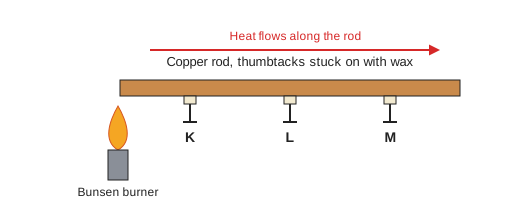
- Particles that receive heat vibrate more and collide with their neighbours, passing the heat along the whole solid.
- The particles do not travel along the rod; only the energy does.
Convection
- The part of the fluid that receives heat expands, becomes less dense and rises.
- The colder, denser fluid moves downwards to take its place.
- This continuous circulation is a convection current.
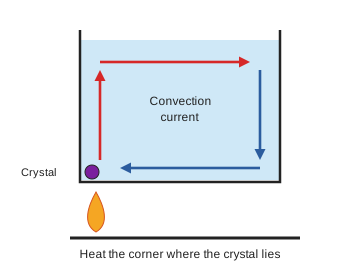
In Activity 9.1B(ii), a glowing incense stick is held at the mouth of the beaker so that the smoke shows how the air moves. Air goes down on the side of the incense, passes under the cardboard and rises over the candle.
Radiation
- Radiation is the only way heat reaches the Earth from the Sun, because space is almost a vacuum.
- Radiation is the fastest way for heat to travel, because it needs no medium.
- The type of surface, the temperature and the total surface area of an object affect the rate of heat flow.
| Method | Medium needed | Happens in | Example |
|---|---|---|---|
| Conduction | Yes, a solid | Solids (best in metals) | Metal spoon in hot soup warms up |
| Convection | Yes, a fluid | Liquids and gases | Water heated in a kettle |
| Radiation | No | Everywhere, including a vacuum | Warmth of the Sun |
Show answerHide answer
Heat flow in natural phenomena
Heat from the Sun reaches the Earth by radiation. Land and sea absorb it, and the warming of the Earth causes climate and natural phenomena such as sea breeze and land breeze.
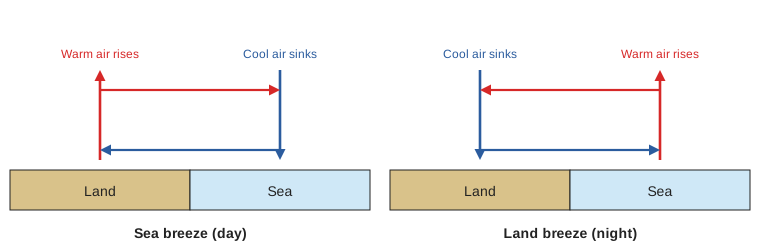
| Sea breeze | Land breeze | |
|---|---|---|
| When | Daytime | Night |
| Warmer surface | Land (heats up faster than the sea) | Sea (cools slower than the land) |
| What happens | Warm air above the land rises; cool, denser air from the sea moves in | Warm air above the sea rises; cool, denser air from the land moves out to sea |
| Wind blows | From sea to land | From land to sea |
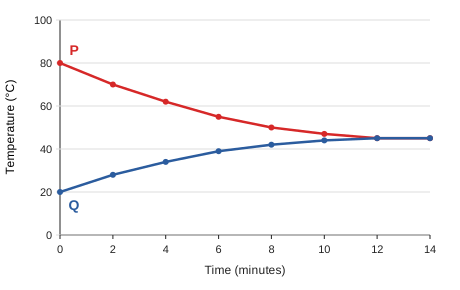
Thermal equilibrium
Heat conductors and heat insulators
| Heat conductor | Heat insulator | |
|---|---|---|
| Meaning | Allows heat to flow through it easily | Prevents (slows down) heat flow |
| Examples of material | Metals such as copper, iron, aluminium; mercury | Wood, fibreglass, polystyrene, cotton, felt, air |
| Uses | Base of an iron and bottom of a pan; mercury in a thermometer | Oven gloves; wooden handles; ice box wall; blanket |
Manipulated: type of insulator. Responding: final temperature after 10 minutes. Constant: volume of water.
Flask K is the control. Flask N loses heat quickly because aluminium is a conductor. Cotton and felt keep the water hot longest, so they are the good insulators.
Show answerHide answer
9.3Expansion and contraction of matter
Contraction: the volume of matter decreases when it is cooled.
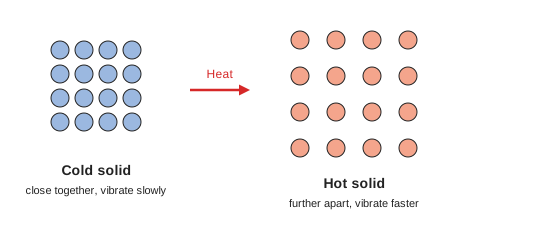
Solids, liquids and gases all expand when heated and contract when cooled. Gases expand the most and solids the least.
| When heated | When cooled | |
|---|---|---|
| Solid | Particles vibrate faster about fixed positions and move further apart. The solid expands. | Particles vibrate slower and move closer. The solid contracts. |
| Liquid and gas | Particles move faster and randomly; the distance between them increases. Volume increases. | Particles move slower and closer together. Volume decreases. |
Uses of expansion and contraction
| Situation | Explanation |
|---|---|
| Mercury in a thermometer | Mercury expands when hot and rises up the tube, and contracts when cold. It is a good heat conductor, so it responds quickly. |
| Gaps between railway tracks | Gaps let the rails expand in hot weather without buckling. |
| Steel bridge with rollers and a gap at one end | Allows the bridge to expand in hot weather. |
| Bimetallic strip | Two different metals expand at different rates, so the strip bends when heated. |
| Tight bottle lid | Put the lid in hot water. It expands and loosens. |
| Dented table tennis ball | Put it in hot water. The air inside expands and pushes the dent out. |
| Loose electric cables | Hung loosely so they can contract in cold weather without snapping. |
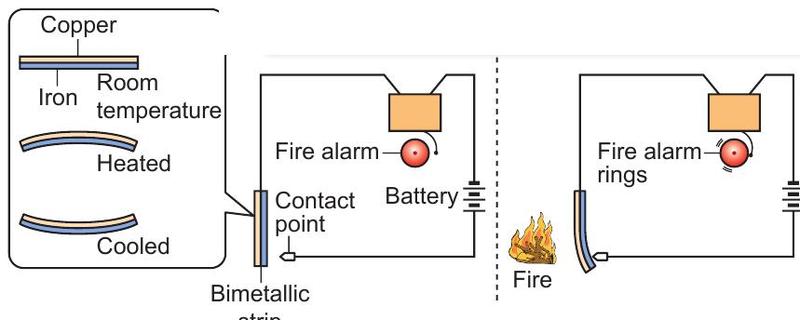
Textbook figure: Science Form 2 (DLP), Figure 9.14, p. 215.
Show answerHide answer
9.4Types of surface, and heat absorption and emission
Dark and dull surfaces are better heat absorbers and better heat radiators than white and shiny surfaces.
| Dark, dull surface | White, shiny surface | |
|---|---|---|
| Absorbs heat | Well | Poorly |
| Radiates heat | Well | Poorly |
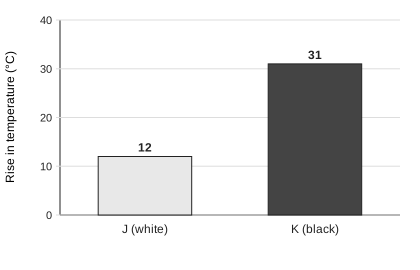
Absorbing: the black can warms more. Radiating: the hot water in the black can cools more. The hypothesis is accepted.
Uses in daily life
- Fuel tanks and lorries are painted white or silver: little heat is absorbed, so less fuel evaporates.
- Bright clothes are worn in hot weather: they absorb less heat, so we feel cooler.
- Thermos flask: shiny walls with a vacuum between them reduce heat radiation and conduction, so the drink stays hot.
- Cooking pots have a black base to absorb heat well; the shiny outside reduces heat lost.
- Green building concept: solar or renewable energy, good water flow, air circulation and lighting, and recycled materials.