Science questions, chapter 9
Nama / NameKelas / ClassTarikh / Date
Heat
44 marks. Use Practice to check each answer as you go, or Exam to answer everything against the clock first.
Section A: objective questions
12 marksChoose the best answer for each question.
1
Question 1
What is the S.I. unit of heat?
Show answerHide answer
C
Heat is a form of energy, measured in joule (J). Kelvin and degree Celsius are units of temperature.
2
Question 2
Heat always flows from
Show answerHide answer
B
Heat flows from a hotter region to a colder region, whatever the sizes of the objects.
3
Question 3
200 mL and 100 mL of water are boiled in two identical beakers. Which statement is correct?
Show answerHide answer
A
Temperature depends on the movement of the particles, so both boil at 100 °C. The larger mass needs more heat, so it takes longer.
4
Question 4
Which method of heat transfer allows the heat from the Sun to reach the Earth?
Show answerHide answer
D
Space is a vacuum. Only radiation can transfer heat without a medium.
5
Question 5
Oven gloves are made of thick cloth. Why?
Show answerHide answer
B
Heat insulators prevent heat flow, so the hand is not scalded.
6
Question 6
During the day the Sun heats the land faster than the sea. Which statement explains the sea breeze that results?
Show answerHide answer
D
The air above the land is warmer, less dense and rises. Cooler, denser air from the sea moves in, which is the sea breeze.
7
Question 7
Two objects are in thermal equilibrium. Which statement is correct?
Show answerHide answer
A
At thermal equilibrium the temperatures are equal, so there is no net heat flow. The amounts of heat may differ.
8
Question 8
What happens to the particles of a solid when it is heated?
Show answerHide answer
C
Heated particles vibrate faster and the distance between them increases, so the solid expands. The particles themselves do not change size.
9
Question 9
Small gaps are left between the rails of a railway track. What is the purpose of the gaps?
Show answerHide answer
C
Without the gaps the rails would buckle when they expand in hot weather.
10
Question 10
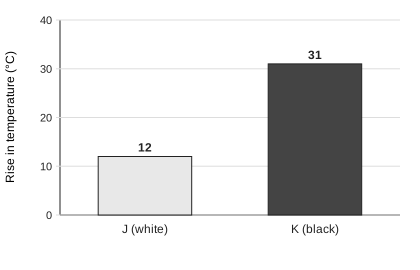
Diagram 1 shows the rise in temperature of the air in a white milk can J and a black milk can K after both were placed the same distance from a Bunsen burner for 10 minutes. What can be concluded?
Show answerHide answer
A
The black can warmed by 31 °C but the white can only by 12 °C under the same conditions, so black absorbs heat better.
11
Question 11
The cooling unit of a refrigerator is placed at the top of the compartment. Why?
Show answerHide answer
D
Air next to the unit cools, becomes denser and sinks. Warmer air rises to take its place, so a convection current cools the whole compartment.
12
Question 12
A bimetallic strip of brass and iron is heated and bends so that the iron is on the inside of the curve. What does this show?
Show answerHide answer
B
The metal that expands more is on the outside of the curve. Brass is on the outside, so it expands faster than iron.
Section B: structured questions
32 marksAnswer all questions. Write your answers in the spaces provided.
13
Question 13
Choose whether each statement describes heat or temperature.
[1 mark]
(a)It is measured in joule.
Show answerHide answer
Heat
[1 mark]
(b)It is measured in degrees Celsius or kelvin.
Show answerHide answer
Temperature
14
Question 14
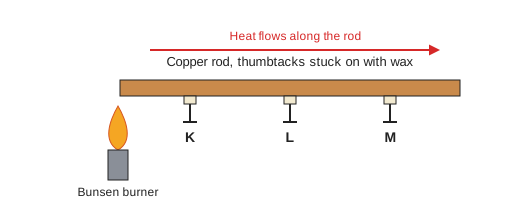
Diagram 2 shows three thumbtacks K, L and M fixed with wax to a copper rod. One end of the rod is heated.
[1 mark]
(a)State the method of heat transfer along the rod.
Show answerHide answer
Tick each point you got.
[1 mark]
(b)Which thumbtack falls first?
Show answerHide answer
K is the nearest to the heat source, so the wax around it melts first.
Tick each point you got.
[2 marks]
(c)Explain how heat travels along the rod.
Show answerHide answer
Tick each point you got.
15
Question 15
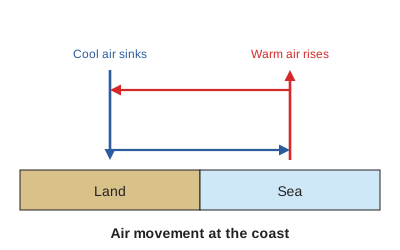
Diagram 3 shows the movement of air near a coast at night.
[1 mark]
(a)Name the type of breeze shown.
Show answerHide answer
Tick each point you got.
[2 marks]
(b)Explain why the air above the sea rises at night.
Show answerHide answer
Tick each point you got.
[1 mark]
(c)State the direction in which the breeze blows.
Show answerHide answer
Tick each point you got.
16
Question 16
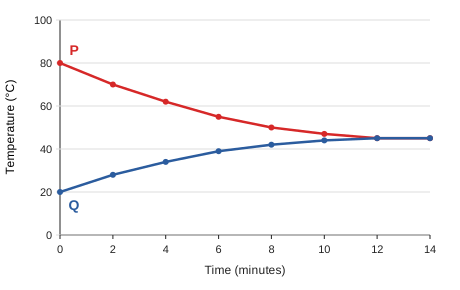
Diagram 4 shows the temperature of two objects P and Q in thermal contact, against time.
[1 mark]
(a)Which object loses heat?
Show answerHide answer
Its temperature falls from 80 °C.
Tick each point you got.
[1 mark]
(b)State the temperature at which the two objects are in thermal equilibrium.
Show answerHide answer
Tick each point you got.
[1 mark]
(c)After how many minutes is thermal equilibrium reached?
Show answerHide answer
Tick each point you got.
17
Question 17
Four identical flat-bottom flasks, each containing 200 mL of boiling water at 95 °C, were left for 10 minutes: K uncovered, L covered with cotton, M covered with felt, N covered with aluminium foil. Diagram 5 shows the final temperatures.
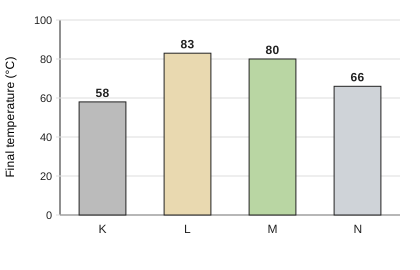
[1 mark]
(a)State the manipulated variable.
Show answerHide answer
Tick each point you got.
[1 mark]
(b)Calculate the drop in temperature of flask L.
Show answerHide answer
Tick each point you got.
[2 marks]
(c)Which material is the best heat insulator? Give a reason.
Show answerHide answer
Tick each point you got.
[1 mark]
(d)What is the purpose of flask K?
Show answerHide answer
Tick each point you got.
[1 mark]
(e)Explain why flask N cooled more than flask L.
Show answerHide answer
Tick each point you got.
18
Question 18
The lid of a glass bottle is very tight. Danish submerges the lid in hot water and is then able to open it.
[2 marks]
(a)Explain why the lid becomes easy to open.
Show answerHide answer
Tick each point you got.
[1 mark]
(b)A dented table tennis ball is placed in hot water and the dent disappears. Name the principle involved.
Show answerHide answer
Tick each point you got.
19
Question 19
A can of insecticide carries the warning: "Keep away from heat or fire!"
[2 marks]
(a)Explain what might happen if the empty can is thrown into a rubbish dump that is heated by the Sun or burning.
Show answerHide answer
Tick each point you got.
[1 mark]
(b)Suggest one safe way to store the insecticide can.
Show answerHide answer
Any 1 points
Tick each point you got.
20
Question 20
Dayah finds it hard to sleep on a cold rainy night even when she uses one thick blanket. She wants a blanket that keeps her warmer.
[2 marks]
(a)Suggest a design of a blanket that keeps her warmer.
Show answerHide answer
Tick each point you got.
[2 marks]
(b)Explain how your design reduces heat loss.
Show answerHide answer
Tick each point you got.
21
Question 21
Fuel tank lorries are usually painted white or silver.
[2 marks]
(a)Explain why.
Show answerHide answer
Tick each point you got.
[1 mark]
(b)Name one daily-life item that is made dark and dull so that it absorbs heat well.
Show answerHide answer
Any 1 points
Tick each point you got.