Science questions, chapter 10
Nama / NameKelas / ClassTarikh / Date
Sound waves
44 marks. Use Practice to check each answer as you go, or Exam to answer everything against the clock first.
Section A: objective questions
12 marksChoose the best answer for each question.
1
Question 1
Sound is produced when an object is
Show answerHide answer
B
Sound is a form of energy caused by vibration, for example a guitar string, a drum skin or your vocal cords.
2
Question 2
Sound waves cannot travel through
Show answerHide answer
D
Sound needs a medium made of particles. It can travel through solids, liquids and gases but not through a vacuum.
3
Question 3
In which medium does sound travel fastest?
Show answerHide answer
A
The particles of a solid are packed very closely, so the vibration is passed on quickly. Liquids are slower and gases slowest.
4
Question 4
Which surface is the best absorber of sound?
Show answerHide answer
C
Soft and rough surfaces such as carpet absorb sound. Marble, painted walls and metal are hard and smooth, so they reflect sound.
5
Question 5
What is the unit of frequency?
Show answerHide answer
B
Frequency is the number of complete waves per second and is measured in hertz (Hz).
6
Question 6
The amplitude of a sound wave increases. What happens to the sound?
Show answerHide answer
D
Loudness depends on amplitude. Pitch depends on frequency, and the speed depends on the medium.
7
Question 7
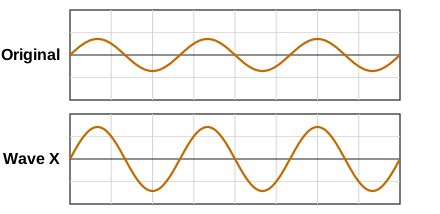
Diagram 1 shows the original sound wave and wave X on a C.R.O. screen. What was changed to produce wave X?
Show answerHide answer
A
Wave X has the same number of waves in the same time (same frequency, so same pitch) but a larger amplitude. A larger amplitude comes from more output power and gives a louder sound.
8
Question 8
An ambulance with its siren on drives towards a person standing by the road. What does the person notice?
Show answerHide answer
C
This is the Doppler effect: the frequency heard increases while the source approaches the observer, then decreases when it moves away.
9
Question 9
What is an echo?
Show answerHide answer
B
An echo is sound reflected from a hard surface that reaches the listener a little after the original sound.
10
Question 10
Ultrasound is a sound with a frequency
Show answerHide answer
D
Ultrasound has a frequency above 20 000 Hz, which is above the upper limit of human hearing.
11
Question 11
Which sound can be heard by a healthy young person?
Show answerHide answer
A
The hearing range of humans is 20 Hz to 20 000 Hz. 5 Hz is below the range; 25 000 Hz and 50 000 Hz are above it.
12
Question 12
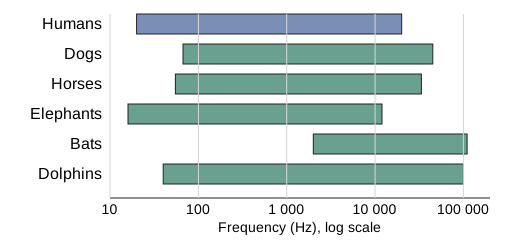
Diagram 2 shows the hearing ranges of some animals. Which animals can hear a sound of 60 000 Hz?
Show answerHide answer
C
Only the bars of bats (2 000 to 110 000 Hz) and dolphins (40 to 100 000 Hz) extend past 60 000 Hz. Dogs stop at 45 000 Hz, horses at 33 500 Hz and elephants at 12 000 Hz.
Section B: structured questions
32 marksAnswer all questions. Write your answers in the spaces provided.
13
Question 13
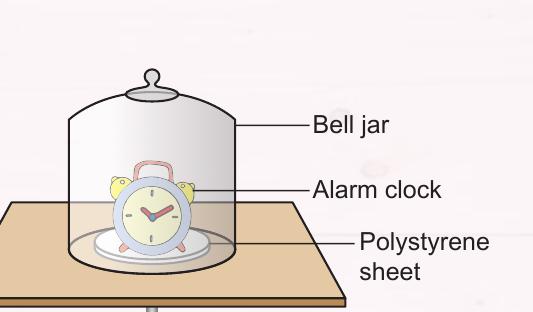
Diagram 3 shows an alarm clock that is ringing inside a bell jar. A vacuum pump then removes the air from the jar.
[1 mark]
(a)What happens to the loudness of the sound as the air is removed?
Show answerHide answer
It gets softer
Fewer air particles are left to carry the vibration.
[1 mark]
(b)What does this show about the propagation of sound?
Show answerHide answer
Tick each point you got.
[2 marks]
(c)Explain how the sound of the clock reaches your ear before the air is removed.
Show answerHide answer
Tick each point you got.
14
Question 14
Amir taps one end of a long steel rail. Bala puts his ear to the other end and hears the sound before Chin, who stands in the air next to him, hears it.
[2 marks]
(a)Explain why Bala hears the sound earlier than Chin.
Show answerHide answer
Tick each point you got.
[1 mark]
(b)Name a medium in which sound travels slower than in steel but faster than in air.
Show answerHide answer
Tick each point you got.
15
Question 15
A pupil repeats Activity 10.1(B) using a ticking stopwatch in a cardboard tube. The table shows how loud the ticking was heard through the second tube for three materials.
| Material | Ticking heard |
|---|---|
| Wooden plank | Loud |
| Metal sheet | Very loud |
| Towel | Very faint |
[1 mark]
(a)Which material is the best absorber of sound?
Show answerHide answer
Towel
The ticking is faintest because the towel absorbs most of the sound.
[1 mark]
(b)Which material is the best reflector of sound?
Show answerHide answer
Metal sheet
The ticking is loudest because the metal sheet reflects most of the sound.
[2 marks]
(c)The walls of a cinema hall are covered with layers of thin softboard. Explain why.
Show answerHide answer
Tick each point you got.
16
Question 16
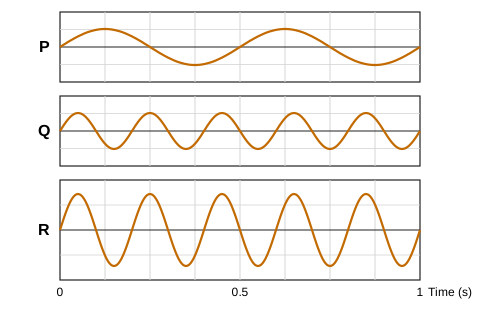
Diagram 4 shows the C.R.O. traces of three sounds P, Q and R recorded over one second. One of the sounds is the moo of a cow.
[1 mark]
(a)Which wave has the lowest frequency?
Show answerHide answer
P
P has only 2 waves in one second.
[1 mark]
(b)State the frequency of Q, with its unit.
Show answerHide answer
Count the complete waves in one second: 5, so 5 Hz.
Tick each point you got.
[2 marks]
(c)Compare Q and R.
Show answerHide answer
Tick each point you got.
[1 mark]
(d)Which wave is more likely to be the cow's moo? Give a reason.
Show answerHide answer
Tick each point you got.
17
Question 17
Farah plucks a guitar string.
[2 marks]
(a)She tightens the string and plucks it again. State the change in the sound and explain it.
Show answerHide answer
Tick each point you got.
[2 marks]
(b)She plucks the string harder. State the change in the sound and explain it.
Show answerHide answer
Tick each point you got.
18
Question 18
Raju stands at the roadside. An ambulance with its siren on drives past him.
[1 mark]
(a)The frequency of the siren that Raju hears while the ambulance approaches
Show answerHide answer
increases
The Doppler effect: the source moves towards the observer.
[1 mark]
(b)The frequency that Raju hears after the ambulance has passed him
Show answerHide answer
decreases
The ambulance is now moving away from him.
[1 mark]
(c)Does the driver of the ambulance hear the siren change in pitch? Give a reason.
Show answerHide answer
Tick each point you got.
19
Question 19
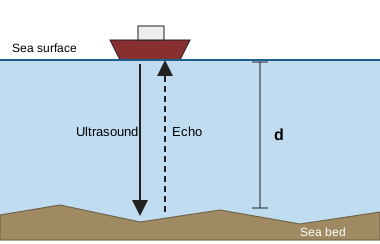
Diagram 5 shows a ship using sonar to find the depth d of the sea. The echo of the ultrasound is received 0.8 s after it was sent. The speed of sound in sea water is 1 500 m s⁻¹.
[1 mark]
(a)Humans cannot hear ultrasound. State its frequency.
Show answerHide answer
Tick each point you got.
[2 marks]
(b)Calculate the depth d of the sea.
Show answerHide answer
600 m
Tick each point you got.
[1 mark]
(c)State one other use of the reflection of ultrasound.
Show answerHide answer
Tick each point you got.
20
Question 20
You are asked to design a recording studio so that the recordings are of good quality.
[3 marks]
(a)Suggest three changes to make to the studio, with a reason for each.
Show answerHide answer
Any 3 points
Tick each point you got.
21
Question 21
Two astronauts are outside their spacecraft. They cannot hear each other's voices directly.
[1 mark]
(a)Explain why they cannot hear each other directly.
Show answerHide answer
Tick each point you got.
[1 mark]
(b)Suggest one other way they can communicate without radio, with a reason.
Show answerHide answer
Any 1 points
Tick each point you got.