Force and motion
What this chapter covers
- Describe force as a push or a pull, name the types of forces, state magnitude, direction and point of application, and measure force in newtons (8.1)
- Explain with examples that every action force has an equal reaction force in the opposite direction (8.1)
- Describe the effects of force on the motion, shape and size of objects (8.2)
- Relate density and buoyant force to floating and sinking, and calculate buoyant force from actual and apparent weight (8.2)
- Classify levers and solve problems using moment of force and the principle of moments (8.2)
- Calculate pressure and explain its applications, gas pressure by the kinetic theory, atmospheric pressure and its change with altitude, and liquid pressure and its change with depth (8.2)
8.1Force
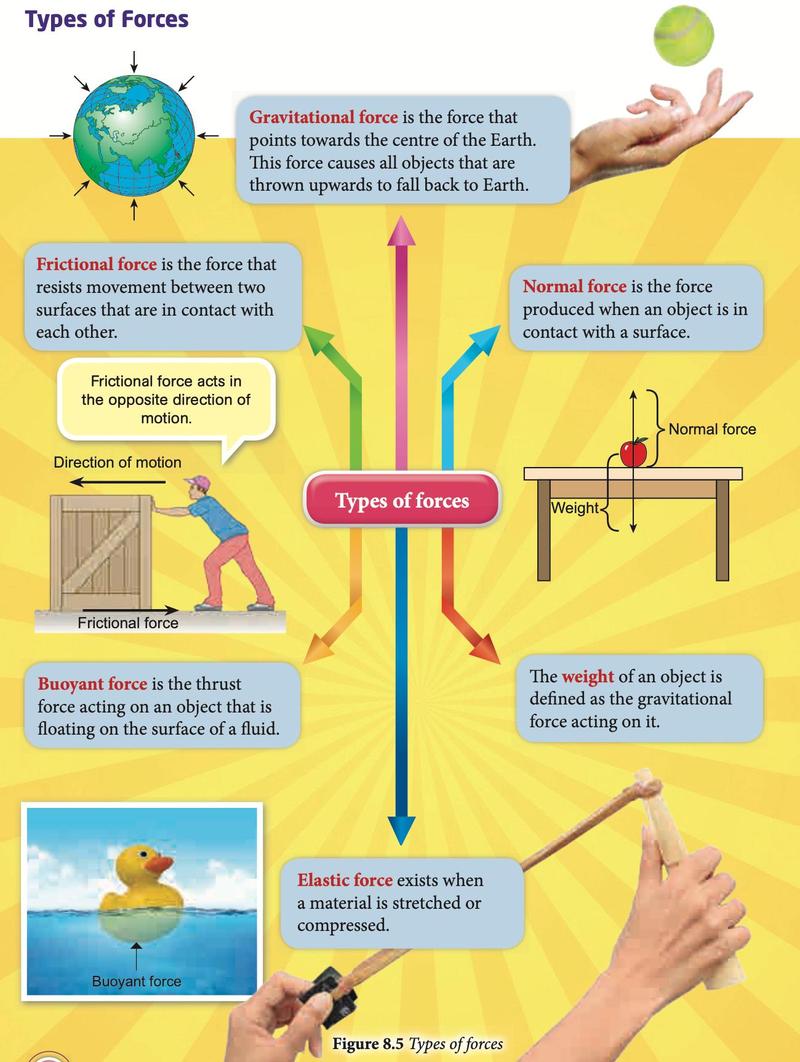
Almost every daily activity involves force, for example opening a can, pressing a switch, kicking a ball or opening a door. You cannot see a force, but you can see or feel its effects.
Types of forces
| Force | What it is | Example |
|---|---|---|
| Gravitational force | Pulls objects towards the centre of the Earth | A ball thrown upwards falls back to the ground |
| Weight | The gravitational force acting on an object | A 1 kg bag has a weight of 10 N on Earth |
| Normal force | Force from a surface that pushes up on an object resting on it | A book on a table |
| Frictional force | Resists movement between two surfaces in contact; acts opposite to the motion | A box pushed along a rough floor |
| Elastic force | Exists when a material is stretched or compressed | A stretched catapult rubber band, a spring |
| Buoyant force (upthrust) | Upward force of a fluid on an object in it | A rubber duck floating on water |
Characteristics of force
To describe a force fully, state three things.
- Magnitude: how large the force is, in newtons (e.g. 10 N).
- Direction: the way the force acts, shown by an arrow.
- Point of application: the place on the object where the force acts, such as the hand that pushes a box or the head of a hammer that pulls out a nail.
Measuring force
Force is measured with a spring balance, which works on the principle of spring extension: the bigger the force, the more the spring stretches, and the force is read from the scale. A metre rule measures length, not force.
Action and reaction forces
| Situation | Action force | Reaction force | Result |
|---|---|---|---|
| Book on a table | Weight (downwards) | Normal force (upwards) | Book stays still |
| Wooden block floating on water | Weight (downwards) | Buoyant force (upwards) | Block floats |
| Two trolleys pushed apart by a compressed spring | Elastic force on trolley 2 | Elastic force on trolley 1, same size, opposite direction | Trolleys move apart by the same distance |
Show answerHide answer
8.2Effects of force
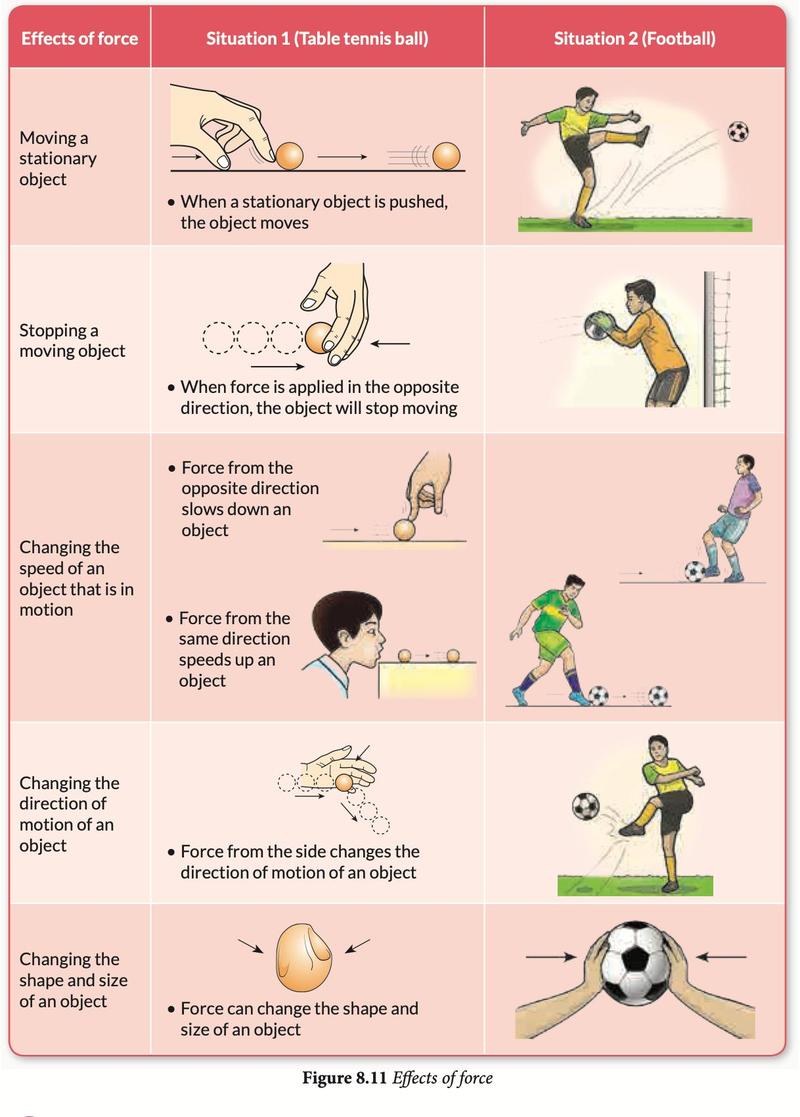
A force can change the shape and size, or the motion, of an object.
| Effect | How the force acts |
|---|---|
| Moves a stationary object | Push or pull the object |
| Stops a moving object | Force in the opposite direction |
| Slows down an object | Force in the opposite direction to the motion |
| Speeds up an object | Force in the same direction as the motion |
| Changes direction of motion | Force from the side |
| Changes shape and size | Squeezing, stretching or compressing |
Buoyant force and density
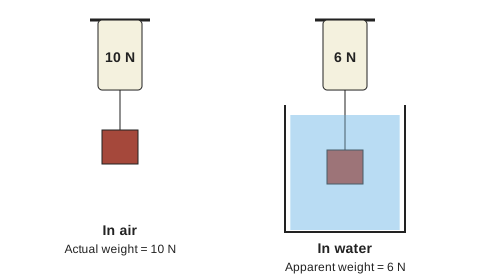
An object floats when the buoyant force on it is enough to support its weight, that is, buoyant force = weight. It submerges when the buoyant force is less than its weight.
Buoyant force (upthrust) = actual weight − apparent weight
Whether an object floats depends on its density compared with the density of the fluid.
| Object compared with water (1.0 g cm−3) | Buoyant force F and weight W | Result | Examples |
|---|---|---|---|
| Less dense | F > W when pushed in, then F = W at the surface | Floats | Cork (0.24 g cm−3) |
| More dense | F < W | Submerges | Iron (7.9), lead (11.3), gold (19.3 g cm−3) |
Buoyant force = 15 − 11 = 4 N. The buoyant force (4 N) is less than the weight (15 N), so the stone sinks.
Plimsoll line. Cargo ships carry Plimsoll lines. Sea water has different density in different places (it depends on temperature and salt), so the lines show the safe level the ship may sink to in each region.
Levers
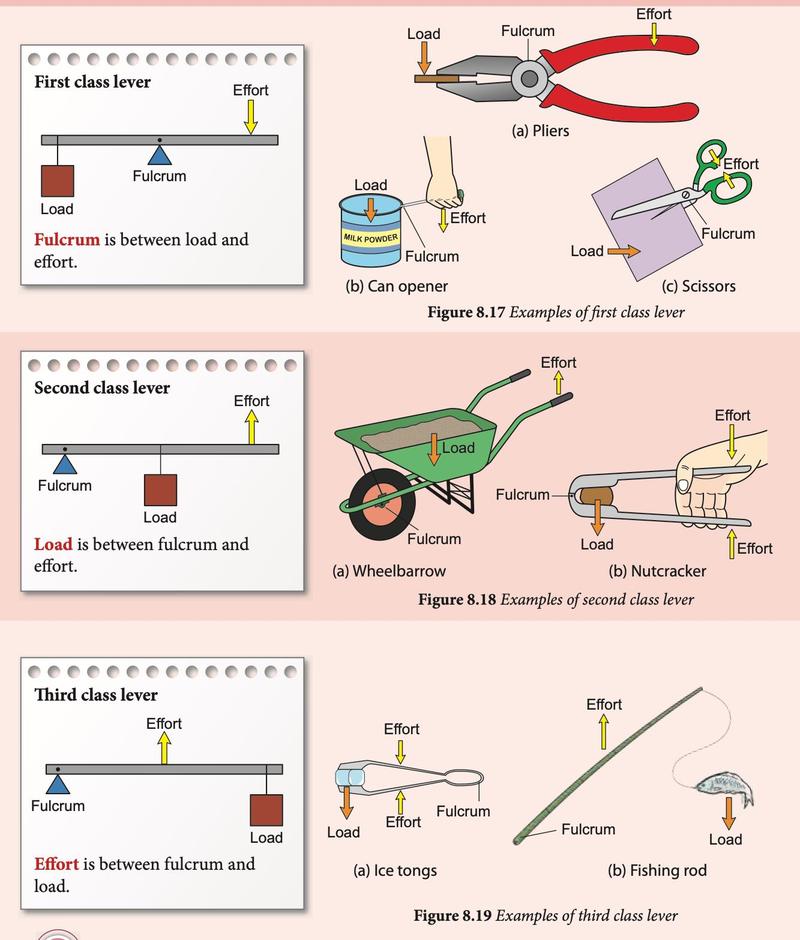
A lever is a simple machine. It lets us do work more easily, often with a smaller force.
| Class | Position | Examples |
|---|---|---|
| First class | Fulcrum is between load and effort | Scissors, pliers, can opener, see-saw |
| Second class | Load is between fulcrum and effort | Wheelbarrow, nutcracker |
| Third class | Effort is between fulcrum and load | Fishing rod, ice tongs, forceps |
Moment of force
Moment of force = force (N) × perpendicular distance from the pivot to the force (m)
The unit is the newton metre (N m). A moment is either clockwise or anticlockwise.
Moment of force increases when the force is greater or the perpendicular distance from the pivot is greater. That is why a long spanner loosens a tight nut more easily.
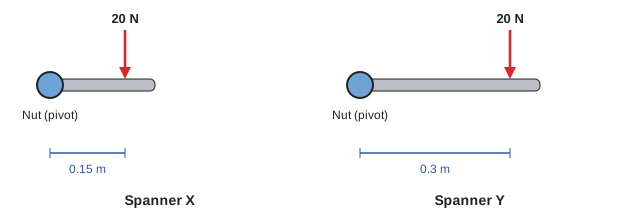
Spanner Y: moment = 20 N × 0.30 m = 6 N m.
Doubling the distance doubles the moment.
Principle of moments
A lever is balanced (horizontal) when the clockwise moment equals the anticlockwise moment.
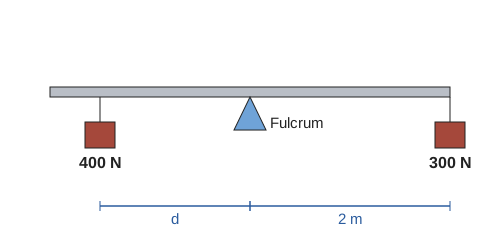
400 N × d = 300 N × 2 m
d = 600 ÷ 400 = 1.5 m
The heavier person sits closer to the fulcrum.
1 000 N × 0.5 m = effort × 2 m, so effort = 250 N.
Show answerHide answer
Pressure
A thumbtack goes into a plank easily but a coin does not, even with the same push. The force is spread over a different surface area.
Pressure (Pa) = force (N) ÷ surface area (m²)
S.I. unit: pascal (Pa); 1 Pa = 1 N m−2. The force acts perpendicular to the surface.
- Same force on a smaller area gives a larger pressure (needle, knife, studs on football boots, thin skating blades).
- Same force on a larger area gives a smaller pressure (elephant's wide feet, tractor wheels, wide straps on a bag).
Pressure = 24 ÷ 0.02 = 1 200 Pa. Standing it on its 10 cm × 5 cm face (0.005 m²) gives 24 ÷ 0.005 = 4 800 Pa.
Gas pressure
The kinetic theory of gas says gas particles move freely and randomly and keep colliding with the walls of the container. These collisions produce a force on the walls, which is gas (air) pressure.
| Factor | Change | Effect on pressure and why |
|---|---|---|
| Volume (fixed amount of gas, fixed temperature) | Volume decreases | Pressure increases: particles hit the walls more often |
| Temperature (fixed volume) | Temperature rises | Pressure increases: particles move faster and hit the walls more often and harder |
This is why a balloon left in the hot sun may burst, and why a bicycle pump gets hard to push as the air is squeezed.
Atmospheric pressure
Many everyday tools work because the pressure inside is made lower than the atmospheric pressure outside, so the higher outside pressure pushes.
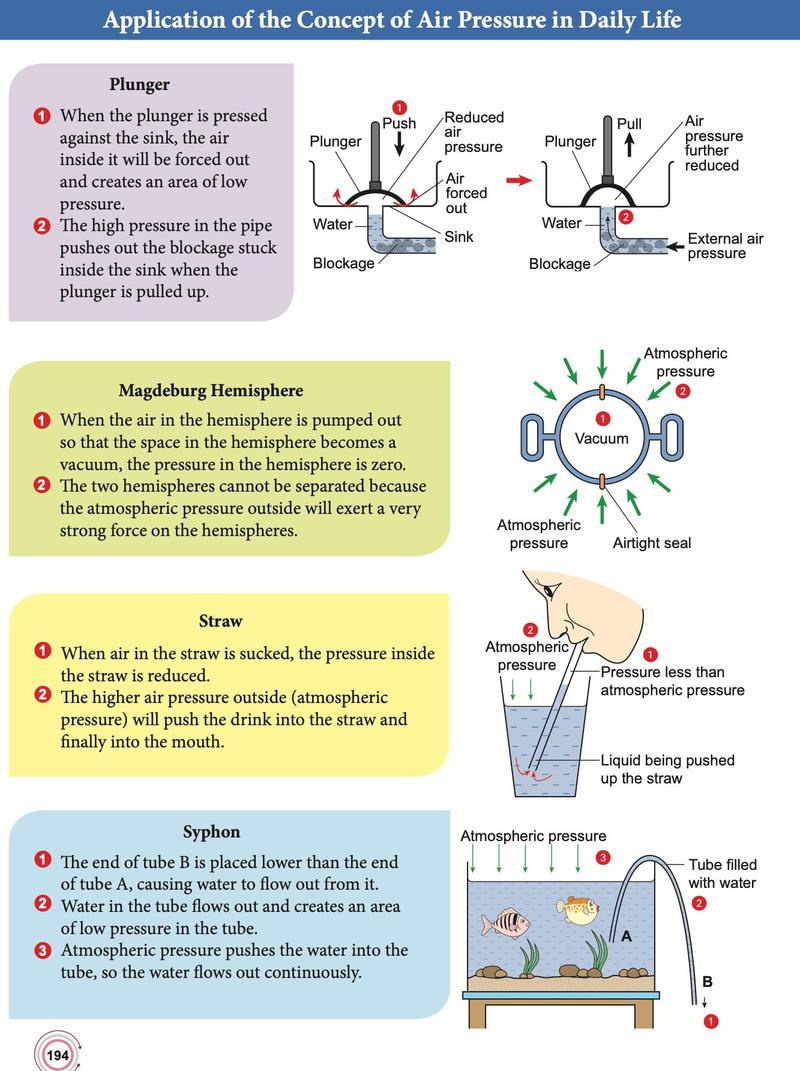
| Device | How it works |
|---|---|
| Drinking straw | Sucking lowers the pressure in the straw; atmospheric pressure on the drink pushes it up |
| Syringe | Pulling the piston lowers the pressure; atmospheric pressure pushes the liquid in |
| Vacuum cleaner | The fan lowers the pressure inside; higher atmospheric pressure pushes in air and dust |
| Plunger | Air is pushed out, making low pressure; atmospheric pressure holds it on the surface |
| Magdeburg hemispheres | With the air pumped out, atmospheric pressure outside holds the halves together |
| Syphon | Water flows down to the lower end, leaving low pressure; atmospheric pressure pushes more water in |
Altitude and atmospheric pressure
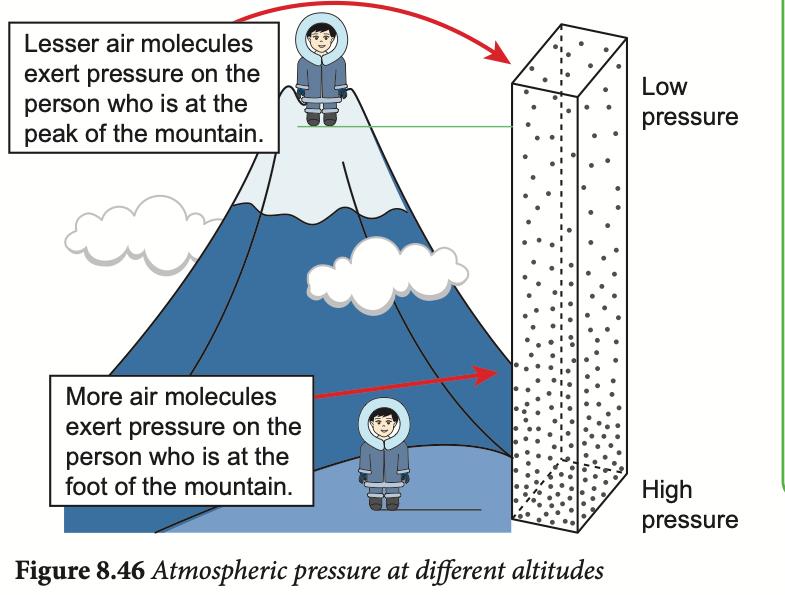
Atmospheric pressure decreases as altitude increases. Gravity pulls air towards the Earth, so air is denser near the surface and thinner at the top of a mountain, where there are fewer air molecules above and fewer collisions.
Depth and liquid pressure
Liquid pressure is caused by the weight of the liquid above. It increases with depth. In Activity 8.11, air bubbles grow bigger as they rise because the liquid pressure on them decreases.
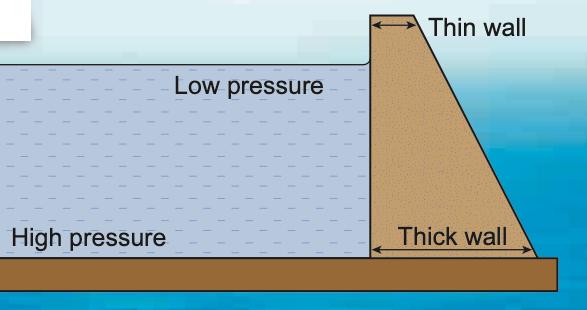
- A dam is thicker at the base to withstand the high water pressure there.
- A diver wears a special suit and a submarine has a strong hull to withstand high pressure deep down.
- Water from the lower hole of a bottle spurts out farther than from the upper hole.
Show answerHide answer
Summary
| Remember | Key fact |
|---|---|
| Force | Push or pull; vector (magnitude, direction, point of application); N; measured with a spring balance |
| Types | Gravitational, weight, normal, frictional, elastic, buoyant |
| Action and reaction | Same magnitude, opposite direction |
| Buoyancy | Upthrust = actual weight − apparent weight; less dense than fluid floats, more dense sinks |
| Levers | 1st: fulcrum in middle; 2nd: load in middle; 3rd: effort in middle |
| Moment of force | Force × perpendicular distance (N m); balance: load × d = effort × d |
| Pressure | Force ÷ area (Pa); small area gives high pressure |
| Gas pressure | Rises when volume falls or temperature rises (kinetic theory) |
| Atmospheric pressure | Falls with altitude; basis of straw, syringe, vacuum cleaner, plunger, syphon |
| Liquid pressure | Rises with depth |