Electricity and magnetism
What this chapter covers
- Describe forms and sources of energy, and explain how electrostatic charges form, how an electroscope shows them and where they matter in daily life (7.1)
- Define current, voltage and resistance with their units and instruments, and use Ohm's Law V = IR (7.1)
- Compare current, voltage and resistance in series and parallel circuits, and solve numerical problems (7.2)
- State the properties of a magnet and the characteristics of magnetic field lines (7.3)
- Describe electromagnets, the pattern and direction of their magnetic fields, the factors that affect their strength and their uses (7.3)
7.1Electricity
Energy: forms and sources
| Forms of energy | Examples |
|---|---|
| Kinetic | A running chicken, a moving car |
| Heat | Boiling water |
| Elastic potential | A compressed spring, a stretched rubber band |
| Gravitational potential | A book on a high shelf |
| Chemical | Food, fuel, dry cells |
| Electrical, light, sound, nuclear | A lighted bulb, a ringing bell, a power station |
Sources of energy: the Sun, wind, waves, water, geothermal, biomass, fossil fuel and radioactive substances.
Show answerHide answer
Electrostatic charges
- When two different objects are rubbed together, only electrons move from one object to the other. The protons stay put.
- The object that gains electrons becomes negatively charged. The object that loses electrons becomes positively charged.
- An object with equal numbers of protons and electrons is neutral.
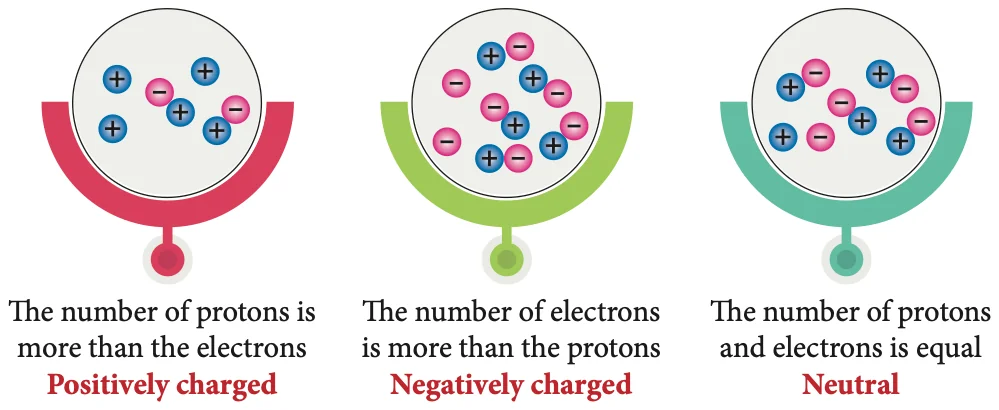
Textbook figure: Science Form 2 (DLP), Figure 7.3, p. 145.
2. The negative charges on the comb attract the positive charges on the neutral pieces of paper.
3. The pieces of paper are pulled towards the comb.
Electroscope
An electroscope detects whether an object carries electric charges. When a charged strip touches the metal cap, the charges spread to the gold leaf and the stem. Both have the same charge, so they repel and the leaf diverges. The further the leaf diverges, the larger the quantity of charges.
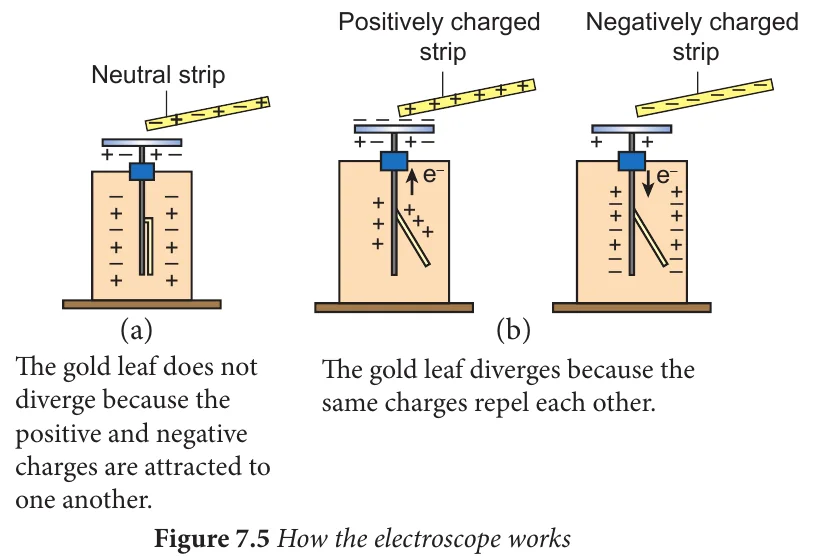
Textbook figure: Science Form 2 (DLP), Figure 7.5, p. 146.
Electrostatics in daily life
| Situation | Explanation |
|---|---|
| Lightning | Friction between clouds and air charges the cloud (the upper part becomes positive and the bottom part negative). The negative charges in the cloud are attracted to the positive charges on the ground, and a huge spark jumps across. A Van de Graaff generator can simulate it in the laboratory. |
| Lightning conductor | A metal rod on a tall building gives the charges an easy path into the ground, so the building is not struck. |
| Dusty TV screen | The positive charges on the screen attract the negatively charged dust. A microfibre cloth (anti-electrostatic material) stops the screen becoming dusty so quickly. |
| Electric shock from a door knob | Charges transfer between your body and the knob. |
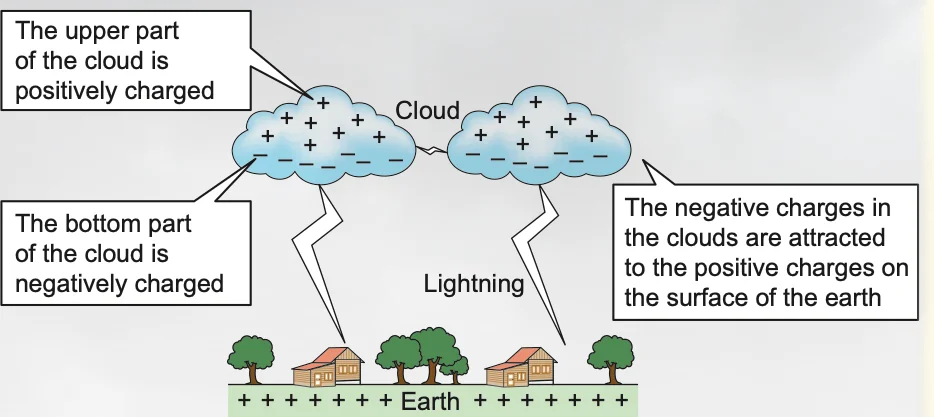
Textbook figure: Science Form 2 (DLP), Figure 7.6, p. 146.
Show answerHide answer
Current, voltage and resistance
Voltage is the potential difference between two points (voltmeter, volt, V).
Resistance is the ability of a conductor to resist the flow of current (ohm, Ω).
| Quantity | Symbol | Unit | Instrument | Connected |
|---|---|---|---|---|
| Current | I | ampere (A) | Ammeter | In series |
| Voltage | V | volt (V) | Voltmeter | In parallel across the component |
| Resistance | R | ohm (Ω) | Calculated: R = V ÷ I |
- More resistance (for example a longer nichrome wire) means less current.
- Higher voltage (for example more dry cells) means more current and a brighter bulb.
- A fixed resistor has a set resistance. A variable resistor (rheostat) can be adjusted.
V = I R I = V ÷ R R = V ÷ I
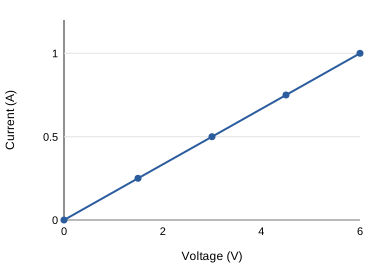
The same bulb on 6 V: I = V ÷ R = 6 ÷ 24 = 0.25 A.
Show answerHide answer
7.2Series and parallel circuits
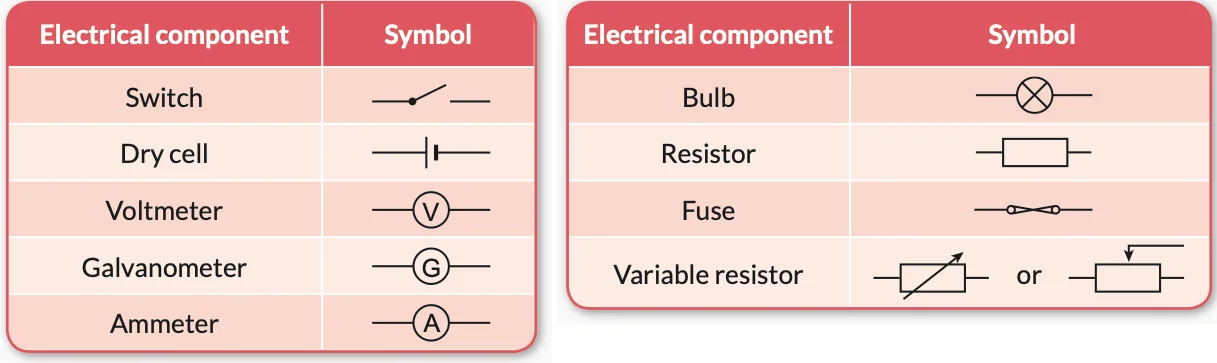
Textbook table: Science Form 2 (DLP), Table 7.1, p. 153.
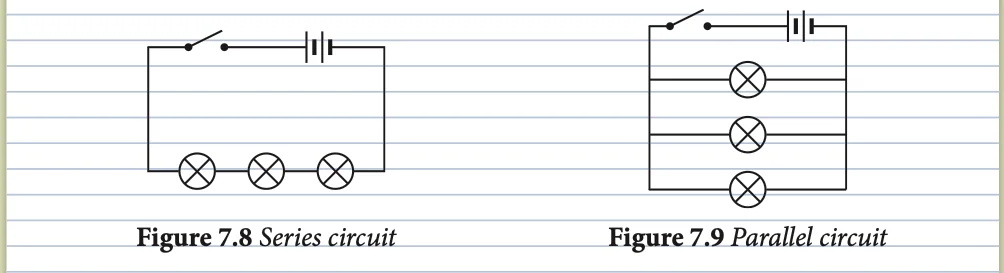
Textbook figures: Science Form 2 (DLP), Figures 7.8 and 7.9, p. 153.
| Series circuit | Parallel circuit | |
|---|---|---|
| Path | One path only | More than one path |
| Current | I = I₁ = I₂ (same everywhere) | I = I₁ + I₂ (current splits) |
| Voltage | V = V₁ + V₂ (shared) | V = V₁ = V₂ (same across each branch) |
| Effective resistance | R = R₁ + R₂ | 1/R = 1/R₁ + 1/R₂ |
| If one bulb fails | All stop | The others keep working |
| Switching | One switch controls all; cannot switch off one appliance | Each appliance can be switched on or off separately |
Series circuit calculation
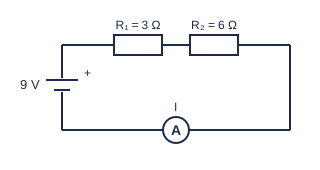
(b) I = V ÷ R = 9 ÷ 9 = 1 A
(c) V₁ = I R₁ = 1 × 3 = 3 V; V₂ = I R₂ = 1 × 6 = 6 V. Check: 3 + 6 = 9 V.
Parallel circuit calculation
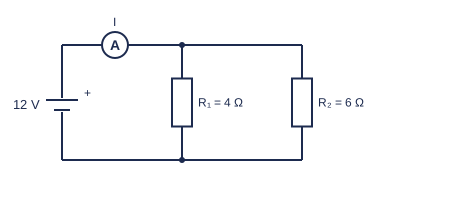
(b) Voltage across each resistor = 12 V
(c) I₁ = 12 ÷ 4 = 3 A; I₂ = 12 ÷ 6 = 2 A; I = 3 + 2 = 5 A. Check: 12 ÷ 2.4 = 5 A.
| Series circuit | Parallel circuit | |
|---|---|---|
| Advantages | Every component receives the same current. One switch controls all the components. A higher voltage gives more current. | Every appliance can be switched on or off separately. Adding more appliances does not affect the others. |
| Disadvantages | If one appliance is damaged, the others stop working. Adding more appliances increases the resistance and reduces the current. | The voltage of each appliance cannot be adjusted because it equals the voltage of the source. |
Direction of flow: electrons flow from the negative terminal to the positive terminal. The current flows from the positive terminal to the negative terminal, the opposite direction to the electrons.
Show answerHide answer
7.3Magnetism
Properties of a magnet
- It attracts magnetic materials.
- It has two poles: a north pole and a south pole. The attraction is strongest at the poles.
- Like poles repel, unlike poles attract.
- A freely suspended magnet comes to rest pointing north-south.
Magnetic field lines
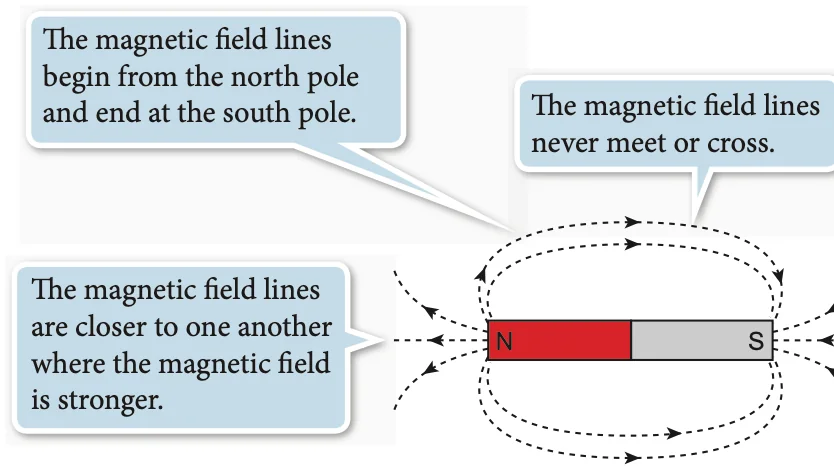
Textbook figure: Science Form 2 (DLP), Figure 7.16, p. 159.
- Lines begin at the north pole and end at the south pole.
- Lines never cross or meet.
- Lines are closer together where the field is stronger (near the poles).
- Between two like poles there is a neutral region where the field cancels out.
Electromagnet
- A straight wire (and a coil) produces field lines in the shape of concentric circles. The field is weaker further from the wire.
- Reversing the current reverses the direction of the field. The pattern stays the same.
- The right-hand grip rule for a straight wire: thumb along the current, curled fingers show the direction of the field.
- A solenoid is a long coil of wire. Looking at one end, current flowing anti-clockwise makes that end a north pole; current flowing clockwise makes it a south pole.
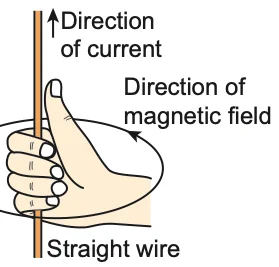
Textbook figure: Science Form 2 (DLP), Figure 7.19, p. 160.
Strength of an electromagnet
| Increase the | Effect on number of pins attracted |
|---|---|
| Current | Stronger magnetic field, more pins |
| Number of turns in the coil | Stronger magnetic field, more pins |
Uses: compass needles, magnetic door locks (electromagnet), credit and debit cards (strip that stores information), electric bells, and electromagnets that lift scrap metal. Switching the current off releases the load.