Science questions, chapter 7
Nama / NameKelas / ClassTarikh / Date
Electricity and magnetism
44 marks. Use Practice to check each answer as you go, or Exam to answer everything against the clock first.
Section A: objective questions
13 marksChoose the best answer for each question.
1
Question 1
What is the S.I. unit of energy?
Show answerHide answer
B
Energy is the ability to do work and its S.I. unit is the joule (J).
2
Question 2
A polythene rod becomes negatively charged when it is rubbed with a woollen cloth. Which statement explains this?
Show answerHide answer
C
Only electrons move when objects are rubbed. The object that gains electrons is negatively charged. Protons never move.
3
Question 3
A positively charged strip is touched to the metal cap of an electroscope and the gold leaf diverges. Why does the gold leaf diverge?
Show answerHide answer
A
The charges spread to the stem and the gold leaf. Same charges repel, so the leaf diverges. The more it diverges, the larger the quantity of charge.
4
Question 4
Why is a lightning conductor installed on a tall building?
Show answerHide answer
D
The conductor gives the charges an easy path to the ground, so the building is not struck.
5
Question 5
Which of the following defines electric current?
Show answerHide answer
B
Electric current is the rate of flow of electric charges. The first option is voltage and the third is resistance.
6
Question 6
A bulb has a current of 0.3 A when it is connected to a 9 V supply. What is the resistance of the bulb?
Show answerHide answer
A
R = V ÷ I = 9 ÷ 0.3 = 30 Ω.
7
Question 7
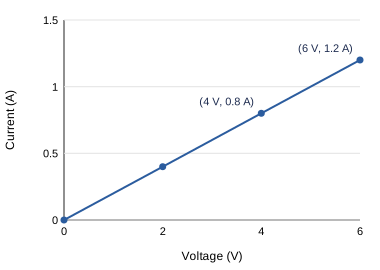
Diagram 1 shows the graph of current against voltage for a resistor. What is the current when the voltage is 5 V?
Show answerHide answer
C
The graph is a straight line, so R = 4 ÷ 0.8 = 5 Ω. At 5 V, I = 5 ÷ 5 = 1.0 A.
8
Question 8
Which statement about a series circuit is correct?
Show answerHide answer
D
In a series circuit the current is the same everywhere and V = V₁ + V₂. If one bulb is removed the circuit is broken and all bulbs go out.
9
Question 9
Two resistors of 6 Ω each are connected in parallel. What is the effective resistance?
Show answerHide answer
B
1/R = 1/6 + 1/6 = 2/6 = 1/3, so R = 3 Ω. (12 Ω would be the series answer.)
10
Question 10
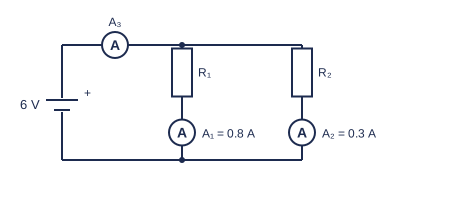
Diagram 2 shows a parallel circuit. What is the reading of ammeter A₃?
Show answerHide answer
C
In a parallel circuit I = I₁ + I₂ = 0.8 + 0.3 = 1.1 A.
11
Question 11
The lamps in a house are connected in parallel. What is the main reason?
Show answerHide answer
A
In a parallel circuit every branch has the same voltage as the supply, and each branch has its own switch. The effective resistance is smaller, not larger.
12
Question 12
Which statement about magnetic field lines is correct?
Show answerHide answer
D
Lines begin at the north pole and end at the south pole, never cross, and are closer where the field is stronger.
13
Question 13
Which change will NOT make an electromagnet stronger?
Show answerHide answer
B
Reversing the current only reverses the poles. The strength depends on the current and the number of turns.
Section B: structured questions
31 marksAnswer all questions. Write your answers in the spaces provided.
14
Question 14
Choose the form of energy for each situation.
[1 mark]
(a)A lighted bulb
Show answerHide answer
Light energy
[1 mark]
(b)A stretched rubber band
Show answerHide answer
Elastic potential energy
15
Question 15
A balloon is rubbed on a student's hair and then held near small pieces of paper. The pieces of paper jump towards the balloon.
[2 marks]
(a)The balloon becomes negatively charged. State the charge on the hair and explain your answer.
Show answerHide answer
Tick each point you got.
[1 mark]
(b)Explain why the pieces of paper are attracted to the balloon.
Show answerHide answer
Tick each point you got.
16
Question 16
Lightning is an example of electrostatic charges in nature.
[1 mark]
(a)What type of charge is found on the bottom part of a storm cloud?
Show answerHide answer
Tick each point you got.
[2 marks]
(b)Explain how lightning occurs.
Show answerHide answer
Tick each point you got.
[1 mark]
(c)State one way to protect a tall building from lightning.
Show answerHide answer
Tick each point you got.
17
Question 17
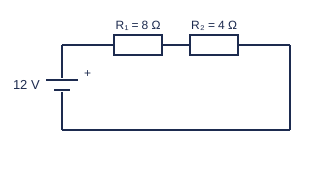
Diagram 3 shows two resistors connected in series to a 12 V cell.
[1 mark]
(a)Calculate the effective resistance.
Show answerHide answer
Tick each point you got.
[1 mark]
(b)Calculate the current in the circuit.
Show answerHide answer
Tick each point you got.
[1 mark]
(c)Calculate the voltage across R₁.
Show answerHide answer
Tick each point you got.
[1 mark]
(d)Calculate the voltage across R₂.
Show answerHide answer
Tick each point you got.
[1 mark]
(e)R₁ is removed from the circuit. What happens to the current? Give a reason.
Show answerHide answer
Tick each point you got.
18
Question 18
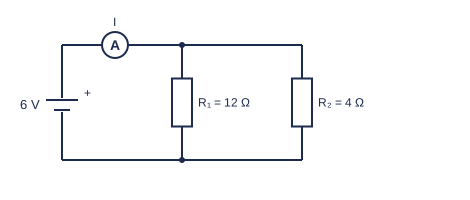
Diagram 4 shows two resistors connected in parallel to a 6 V cell.
[1 mark]
(a)What is the voltage across R₂?
Show answerHide answer
Tick each point you got.
[1 mark]
(b)Calculate the current through R₁.
Show answerHide answer
Tick each point you got.
[1 mark]
(c)Calculate the current through R₂.
Show answerHide answer
Tick each point you got.
[1 mark]
(d)What is the reading of the ammeter?
Show answerHide answer
Tick each point you got.
[2 marks]
(e)Calculate the effective resistance of the two resistors.
Show answerHide answer
Tick each point you got.
19
Question 19
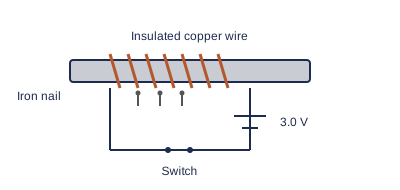
Diagram 5 shows an iron nail wound with insulated copper wire and connected to a dry cell through a switch. Some pins are placed below the nail.
[1 mark]
(a)What happens to the pins when the switch is turned on?
Show answerHide answer
Tick each point you got.
[1 mark]
(b)Name the type of magnet formed.
Show answerHide answer
Tick each point you got.
[2 marks]
(c)What happens to the pins when the switch is turned off? Explain.
Show answerHide answer
Tick each point you got.
20
Question 20
A shopkeeper wants to install three lights in his shop. He can connect them in series or in parallel.
[1 mark]
(a)Which connection is better?
Show answerHide answer
Tick each point you got.
[2 marks]
(b)Give two reasons for your answer.
Show answerHide answer
Any 2 points
Tick each point you got.
21
Question 21
Aina wants to investigate whether the number of turns of a coil affects the strength of an electromagnet. She uses an iron rod, copper wire, a power supply and some pins.
[1 mark]
(a)State the manipulated variable.
Show answerHide answer
Tick each point you got.
[1 mark]
(b)State the responding variable and how it is measured.
Show answerHide answer
Tick each point you got.
[1 mark]
(c)State one constant variable (a variable that is kept the same).
Show answerHide answer
Any 1 points
Tick each point you got.
[1 mark]
(d)Construct a hypothesis for this investigation.
Show answerHide answer
Tick each point you got.