Science questions, chapter 8
Nama / NameKelas / ClassTarikh / Date
Force and motion
44 marks. Use Practice to check each answer as you go, or Exam to answer everything against the clock first. Take g = 10 N kg⁻¹.
Section A: objective questions
14 marksChoose the best answer for each question.
1
Question 1
Which of the following is a vector quantity?
Show answerHide answer
C
A force has both magnitude and direction, so it is a vector quantity. Mass, time and density have magnitude only.
2
Question 2
Which instrument is used to measure force, and what is the S.I. unit of force?
Show answerHide answer
A
Force is measured with a spring balance, which works by spring extension, in newtons (N).
3
Question 3
A box is pushed to the right across a rough floor. In which direction does the frictional force on the box act?
Show answerHide answer
B
Frictional force resists movement, so it acts in the direction opposite to the motion, which is to the left.
4
Question 4
A bag of rice has a mass of 4.5 kg. What is its weight on Earth?
Show answerHide answer
C
Weight = mass × 10 N kg⁻¹ = 4.5 × 10 = 45 N.
5
Question 5
A wooden block floats at rest on water. Which force is the reaction to the weight of the block?
Show answerHide answer
D
The weight acts downwards. The buoyant force acts upwards with the same magnitude, so the block floats.
6
Question 6
A rolling ball is hit from the side by a stick. Which effect of force is shown?
Show answerHide answer
B
A force from the side changes the direction of motion of a moving object.
7
Question 7
A block has a weight of 7.5 N in air and an apparent weight of 5.0 N when immersed in water. What is the buoyant force on the block?
Show answerHide answer
A
Buoyant force = actual weight − apparent weight = 7.5 − 5.0 = 2.5 N.
8
Question 8
A solid has a mass of 60 g and a volume of 50 cm³. The density of water is 1.0 g cm⁻³. What happens when the solid is put into water?
Show answerHide answer
D
Density = 60 ÷ 50 = 1.2 g cm⁻³. This is more than water (1.0 g cm⁻³), so the buoyant force is less than the weight and the solid sinks.
9
Question 9
Which tool is a second class lever?
Show answerHide answer
C
In a wheelbarrow the load is between the fulcrum (the wheel) and the effort (the handles). Scissors are first class; a fishing rod and forceps are third class.
10
Question 10
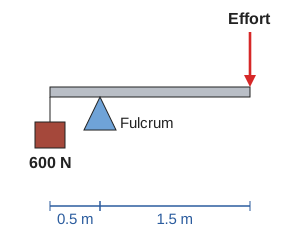
Diagram 1 shows a crowbar balanced with a load of 600 N. What effort is needed to balance the load?
Show answerHide answer
B
600 N × 0.5 m = effort × 1.5 m, so effort = 300 ÷ 1.5 = 200 N.
11
Question 11
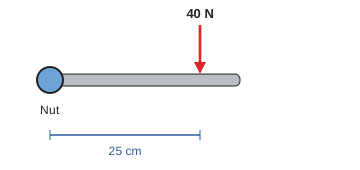
Diagram 2 shows a force of 40 N applied to a spanner 25 cm from the nut. What is the moment of force on the nut?
Show answerHide answer
A
Moment = force × perpendicular distance = 40 N × 0.25 m = 10 N m. The distance must be in metres.
12
Question 12
A force of 60 N acts perpendicularly on a surface of area 0.03 m². What is the pressure?
Show answerHide answer
D
Pressure = force ÷ area = 60 ÷ 0.03 = 2 000 Pa.
13
Question 13
A sealed rigid container of air is heated. Why does the air pressure inside increase?
Show answerHide answer
C
A higher temperature makes the particles move faster, so they collide with the walls more frequently and with greater force. The number of particles stays the same.
14
Question 14
Which activity does not depend on atmospheric pressure?
Show answerHide answer
B
A thumbtack goes in because the force is on a small area (high pressure). The straw, vacuum cleaner and plunger all work because the pressure inside is lowered and the higher atmospheric pressure outside pushes.
Section B: structured questions
30 marksAnswer all questions. Write your answers in the spaces provided.
15
Question 15
Name the main force acting in each situation.
[1 mark]
(a)A bungee jumper falls towards the ground.
Show answerHide answer
Gravitational force
Gravitational force pulls the jumper towards the centre of the Earth.
[1 mark]
(b)A bicycle slows down on a rough road when the rider stops pedalling.
Show answerHide answer
Frictional force
Friction between the tyres and the road resists the motion.
[1 mark]
(c)A hot air balloon floats at a fixed height.
Show answerHide answer
Buoyant force
The air pushes the balloon upwards with a force equal to its weight.
16
Question 16
A book with a weight of 12 N rests on a table.
[1 mark]
(a)Name the reaction force that acts on the book.
Show answerHide answer
Tick each point you got.
[2 marks]
(b)State the magnitude and direction of this force. Explain why the book stays at rest.
Show answerHide answer
Tick each point you got.
17
Question 17
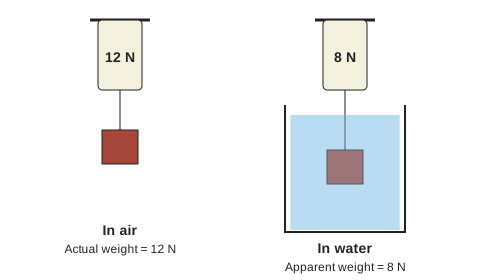
Diagram 3 shows a stone hung from a spring balance in air and then in water.
[1 mark]
(a)State the actual weight of the stone.
Show answerHide answer
Tick each point you got.
[1 mark]
(b)Calculate the buoyant force on the stone.
Show answerHide answer
Tick each point you got.
[2 marks]
(c)Explain why the stone sinks in water.
Show answerHide answer
Tick each point you got.
18
Question 18
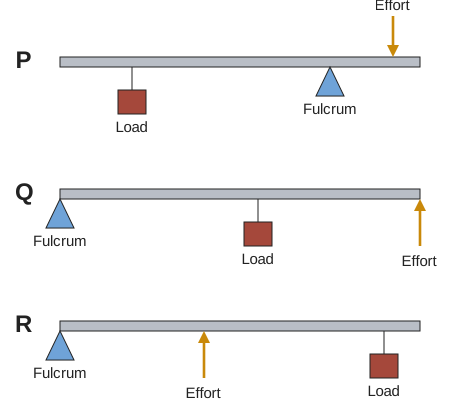
Diagram 4 shows three levers, P, Q and R. State the class of each lever.
[1 mark]
(a)Lever P
Show answerHide answer
First class
The fulcrum is between the load and the effort.
[1 mark]
(b)Lever Q
Show answerHide answer
Second class
The load is between the fulcrum and the effort.
[1 mark]
(c)Lever R
Show answerHide answer
Third class
The effort is between the fulcrum and the load.
19
Question 19
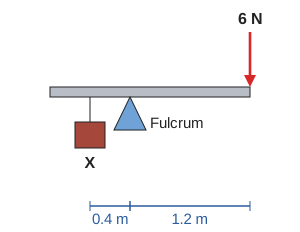
Diagram 5 shows a lever in equilibrium. A weight X hangs 0.4 m from the fulcrum and an effort of 6 N is applied 1.2 m from the fulcrum on the other side.
[1 mark]
(a)Calculate the moment of force of the 6 N effort about the fulcrum.
Show answerHide answer
Tick each point you got.
[2 marks]
(b)Calculate the weight of X.
Show answerHide answer
Tick each point you got.
20
Question 20
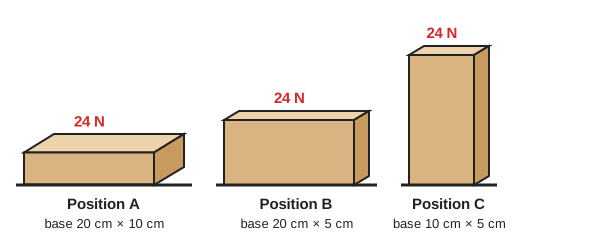
Diagram 6 shows the same block, which has a weight of 24 N, resting on three different faces, A, B and C.
[2 marks]
(a)Calculate the pressure exerted on the surface in position A.
Show answerHide answer
Tick each point you got.
[2 marks]
(b)Calculate the pressure exerted on the surface in position C.
Show answerHide answer
Tick each point you got.
[1 mark]
(c)State the relationship between surface area and pressure when the force is the same.
Show answerHide answer
Tick each point you got.
21
Question 21
Hana cannot drink from a juice box through a straw. She finds a small hole near the top of the straw.
[2 marks]
(a)Explain why Hana cannot drink the juice.
Show answerHide answer
Tick each point you got.
[1 mark]
(b)Suggest what Hana should do.
Show answerHide answer
Tick each point you got.
22
Question 22
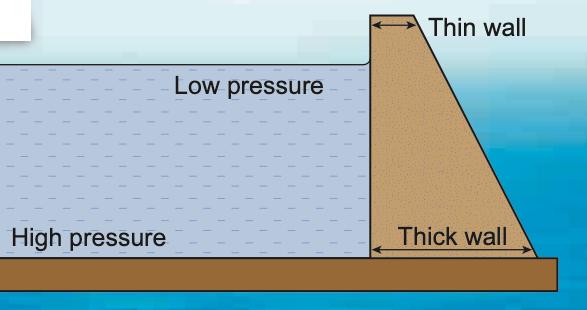
Diagram 7 shows the cross-section of a dam. A diver who goes deep into the sea also has to wear a special suit.
[1 mark]
(a)How does the pressure of the water change as the depth increases?
Show answerHide answer
Tick each point you got.
[2 marks]
(b)Explain why the dam wall is thicker at the base.
Show answerHide answer
Tick each point you got.
23
Question 23
Wan has a weight of 450 N and Nurul has a weight of 300 N. They sit on opposite sides of a see-saw, each 1.0 m from the fulcrum, and the see-saw is not balanced.
[3 marks]
(a)Suggest how Nurul can balance the see-saw. Support your answer with a calculation.
Show answerHide answer
Tick each point you got.