Reading short texts: notices, messages and signs
What this chapter covers
- I can tell what kind of text I am reading (advert, text message, notice, note, email or poster) and where I would find it (1.1)
- {'I can use the Exam Close-up "Eliminating answers"': 'read all the texts, underline key words in the options, then cross out options with no support in the text (1.2)'}
- {'I can use the Exam Close-up "Checking similar words"': 'read the whole sentence around a repeated word before I trust an option (1.3)'}
- I can work out who writes to whom and why, and find details such as times, prices, dates and conditions (1.4)
- I can do the small sums that hide in short texts, such as time gaps and ticket prices (1.4)
- I can read a longer text for general understanding and fill a gap by reading around it, using the Exam Close-ups of Units 7 and 8 (1.5)
- I know the Word Focus words of Units 5, 7, 8 and 10 (urgent, reschedule, enquiry, exhausted, threat ...) and can use them in sentences (1.6)
- I can report what a note or message says with said and told, changing tense, pronouns and time words (1.7)
In this unit you will practise the reading tasks of Close-up B1 Form 3 that use short texts: notes, text messages, emails, notices, adverts and posters. Each text has one question with three options (a, b or c). You will also meet two longer texts with four options (a to d). The book gives you four Exam Close-up tips for these tasks. This unit shows how to use each one.
1.1What kind of text is it?
Before you read the options, say what the text is and where you would find it. This is the first step in the Exam Close-up on page 59. The text type tells you what the writer wants.
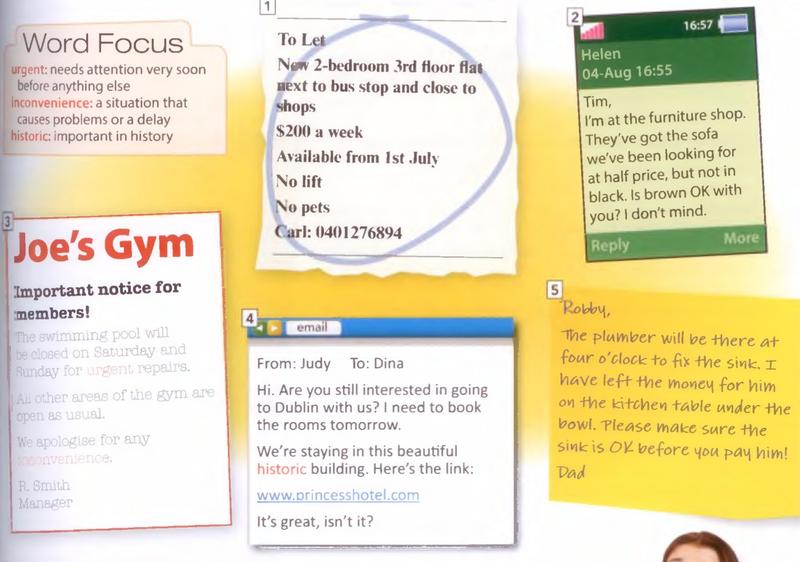
Close-up B1 Student's Book (Form 3), p.59, short texts 1 to 5 and Word Focus.
| Text type | Where you see it | What it usually does | Clue words |
|---|---|---|---|
| Advert (To Let, For Sale) | Newspaper, shop window, notice board | Offers something and gives price, place and contact | a week, available from, no pets, phone |
| Text message | Phone | Asks a quick question or gives news | Is ... OK with you? I'll leave ... See you |
| Notice | Gym, school, office | Gives information to many people | Important notice, closed, apologise |
| Computer or phone | Asks or answers; has From and To | Hi ..., Here's the link, Thank you for your enquiry | |
| Note | Kitchen table, fridge, desk | Gives instructions to one person at home | Please ..., don't forget, Dad, Mum |
| Poster | Street, theatre | Sells tickets for an event | date, time, hall, price, sold out |
1.2Eliminating answers
This is the Exam Close-up of Unit 5 (p.59). The steps are:
- Read all the texts first and think about where each one comes from.
- Read the answer options and underline the key words.
- Look in the text for information like the words you underlined.
- If you cannot find anything about an option in the text, eliminate it (cross it out).
- Check the options that are left and choose the one that answers the question.
What does the notice say?
a Members cannot use the reading room on Wednesday.
b The shop will be open on Wednesday.
c The cafe will be closed for a month.
Answer: b. Key words: reading room, shop, closed for a month. The text says the shop and the reading room are "open as usual", so a is wrong and b is right. The text gives only Wednesday, with nothing about a month, so c has no support and you can eliminate it.
Show answerHide answer
1.3Checking similar words
This is the Exam Close-up of Unit 10 (p.123). Writers of options often copy words from the text but change the meaning. If an option uses the same words as the text, slow down.
- Be careful with words that are the same in the options and in the text; they often say something different.
- Read the option, then read the complete sentence in the text. Ask: does it mean the same?
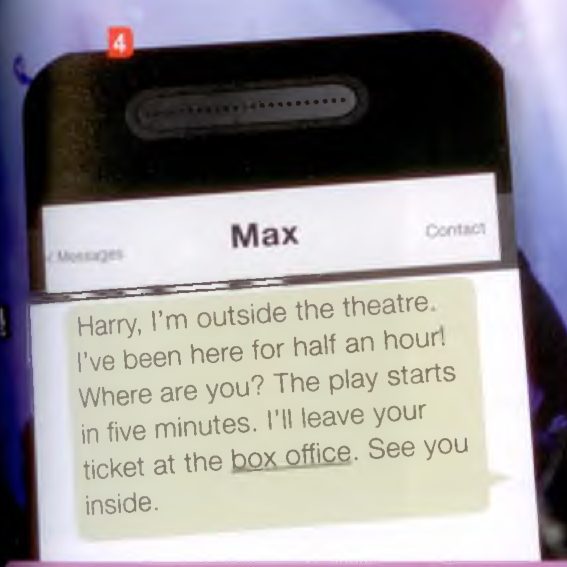
Close-up B1 Student's Book (Form 3), p.123, text 4.
What should Harry do?
a Buy tickets for him and Max.
b Collect his ticket himself.
c Meet Max outside the box office.
Answer: b. Option c copies "outside" and "box office" from the message. But Max is outside the theatre, and he will leave the ticket at the box office. Harry must pick it up. Option a has no support: Max already has the ticket and leaves it at the box office, so Harry need not buy any.
| Trap | What it looks like |
|---|---|
| Same words, wrong meaning | The option copies a phrase but joins it to the wrong place or action. |
| Opposite | The text says "open as usual"; the option says "closed". |
| Wrong person | "Dad will collect you" becomes "Becky will collect Dad". |
| Not in the text | A sensible idea with no support in the text. |
Show answerHide answer
1.4Purpose, details and small sums
A question stem tells you what to look for. Read it before you read the text.
| Stem | It asks for | Look for |
|---|---|---|
| Why has Judy written the email? Why has ... been written? | Purpose | The sentence with a question, request or news |
| What must Robby do? What should Harry do? | An instruction | Please ..., make sure ..., don't forget ... |
| The advert says the guitar ... | A fact | Numbers, conditions, adjectives |
Purpose words
| Purpose | Clues in the text |
|---|---|
| to ask someone to do something | Please ...; Can you ...?; make sure ... |
| to check / ask for information | Are you still interested ...? Is brown OK with you? |
| to give information | Thank you for your enquiry. The next series will be ... |
| to change a plan | rang to reschedule; she can see you at 5 |
| to remind | don't forget ... |
Hi. Are you still interested in going to Dublin with us? I need to book the rooms tomorrow. We're staying in this beautiful historic building.
Why has Judy written the email? a to get Dina's opinion about the hotel b to check if Dina is going to Dublin c to ask Dina to book rooms for them
Answer: b. The question "Are you still interested in going ...?" is the main point; she needs to know before she books. The hotel is only a detail (so a is wrong). Judy books the rooms herself (so c is wrong).
Small sums
Some questions need a small calculation. Write the numbers down.
Mum's note to Becky says: "She says she can see you at 5. Dad will collect you at 4.30." How long is it from the time Dad collects her to the lesson?
4.30 to 5.00 is 30 minutes.
An adult ticket for The Smash costs £50 and a student ticket costs £30. Two adults and one student: 2 × £50 + £30 = £130.
1.5Longer texts: general understanding and gaps
Unit 7 and Unit 8 use longer articles with four options (a to d). Each unit gives one Exam Close-up.
| Task | Exam Close-up (book) | What you do |
|---|---|---|
| Questions on a whole article (Survival in the Andes, p.85) | Reading for general understanding | Read it all the way through without stopping at new words. Make a note of the main idea of each paragraph. Then answer. |
| Choose the word for each gap (Deep into Darkness, p.97) | Reading around the gap | Read the text quickly. Think of a word that could fit before you look at the options. Cross out the clearly wrong ones. Read around the gap because two options can look possible. |
Sentence: "Polluted water from farms can ___ into a cave and kill the animals that live there."
Options: a crawl b capture c flow d surround.
First think of your own word: water moves into the cave. Crawl is for people or animals moving on hands and knees, and capture means to catch someone or something. Surround means to be all around something, so it does not fit "into". The answer is c, flow (to move easily in one direction).
Show answerHide answer
1.6Word Focus: words in the reading boxes
| Word | Meaning | Example |
|---|---|---|
| urgent | needs attention very soon, before anything else | The pool is closed for urgent repairs. |
| inconvenience | a situation that causes problems or a delay | We apologise for any inconvenience. |
| historic | important in history | We are staying in a historic building. |
| reschedule | change the time of a planned event | Mrs Potts rang to reschedule the lesson. |
| enquiry | an act of asking for information | Thank you for your enquiry. |
| attach | join something to something else | Fill in the attached form. |
| purchase | to buy | The guitar was purchased new two years ago. |
| exhausted | very tired | The exhausted men reached the town. |
| valley | an area of low land between mountains, often with a river | They hoped to find a valley. |
| threat | something that can cause damage or danger | Pollution is a threat to caves. |
Other words from the exam tasks: audition (a try-out for a part), sheet music (printed musical notes), scratch (a thin mark on a surface), box office (where tickets are sold), drum kit (a set of drums).
1.7Language help: what messages say
Notes and messages often talk about the future and often report what someone said.
| Form | Use | Example in a text |
|---|---|---|
| will + verb | arrangements, promises, offers | The plumber will be there at four. Dad will collect you at 4.30. |
| be going to + verb | plans and predictions with evidence | We're going to repaint the lab next week. |
| said / told + (that) clause | reporting what someone said | Mrs Potts said (that) she could see Becky at 5. |
In reported speech (p.125) the main verb usually moves back one tense (can becomes could, am becomes was), pronouns change, and time words change (tomorrow becomes the next day). Use told + person (told me), but said without an object.
Show answerHide answer
1.8A step-by-step method
- Question first. Read the stem: purpose, instruction or fact?
- Name the text. Advert, message, note, notice, email or poster? Who writes to whom?
- Underline key words in the options.
- Find and compare. Match each option with the text. Check similar words with care.
- Eliminate options with no support or the opposite meaning, then choose the best one. Check any numbers once more.