Grammar: present, past and perfect tenses
What this chapter covers
- I can use the present simple and present continuous for facts, routines, timetables, temporary actions, changes and plans (2.1)
- I can tell stative verbs from action verbs, and explain how have, think, see, taste and be change meaning (2.1)
- I can use the past simple and past continuous to set a scene, show an interrupted action and tell a story (2.2)
- I can use used to, would, be used to and get used to correctly (2.3)
- I can choose between the present perfect simple, the present perfect continuous and the past simple, and use for, since and ago (2.4)
- I can use the past perfect simple and continuous for an earlier action in the past (2.5)
- I can find and correct one-word tense errors in a text, as in UASA Paper 1 Part 2 (2.6)
In Tingkatan 1 you met five tenses. At B1 level the question is no longer only "past or present?" but how we see the action: a finished event, an action in progress, a result that matters now, or something that happened before another past event. This unit covers eight forms. It is the grammar that Paper 1 Part 2 (error correction) and the Paper 2 stories need. The unit follows Units 1, 2, 3 and 7 of the textbook and its Grammar Reference (pp.161 to 168).
| Simple | Continuous | Perfect simple | Perfect continuous | |
|---|---|---|---|---|
| Present | she studies | she is studying | she has studied | she has been studying |
| Past | she studied | she was studying | she had studied | she had been studying |
2.1Present simple, present continuous and stative verbs
Textbook: Unit 1 p.9; Grammar Reference 1.1 to 1.4, pp.161 to 162.
| Tense | Uses | Example |
|---|---|---|
| Present simple | facts and general truths | Water boils at 100 °C. |
| routines and habits (with adverbs of frequency) | My sister always plays volleyball at the weekend. | |
| permanent states | We live in Sevenoaks. | |
| timetabled future events | The film starts at 8 o'clock. | |
| Present continuous | in progress now, or around now | We are watching a DVD about elephants. |
| temporary situations | My cousin is staying with us this weekend. | |
| changing and developing situations | Families are becoming smaller and smaller. | |
| an annoying habit (always, forever, constantly) | My brother is forever complaining about homework. | |
| plans and arrangements | We are visiting my aunt this Saturday. |
Stative verbs
A stative verb describes a state (what you feel, think, own or sense), not an action, so it normally takes the present simple, not -ing.
| Group | Verbs |
|---|---|
| emotion | hate, like, love, need, prefer, want |
| senses | feel, hear, see, smell, sound, taste |
| state of mind | believe, doubt, forget, imagine, know, remember, seem, suppose, think, understand |
| possession | belong to, have, own, possess |
| other | be, consist, contain, cost, include, mean |
Some of these verbs have two meanings. Only the action meaning can be continuous.
| Verb | State (simple) | Action (continuous) |
|---|---|---|
| be | John is very honest. (his character) | Ken is being very rude. (just now, not normal) |
| have | Lucy has a lovely house. (own) | Susan is having a great time. / We are having lunch. |
| think | I think you're mad. (opinion) | Jenny is thinking of going to France. (considering) |
| see | Oh, I see. (understand) | I am seeing Wendy tomorrow. (meeting) |
| taste | This soup tastes horrible. (its flavour) | Why are you tasting the sauce? (testing it) |
| weigh | Jill weighs 48 kg. | I am weighing my suitcase. |
| look | She looks like her mother. (resembles) | Are you looking for your keys? (searching) |
Adverbs of frequency
always, usually, often, sometimes, rarely / hardly ever / seldom, never. They go before the main verb but after be: "Susan rarely argues with her brother." "Jeremy is often tired in the morning."
"I
"Tony
"Bob and Sue
"The film
"Jenny
(a) Granddad isn't feeling well. He (sees / is seeing) the doctor later today.
(b) Who's that? I (don't remember / am not remembering) her name.
(c) Mum and Dad always (take / are taking) us with them on holiday.
(d) Families (become / are becoming) smaller and smaller these days.
Show answerHide answer
(b) don't remember (state of mind)
(c) take (always = a habit)
(d) are becoming (a changing situation)
2.2Past simple and past continuous
Textbook: Unit 2 p.21; Grammar Reference 2.1 and 2.2, p.163.
| Tense | Form | Uses |
|---|---|---|
| Past simple | -ed / irregular; didn't + base; Did ... + base? | finished actions; past routines and habits; a series of actions one after another (telling a story) |
| Past continuous | was / were + -ing | action in progress at a specific time; two actions in progress at the same time; background to a story; an action interrupted by another |
I was cooking while my brother was watching TV. (at the same time)
The sun was shining and the children were playing outside when there was a loud bang. (background, then the event)
We were getting ready to have dinner when the doorbell rang. (interrupted)
"While I
"I
"He
Spelling: travel → travelled, travelling; tidy → tidied, tidying; write → writing.
(a) The children ______ (order) pizza when I ______ (walk) into their room.
(b) Karen ______ (make) lunch while Peter ______ (set) the table.
(c) My dad ______ (cook) dinner on Saturday because Mum ______ (be) ill.
Show answerHide answer
(b) was making ... was setting (two actions at the same time)
(c) cooked ... was (a finished past action and a past state)
2.3Used to, would, be used to and get used to
Textbook: Unit 2 p.25; Grammar Reference 2.3 and 2.4, p.163.
| Form | Meaning | Example |
|---|---|---|
| used to + base verb | a past habit or past state that is not true now | I used to love eating out, but now I prefer cooking at home. |
| would + base verb | a past repeated action only (never a state) | Their mother would cook something special at the weekends. |
| be used to + gerund / noun | something that is usual and familiar now | Her daughter is used to eating late at night. |
| get used to + gerund / noun | the process of becoming familiar | I am getting used to salty food. |
"I
"I'm not used to
"Did you
"Julie has never got used
(a) We (used to / are used to) have picnics at the beach every weekend when I was little.
(b) It is very cold here, but I (am getting used to / use to) it slowly.
(c) In "When I was seven I ______ have a red bicycle", which is not possible: would or used to?
Show answerHide answer
(b) am getting used to (the process of becoming familiar)
(c) would. "Have a bicycle" is a state, and would is only for repeated actions.
2.4Present perfect simple and present perfect continuous
Textbook: Unit 3 p.35; Grammar Reference 3.1 to 3.6, pp.163 to 164.
| Tense | Form | Uses | Example |
|---|---|---|---|
| Present perfect simple | have / has + past participle | started in the past and continues until now; unspecified time in the past; past action with a result now; just finished; experiences and achievements | That scientist has studied global warming since 2001. The museum has just closed. |
| Present perfect continuous | have / has + been + -ing | in progress up to now, or repeated until now; recently finished with a result you can see; emphasising how long | My eyes hurt because I have been working on the computer for hours. |
For, since and ago
| Word | Used with | Example |
|---|---|---|
| for | a length of time + present perfect | The Tasmanian wolf has been extinct for about 50 years. |
| since | a point in time + present perfect | The dodo has been extinct since 1681. |
| ago | a length of time + past simple | He went to a conference a month ago. |
Other signal words for the present perfect: already, ever, never, just, yet, recently, so far, once, twice, three times, until now. For the continuous: all day, lately, recently, since, for ages, and the question How long ...?
Which one to choose?
| Choose | When | Example |
|---|---|---|
| present perfect simple | the focus is on what was done or achieved, the action is complete, or you say how many times | We have watched that documentary five times this month. |
| present perfect continuous | the focus is on how long, whether or not it has finished | The storm has been going on for days. |
| past simple | you say when (last year, in 2019, two days ago) | We met the scientist at a conference last year. |
"He
"I have lived here
"I
"She
(a) Lin is tired because she ______ (study) since 2.00 p.m.
(b) Biologists ______ (find) three new species so far this year.
(c) How long ______ Bob ______ (work) in this lab?
(d) The team ______ (leave) for the Amazon two weeks ago.
Show answerHide answer
(b) have found (a number, so the simple form)
(c) has ... been working (How long ...?)
(d) left (ago = past simple)
2.5Past perfect simple and past perfect continuous
Textbook: Unit 7 pp.87 and 93; Grammar Reference 7.1 to 7.3, pp.167 to 168.
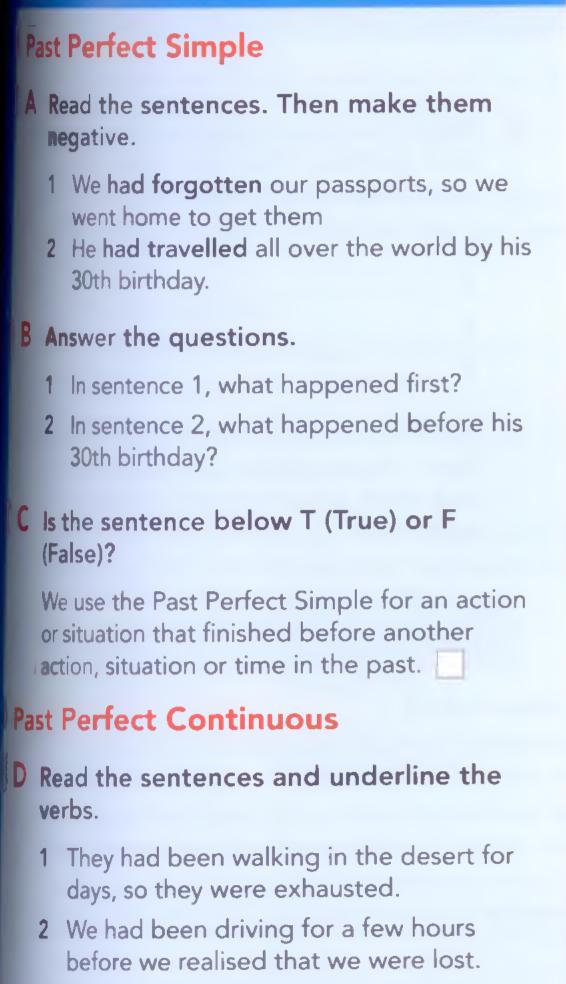
Close-up B1 Student's Book (Form 3), p.87 (Unit 7 Grammar).
| Tense | Form | Uses | Example |
|---|---|---|---|
| Past perfect simple | had + past participle | an action or situation that finished before another past action, situation or time | The lost climber had been on the mountain for days before he was rescued. |
| Past perfect continuous | had + been + -ing | an action in progress when another past action began; an action in progress that had an effect on a later past action | The hiker had been walking for days and collapsed just before reaching his destination. |
The negative is hadn't + participle, and the question is Had + subject + participle. Signal words: already, just, never, yet, for, since, by the time, before (past perfect simple); for, since, all day, How long ...? (continuous).
Past simple or past perfect?
If the order of two events is clear, you can use the past simple for both. Use the past perfect for the earlier action when the order is unclear or you want to stress which came first. But when one action follows another immediately or is the direct result of it, both are past simple.
He realised later that he had done a very dangerous thing. (the earlier action is stressed)
Light rain had already begun when we set out for a run. (before the start of the run)
Timelines
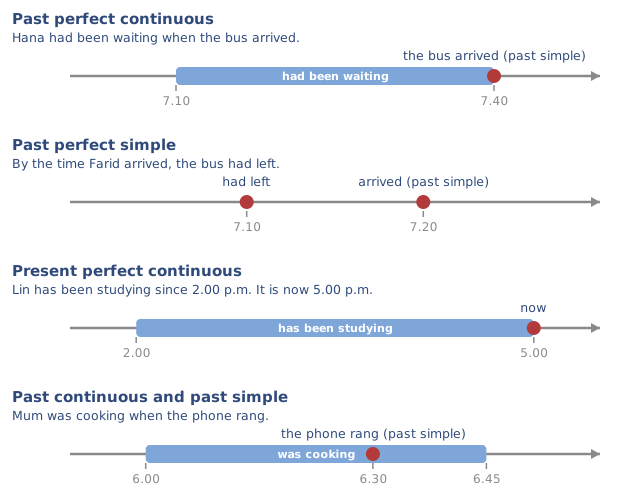
"When I arrived at the stop, the bus
"She
"He had
"They had been
(a) How long had Hana been waiting when the bus arrived at 7.40 (she started at 7.10)?
(b) Complete: By the time Farid arrived at 7.20, the bus ______ (leave).
(c) Choose: Mum (cooked / was cooking) when the phone rang at 6.30.
Show answerHide answer
(b) had left
(c) was cooking (in progress, then interrupted)
2.6Narrative tenses and correcting tense errors
Textbook: Unit 7 p.92 (Using narrative tenses); Grammar Reference 7.2, p.167.
A story in the past mixes four tenses. Each one has a job.
| Tense | Job in a story | Example |
|---|---|---|
| Past simple | takes the story forward; a series of finished actions | He stopped running, took out the phone and threw it into the river. |
| Past continuous | sets the scene; an action that is interrupted | The family was sitting in the garden when they heard the blast. |
| Past perfect simple | an event before the time of the story | Jane couldn't believe she had made such a dangerous journey on her own. |
| Past perfect continuous | a longer action that explains a later event | Everyone was exhausted because they had been running for miles. |
Method for Paper 1 Part 2
- Decide the main time of the text (a past story, present habits, or a report of an earlier event).
- Find the subject and check agreement (he / she / it, and were with you, we, they).
- Look for time words (since, for, ago, by the time, while, yesterday).
- Look for an earlier action: does it need had?
- Is the verb stative? Then it is not continuous.
- Write one word only and read the sentence again.
(0) showed (past story). (1) were (we). (2) realised (the interrupting action, past simple). (3) had (she lost it before she realised: earlier action). (4) had (a longer action before the time of the story: had been keeping).
"Last night, my brother (a) is doing his homework when the lights went out. He (b) use to be afraid of the dark, but he (c) were calm. Later he said he (d) didn't been so scared since he was little."
Show answerHide answer
(b) used (used to be afraid)
(c) was (he takes was)
(d) hadn't (past perfect: had not been so scared before that night)
Summary
| Tense | Form | Main use | Example |
|---|---|---|---|
| Present simple | base / +s | facts, routines, timetables | The train leaves at 8. |
| Present continuous | am / is / are + -ing | now, temporary, changing, plans | She is staying with us. |
| Past simple | -ed / irregular | finished past, story sequence | We met in March. |
| Past continuous | was / were + -ing | in progress, background, interrupted | It was raining when I left. |
| Present perfect simple | have / has + p.p. | result now, experience, unspecified time | I have lost my keys. |
| Present perfect continuous | have / has been + -ing | how long, until now | I have been waiting for an hour. |
| Past perfect simple | had + p.p. | before another past time | The film had started. |
| Past perfect continuous | had been + -ing | longer action before a past event | They had been walking for days. |
- Stative verbs (know, like, want, belong, seem) are not used in continuous tenses. Some (have, think, see, taste) change meaning.
- Used to + base verb for past habits and states; would only for repeated actions; be / get used to + -ing.
- for + a length of time, since + a point in time, ago + past simple.
- Number or quantity: simple form. How long: continuous form.
- If you say when it happened, use the past simple, not the present perfect.
- The earlier action in a past story needs the past perfect (unless the order is obvious or immediate).