Grammar: nouns, articles, quantifiers and relative clauses
What this chapter covers
- I can sort nouns into countable and uncountable, including nouns that are both (hair, chocolate, time) and nouns whose -s is misleading (news, maths, children) (1.5, 1.6)
- I can count uncountable nouns with a piece of, a carton of, a loaf of and similar phrases, and choose a singular or plural verb correctly (1.6)
- I can choose some, any, a lot of, a few, a little, much and many for the type of noun and the type of sentence (1.7)
- I can use a, an, the and no article, including first and second mention, unique things, rivers and deserts, instruments, nationalities and superlatives (3.7, 3.8)
- I can join sentences with who, which, that, whose, when and where (4.1)
- I can tell a defining relative clause from a non-defining one, use commas correctly and know that that cannot be used in a non-defining clause (4.2, 4.3)
- I can find and correct noun, article, quantifier and relative-clause errors in a UASA Paper 1 Part 2 text (Paper 1 Part 2)
In Form 1 you learnt the basic rules for nouns, articles and quantifiers. In Form 3 the same words come back in longer, harder texts, together with relative clauses, which let you join ideas in one sentence. In the UASA, Paper 1 Part 2 (error correction) and Paper 2 (writing) test all of them. This unit follows the Close-up B1 book: countable and uncountable nouns and quantifiers (Unit 1, p.13), articles (Unit 3, p.39) and relative clauses (Unit 4, p.47), with the Grammar Reference on pp.162 and 165.
3.1Countable and uncountable nouns
| Countable | Uncountable | |
|---|---|---|
| Examples | story, tradition, generation, mirror, family, aunt | advice, information, research, homework, furniture, equipment, luggage, money, music, weather, traffic, rubbish, knowledge, progress |
| Article | a story, an aunt, the traditions | no a / an: |
| Verb | The traditions are old. | The research is finished. Milk is good for you. |
Three things that catch students out
| Trap | What to remember | Examples |
|---|---|---|
| Plural countable nouns without -s | They still take a plural verb. | The children are friendly. My feet are sore. Many people were there. |
| Uncountable nouns that end in -s | They take a singular verb. | The news is good. Maths is my favourite subject. |
| One noun, two meanings | Some nouns are uncountable in a general sense and countable for one item or kind. | hair on your head (U): She washes her hair. hairs one by one (C): There are dog hairs on the sofa. chocolate (U): I love chocolate. / (C): a box of chocolates. time (U): I have no time. / (C): three times. |
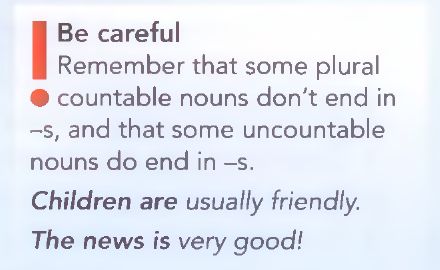
Figure: Close-up B1 Student's Book (Form 3), p.13.
Counting uncountable nouns
Use a phrase of quantity + of. The phrase becomes plural, not the noun: a piece of advice, two pieces of advice. The book lists: a bag of, a bottle of, a bowl of, a can of, a carton of, a cup of, a glass of, a jar of, a kilo of, a loaf of, a packet of, a piece of, a tin of. (a number of goes with plural countable nouns: a number of students.)
Show answerHide answer
3.2Quantifiers
| Quantifier | Plural countable | Uncountable | Where we use it |
|---|---|---|---|
| some | some birds | some advice | positive sentences; offers and requests (Would you like some chocolate?) |
| any | any biscuits | any fruit | negatives and questions |
| a lot of / lots of | a lot of people | a lot of traffic | both kinds of noun, all sentence types |
| a few | a few biscuits | – | positive sentences: a small number |
| a little | – | a little milk | positive sentences: a small amount |
| many | many friends | – | negatives and questions |
| much | – | much snow | negatives and questions |
There wasn't much snow last night. (negative, uncountable) Have many of your friends seen the film? (question, countable)
There are a lot of people in town. (positive, countable)
Show answerHide answer
3.3Articles: a, an, the and no article
| Article | When we use it | Examples |
|---|---|---|
| a / an | a singular countable noun mentioned for the first time; a job or status; "each" in expressions of frequency. a before a consonant sound, an before a vowel sound. | An elephant was born at the zoo. He is an archaeologist. We meet once a week. a uniform, an hour |
| the | something already mentioned or specific; unique things; rivers, deserts and mountain ranges; musical instruments; nationalities; superlatives; adjectives used as nouns; countries with plural names; names with of; names of hotels, cinemas and ships; the beach, the countryside, the station, the jungle; the morning, the afternoon, the evening | The baby elephant is popular. the sun, the sky, the Sahara Desert, the Andes, plays the violin, the Chinese, the best student, the poor, the Philippines, the United States |
| no article | plural or uncountable nouns used in a general sense; proper names; sports, games, colours, days, months, drinks, meals, languages; school subjects; most countries, cities, streets, parks, individual mountains, lakes and islands | Pollution is a serious problem. Blue is my favourite colour. We study physics. Is Anna at work? |
The same noun, with and without "the"
| No article: the main purpose | The: a visit or a particular place |
|---|---|
| Fran is in hospital. (she is a patient) | Angela has gone to the hospital to visit Fran. |
| They go to work by train. | She left her bag in the car. |
| I love music. (in general) | The music I don't like at all is jazz. (a particular kind) |
The same rule applies to bed, church, school, prison, university, college, court. In go to work and at work, work takes no the.
Missing "the":
Show answerHide answer
3.4Relative clauses: defining and non-defining
| Word | Refers to | Example |
|---|---|---|
| who | people | The book is about a boy who is homeless. |
| which | things | The programme which was about guide dogs was interesting. |
| that | people or things (defining clauses only) | These are the workers who / that rescued hundreds of people. |
| whose | possession | The woman whose dog got lost was upset. |
| when | a time | A birthday is a time when you feel emotional. |
| where | a place | This is the house where we grew up. |
Defining or non-defining?
| Defining | Non-defining | |
|---|---|---|
| Job | Essential information: it tells us which person or thing | Extra information: the sentence makes sense without it |
| Commas | No commas | Commas before and after (or before and a full stop) |
| that | can replace who / which | cannot replace who / which |
| Example | The ball which / that is over there is mine. (there are many balls) | The ball, which is over there, is mine. (only one ball; the clause is extra) |
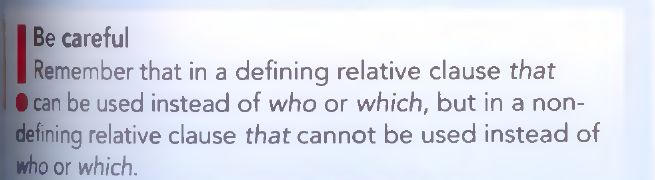
Figure: Close-up B1 Student's Book (Form 3), p.47.
The teacher is talking to the boy whose shirt is scruffy.
His father is a trainer. He has a great love for dogs.
His father, who is a trainer, has a great love for dogs.
Show answerHide answer
3.5Exam skill: Part 2 error correction
In Part 2 you meet a text with underlined words that are wrong, and you write one correct word for each. In a Form 3 text the errors come from this unit and from the tenses unit. Look for the clue words:
| You see | Ask yourself | Typical error |
|---|---|---|
| a noun after a number, many, both of | plural? | both of his |
| a noun like information, advice, news, furniture | uncountable? singular verb? | |
| much, many, a few, a little | can I count the noun? | much people, many electricity |
| a, an, the | first mention? sound? general or specific? unique or river or desert? | |
| who, which, that, whose, when, where | person, thing, owner, time or place? commas? |
(1) the clause is extra and between commas, so who. (2) advice is uncountable: some (or a piece of). (3) students is countable: many. (4) information is uncountable: information.
Write only the corrected word, spelled correctly, then read the sentence again to be sure it sounds right.
Summary
| Point | Remember |
|---|---|
| Countable / uncountable | Uncountable: no plural, no a / an, singular verb (news, maths, information). Plural without -s takes a plural verb (children, people, feet). hair, chocolate, time can be both. Count with a piece of, a carton of, a loaf of. |
| Quantifiers | some in positives and offers; any in negatives and questions; a lot of with both; a few + plural countable; a little + uncountable; many + plural; much + uncountable. |
| Articles | a / an first mention, jobs, per; the for specific, unique, rivers, deserts, instruments, nationalities, superlatives; none for general plurals, meals, sports, subjects, proper names. |
| Relative clauses | who people; which things; whose owner; when time; where place; that (defining only). Non-defining: commas, extra information, no that. |
| Part 2 method | Name the word type, ask the right question, write one corrected word, read it again. |