Grammar: adjectives, adverbs and comparison
What this chapter covers
- I can put two or three adjectives in the correct order, such as "a lovely old wooden house" (4.1)
- I can choose between -ed and -ing adjectives (bored / boring) and use the right preposition after them (4.2)
- I can use so and such correctly, with so ... that and such ... that for results (4.3)
- I can name the five types of adverb (manner, place, time, frequency, degree) and form adverbs of manner (4.4)
- I can put adverbs in the right position and order, including manner + place + time (4.5)
- I can use too and enough with adjectives, adverbs and nouns (4.6)
- I can make comparatives and superlatives, including irregular forms and modifiers such as much and slightly (4.7)
- I can compare with as ... as, not as ... as and less ... than, and rewrite sentences with the same meaning (4.8)
- I can find and correct adjective, adverb and comparison errors in a Paper 1 Part 2 text and read comparisons in numbers (4.9)
Adjectives and adverbs make your English exact and interesting, and they are tested in Paper 1 Part 2 (error correction and sentence completion) and used in every piece of writing in Paper 2. In Form 3 the rules are more detailed than in Form 1: three or more adjectives in order, so and such, too and enough, the order of several adverbs, and comparison with modifiers. This unit follows the Close-up B1 Student's Book (Unit 12 and the review of Unit 2) and its Grammar Reference.
4.1Adjectives and their order
When two or more adjectives come before a noun, they follow a fixed order. The textbook table below shows the order, with examples of each kind.
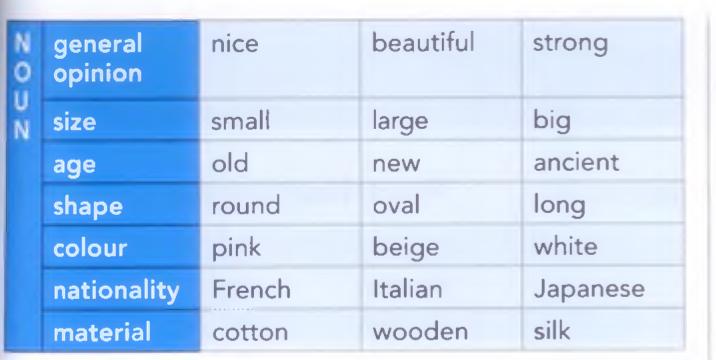
Close-up B1 Student's Book (Form 3), p.173 (Grammar Reference 12.1), cropped.
| 1 Opinion | 2 Size | 3 Age | 4 Shape | 5 Colour | 6 Origin | 7 Material | Noun |
|---|---|---|---|---|---|---|---|
| a lovely | small | old | wooden | house | |||
| a gorgeous | white | woollen | scarf | ||||
| an awful | green | woollen | jumper | ||||
| a beautiful | large | round | wooden | table | |||
| a huge | old | English | cottage |
Two kinds of opinion
A general opinion adjective (nice, good, wonderful, lovely, awful) can describe almost any noun, so it comes first. A specific opinion adjective (tasty, comfortable, intelligent) only fits certain nouns, so it comes after the general one and next to the noun: a nice, tasty meal; a lovely, intelligent child.
Commas and "and"
- Adjectives of different kinds are usually just placed side by side (sometimes with a comma): a big round table.
- Two adjectives of the same kind are joined by and, usually in alphabetical order: a black and white photograph.
- After a linking verb, join the last two adjectives with and: The room was big, bright and clean.
- Wrong order:
a wooden old table→ an old wooden table;a blue nice uniform→ a nice blue uniform. - Plural adjective:
two beautifuls dresses→ two beautiful dresses. - Putting an adjective after the noun, as in Malay:
a book interesting→ an interesting book.
Show answerHide answer
4.2-ed and -ing adjectives
Many adjectives come from verbs and have two forms. The -ed form says how a person feels. The -ing form says what a person, place or thing is like, that is, what causes the feeling.
| -ed: the feeling | -ing: the cause |
|---|---|
| I was bored during the long lecture. | The lecture was boring. |
| Hakim is interested in the human body. | The documentary about the body was interesting. |
| The children are excited about the funfair. | Riding a rollercoaster is exciting. |
| We were amazed by the speed of the brain. | The human body is amazing. |
Notice the prepositions that go with the -ed adjectives: interested in, bored with, excited about, worried about, surprised at / by, frightened of.
Show answerHide answer
4.3So and such
So and such give extra force to a description. They are stronger than very. They look alike but follow different words.
| Word | Pattern | Examples |
|---|---|---|
| so | so + adjective / adverb | This course is so interesting! He ran so quickly that nobody could catch him. |
| such | such + (a / an) + (adjective) + noun | She is such a clever girl. Oranges are such a good source of vitamin C. They are such lovely people. |
- so is never followed directly by a noun:
so a good idea→ such a good idea (or: so good). - such needs a noun:
such important→ so important, or such an important thing. - Do not forget a / an with a singular noun:
such good idea→ such a good idea. With plural or uncountable nouns there is no a: such good ideas, such good advice. The seminar was so a success→ The seminar was such a success.
Show answerHide answer
4.4Adverbs and what they tell us
An adverb gives information about a verb, an adjective or another adverb. The textbook lists five common types. Each answers a different question.
| Type | Answers | Examples | In a sentence |
|---|---|---|---|
| Manner | How? | carefully, quickly, well, badly, hard, fast | She sings beautifully. |
| Place | Where? | here, there, outside, upstairs, nearby | The gym is nearby. |
| Time | When? | yesterday, now, soon, later, tomorrow | Tom broke his leg yesterday. |
| Frequency | How often? | always, usually, often, sometimes, seldom, never, regularly | They see each other regularly. |
| Degree | To what degree? | quite, rather, very, too, almost, really, enough | My grandad is quite fit. |
Making adverbs of manner
| Rule | Adjective | Adverb |
|---|---|---|
| add -ly | careful, quick, slow | carefully, quickly, slowly |
| consonant + y: y → ily | happy, easy, noisy | happily, easily, noisily |
| -le: drop e, add -y | gentle, comfortable | gently, comfortably |
| -ic: add -ally | enthusiastic, dramatic | enthusiastically, dramatically |
| irregular | good | well |
| same form | fast, hard, early, late | fast, hard, early, late |
- After a verb that describes how something is done, use an adverb:
He speaks slow→ He speaks slowly. After a linking verb use an adjective: She looks beautiful, notbeautifully. - hard and hardly are different: He works hard (a lot) but He hardly works (almost not at all). late and lately differ in the same way.
- good is an adjective, well is the adverb:
She plays the piano good→ She plays the piano well.
Show answerHide answer
4.5Position and order of adverbs
One adverb: where does it go?
| Adverb | Usual position | Example |
|---|---|---|
| Frequency (always, seldom, never) | after the verb be; before the main verb; after a helping verb | She is always on time. He seldom eats sweets. I have never been there. |
| Degree (quite, rather, too, very) | before an adjective or adverb | He is quite good at maths. The film was rather scary. |
| enough (degree) | after an adjective or adverb, or after a verb | The film wasn't good enough to win an award. She earns enough to buy a car. |
| Manner (carefully) | after the verb, or after the object | She wrote her name carefully. NOT |
Two or three adverbs together
When several adverbs end a sentence, the usual order is manner + place + time.
After verbs of movement such as come, go, leave, the order changes to place + manner + time.
An adverb of time can also come at the beginning of the sentence: After the meeting he put the envelope carefully into his pocket.
Show answerHide answer
4.6Too and enough
| Word | Meaning | Pattern | Example |
|---|---|---|---|
| too | more than is good or possible (negative result) | too + adjective / adverb (+ to + verb) | My little sister is too short to go on the rollercoaster. |
| enough | as much as we need | adjective / adverb + enough (+ to + verb) | His grades weren't good enough to enter the university. |
| enough with a noun | sufficient amount | enough + noun | We have enough chairs for everyone. |
- enough follows an adjective but comes before a noun:
enough tall→ tall enough;chairs enough→ enough chairs. - too does not mean "very": The tea is too hot means you cannot drink it. If it is only a strong description use very.
- too much / too many go with nouns: too much noise, too many people.
Show answerHide answer
4.7Comparison of adjectives and adverbs
Use the comparative to compare two people or things, and the superlative to compare one with all the others in a group.
| Kind of word | Comparative | Superlative |
|---|---|---|
| one syllable: add -er / -est | long → longer (than) | long → the longest |
| ends in -e: add -r / -st | nice → nicer, brave → braver | the nicest, the bravest |
| short vowel + consonant: double the consonant | big → bigger, hot → hotter | the biggest, the hottest |
| consonant + y: y → ier / iest | tidy → tidier, easy → easier | the tidiest, the easiest |
| two or more syllables: more / most | expensive → more expensive | the most expensive |
| adverbs ending in -ly: more / most | more carefully | the most carefully |
| adverbs with the same form as the adjective: -er / -est | fast → faster, early → earlier | the fastest, the earliest |
Irregular forms: learn these by heart
| Adjective / adverb | Comparative | Superlative |
|---|---|---|
| good / well | better | the best |
| bad / badly | worse | the worst |
| many / much | more | the most |
| little | less | the least |
| far | farther / further | the farthest / furthest |
Making comparisons stronger or weaker
- Big difference: much, far, a lot + comparative: This route is much shorter. Cats are far more independent than dogs.
- Small difference: a bit, a little, slightly + comparative: My bag is slightly heavier than yours.
- less and the least are the opposite of more and the most: Kelly takes less time than the others. Which phone is the least expensive?
- Superlatives often end with in + a place or group, or of + a number or all: the tallest student in the class; the best of the three. A superlative can also take I have ever ...: the best documentary I have ever seen (present perfect).
- Double comparison:
more taller,the most tallest,more better→ taller, the tallest, better. - Forgetting than:
He is taller me→ He is taller than me. Do not use then (time). - Forgetting the before a superlative:
She is best singer→ She is the best singer. (After a possessive no the: my best friend.)
Show answerHide answer
4.8As ... as and other ways to compare
| Meaning | Pattern | Example |
|---|---|---|
| the same | as + adjective / adverb + as | My computer is as fast as your laptop. Lucy can run as fast as Beth. |
| not the same (less) | not as / not so + adjective / adverb + as | I am not as successful as my brother. |
| less | less + adjective + than | This phone is less expensive than that one. |
| the same as | the same + noun + as | Amir is the same age as Hakim. |
The adjective or adverb between the two as stays in its plain form. Never write as taller as or as more expensive as.
Rewriting sentences (same meaning)
The textbook exercise asks you to complete a second sentence with the same meaning as the first, using a given word. Practise swapping between the three comparison patterns.
| Sentence 1 | Sentence 2 (same meaning) |
|---|---|
| Mum and Dad go to bed at midnight. I go to bed at ten. | I don't go to bed as late as Mum and Dad. |
| Cathy's hair is waist length. My hair is shoulder length. | My hair is shorter than Cathy's. / My hair is not as long as Cathy's. |
| Mum says that nobody sings as beautifully as I do. | Mum says that I sing the most beautifully of all. |
| I haven't seen a better documentary than this one. | This is the best documentary I have ever seen. |
4.9Exam skills: error correction and comparison in texts
In Paper 1 Part 2 you correct a word in a text, or complete a gap using the right form of a word. A reading text in Part 3 or 4 may also use comparison to hide the answer: you have to work it out from numbers.
Method: four steps
| Step | What to do |
|---|---|
| 1. Read the whole sentence | Do not stop at the underlined word. Read to the full stop. |
| 2. Name the job | Does the word describe a noun or follow be / look / feel (adjective)? Does it say how, when, where or how often (adverb)? Does it describe a feeling (-ed) or the cause (-ing)? |
| 3. Find signal words | than (comparative), the ... in / of / I have ever (superlative), as ... as (plain form), so ... that / such ... that, too / enough ... to. |
| 4. Write and check | Write the correct word, with spelling: happier, hottest, carefully. Read the whole sentence again. |
(1) so: the next word, big, is an adjective with no noun, and "that" shows the result.
(2) friendlier: friendly ends in -y, so -ier. Never "more" and "-er" together.
(3) clearly: it says how he explained (adverb).
(4) most interesting: the trip causes interest, so -ing, and the superlative uses "most".
Reading numbers to compare
"Farid exercises more than Siti." 150 > 120, so True.
"Siti exercises as much as Farid." 120 is not 150, so False.
"Aisyah exercises the most." 210 is the largest number, so True.
Show answerHide answer
Summary
| Topic | Remember |
|---|---|
| Adjective order | Opinion, size, age, shape, colour, origin, material + noun. Same kind: "black and white". |
| -ed / -ing | -ed = how a person feels (bored). -ing = what causes the feeling (boring). |
| so / such | so + adjective / adverb; such + (a / an) + (adjective) + noun. so / such ... that = result. |
| Types of adverb | manner (how), place (where), time (when), frequency (how often), degree (to what degree). |
| Position | frequency: after be, before the main verb. Degree: before the adjective; enough after it. Manner + place + time (place + manner + time after come / go / leave). |
| too / enough | too + adjective (+ to + verb); adjective + enough (+ to + verb); enough + noun. |
| Comparative | short word + -er (+ than); long word: more + word (+ than). Never "more taller". |
| Superlative | the + -est / the most + word (+ in / of). Irregular: good → better → best; bad → worse → worst. |
| as ... as | as + plain adjective + as (same); not as ... as (less). |
| Part 2 method | Read the whole sentence, name the word's job, find signal words, write and check spelling. |