Passive, reported speech, causative and spotting errors
What this chapter covers
- I can change an active sentence into the passive in the present, past, perfect and future tenses, and use by for the agent and with for a tool or material (6.1)
- I can use the passive after modal verbs, and as being + participle or to be + participle (6.2)
- I can report statements, changing the tense, pronouns and time words, and use say and tell correctly (6.3)
- I can report questions, commands and requests with if, whether, to and not to (6.4)
- I can use the causative have something done to say what somebody else does for me (6.5)
- I can choose between a gerund, a full infinitive and a bare infinitive, including verbs that change meaning such as remember, forget and stop (6.6)
- I can add question tags and answer subject, object and negative questions (6.7)
- I can use the prepositions and phrasal verbs listed in the textbook (6.8)
- I can find and correct errors in a text and complete a second sentence so that it means the same as the first (6.9)
This unit gathers the Form 3 grammar that changes the shape of a sentence: the passive voice, reported speech, the causative, gerunds and infinitives, question tags and other special questions, plus the prepositions and phrasal verbs that go with them. At the end you will use all of it to spot and correct errors in a text, the skill tested in UASA Paper 1 Part 2, and to rewrite sentences so that the meaning stays the same. The rules and the example forms follow the textbook Grammar Reference; the sentences are our own.
6.1The passive voice: tenses, by and with
To change an active sentence into a passive one, follow three steps. First, the object of the active sentence becomes the subject of the passive sentence. Second, the verb be goes into the same tense as the active verb. Third, add the past participle of the main verb.
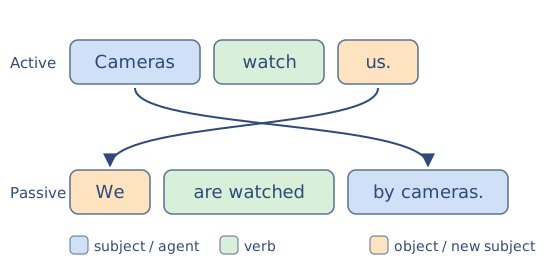
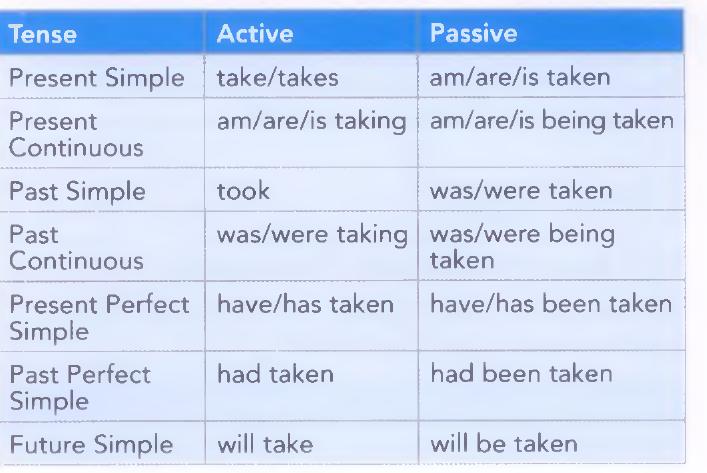
Table: Close-up B1 Student's Book (Form 3), Grammar Reference 9.1, p.169.
Past simple: The gym was built last year.
Present perfect: The gym has been built already.
Future: The gym will be built next year.
By and with
| Word | Use it for | Example |
|---|---|---|
| by | the agent: the person or thing that does the action | The telephone was invented by Alexander Graham Bell. |
| with | the tool or material that is used | The window was broken with a stone. The jug was filled with water. |
If the agent is people, someone, they or is obvious, we leave it out: The shop was robbed last night. (We do not need by thieves.)
Two objects
Some verbs (give, send, show, tell, offer) have two objects, so there are two passive versions. Choose the one you want to put first.
Passive 1: Aina was given a prize by the teacher.
Passive 2: A prize was given to Aina by the teacher. (to is needed when the person comes last)
(a) Many people use mobile phones. (b) Someone stole my bicycle last night. (c) The school will announce the results next week. (d) They are repairing the road now.
Show answerHide answer
6.2The passive with modals, gerunds and infinitives
The passive also works after a modal verb and in the three non-finite forms. The pattern is always be in the right form + past participle.
| After | Active | Passive | Example |
|---|---|---|---|
| a modal or had better (bare infinitive) | take | be taken | Cameras should be installed here. The project had better be finished by tomorrow. |
| a verb or adjective that takes to (full infinitive) | to take | to be taken | The battery needs to be recharged. She hopes to be chosen. |
| a preposition or a verb that takes -ing (gerund) | taking | being taken | He avoided being recognised. I dislike being laughed at. |
(a) The new robots might (be shown / being shown / to be shown) at the fair.
(b) Nobody likes (be ignored / being ignored / to being ignored).
(c) The old computers need (be replaced / to be replaced / being replaced).
Show answerHide answer
6.3Reported statements
Tense changes
| Direct speech | Reported speech |
|---|---|
| present simple: "He likes hip-hop." | past simple: She said he liked hip-hop. |
| present continuous: "He is listening." | past continuous: She said he was listening. |
| present perfect: "They have bought a CD." | past perfect: She said they had bought a CD. |
| past simple: "He watched a film." | past perfect: She said he had watched a film. |
| past continuous: "He was reading." | past perfect continuous: She said he had been reading. |
| will, can, may, must | would, could, might, had to |
These do not change: the past perfect, would, could, might, should, ought to, used to, had better, mustn't, and must when it means a deduction (a guess that something is true).
Pronouns, time and place
| Direct | Reported | Direct | Reported |
|---|---|---|---|
| today | that day | tomorrow | the next / following day |
| tonight | that night | next week | the following week |
| yesterday | the day before / the previous day | last month | the month before / the previous month |
| now, at the moment | then, at that moment | ago | before |
| this, these | that, those | here | there |
→ Rizal said (that) he would buy his tickets the next day.
"We saw the show two weeks ago," the girls told us.
→ The girls told us (that) they had seen the show two weeks before.
Say and tell
Tell is always followed by a person: Julia told her friends (that) they would love it. Say has no person after it: Julia said (that) they would love it. The word that may be left out.
(a) "I enjoyed the party last night," Veronica said. Veronica said ...
(b) "We are going to the museum tomorrow," Mrs Jones told us. Mrs Jones told us ...
(c) "I must finish my report tonight," Samantha said. Samantha said ...
Show answerHide answer
6.4Reported questions, commands and requests
Questions
The tense, pronoun and time changes are the same as for statements. In addition, a reported question uses statement word order: no do, does, did and no question mark.
| Direct question | Reported question | What changes |
|---|---|---|
| "Which instrument do you like best?" | He asked me which instrument I liked best. | Keep the question word. Subject before verb; do is dropped. |
| "Did you enjoy the festival?" | He asked me if / whether I had enjoyed the festival. | No question word, so use if or whether. |
| "Where is the concert hall?" | The tourist asked where the concert hall was. | Normal order after the question word (not where was). |
Commands and requests
| Type | Pattern | Example |
|---|---|---|
| Command | tell + person + (not) to + base verb | "Turn down the music!" → He told me to turn down the music. "Don't touch the exhibits." → The guard told us not to touch the exhibits. |
| Request | ask + person + (not) to + base verb | "Please lend me your pen." → She asked me to lend her my pen. "Please don't tell anyone." → He asked us not to tell anyone. |
(a) "Where do you live?" Hana asked me. Hana asked me ...
(b) "Do you like durian?" Aiman asked Mei. Aiman asked Mei ...
(c) "Don't be late," Mum told us. Mum told us ...
Show answerHide answer
6.5The causative: have something done
| Sentence | Who does the action? |
|---|---|
| Hakim repaired his bicycle. | Hakim himself. |
| Hakim had his bicycle repaired. | A mechanic (somebody else), arranged by Hakim. |
- Arranged service: John is having his new computer delivered in the morning.
- Something unpleasant happened: Mrs Temp has had her car broken into.
- Other tenses: only have changes. We will have the hall painted. I was having my hair cut. She has had her clothes made for years.
- Informal: get + object + past participle: He got his phone taken away.
- To name the doer, use by: I will have my project graded by a teacher.
(a) A photographer took our family photo. (We had ...)
(b) A workman is going to paint the fence. (We are going to ...)
Show answerHide answer
6.6Gerunds and infinitives
When two verbs come together, the second verb takes a particular form. The first verb (or the word before it) decides which.
| Form | Use it | Examples |
|---|---|---|
| Gerund (verb + -ing) | as a noun; after a preposition; after go for activities; after verbs such as enjoy, avoid, imagine, suggest, practise, mind, keep, finish, dislike, can't help; after it's no use, it's worth, have difficulty | Swimming is fun. She is good at drawing. We went canoeing. He avoids shouting. It's no use waiting. |
| Full infinitive (to + verb) | to show purpose; after adjectives (happy, glad, afraid); after too and enough; after verbs such as want, need, decide, hope, plan, agree, refuse, manage, promise, afford | I went to the library to find a book. He was too tired to walk. They decided to leave. |
| Bare infinitive (verb only) | after modals; after had better and would rather | You should ask your teacher. You'd better hurry. I'd rather stay in. |
A few verbs (begin, start, continue, like, love, hate) can take a gerund or a full infinitive with no change in meaning: It started raining / to rain.
Same verb, different meaning
| Verb | + gerund | + full infinitive |
|---|---|---|
| remember | I remember locking the door. (I did it, and now I recall it.) | Remember to lock the door. (Do not forget to do it.) |
| forget | I'll never forget meeting the Prime Minister. | I forgot to bring my book. |
| stop | He stopped talking. (He did not talk any more.) | He stopped to talk to a friend. (He stopped something else in order to talk.) |
| try | Try adding some salt. (an experiment) | Try to finish before six. (make an effort) |
| regret | I regret lending him my bike. (I wish I had not.) | I regret to tell you that the show is cancelled. (sorry to say) |
| go on | She went on reading. (she continued) | She went on to read a poem. (then she did something new) |
(a) The children are too small (reaching / to reach) the shelf.
(b) Do you fancy (to go / going) to the cinema?
(c) I forgot (posting / to post) the letter, so it is still in my bag.
Show answerHide answer
6.7Question tags and special questions
Question tags
- A positive statement takes a negative tag: The athletes are training hard, aren't they?
- A negative statement takes a positive tag: You haven't entered the race, have you?
- With the present simple or past simple use do / does / did: You swim every day, don't you? You went yesterday, didn't you?
| Special case | Tag |
|---|---|
| I am lucky ... | ..., aren't I? |
| Let's hike ... | ..., shall we? |
| Don't forget (an order or request) | ..., will you? |
| Everyone / somebody is ... | ..., aren't they? |
| This / That is ... | ..., isn't it? |
| These / Those are ... | ..., aren't they? |
Subject and object questions
| Who asks about | Word order | Example |
|---|---|---|
| the subject (who does the action) | like a statement; no do / did | Who survived the accident? (Everyone survived.) |
| the object (who receives the action) | question order, with do / did | Who did the rescue team save? (They saved the captain.) |
Negative questions
Negative questions show surprise, make an exclamation, or ask the listener to agree: Didn't Jamie finish the race? Isn't it a lovely day? Answer with Yes if the positive idea is true and No if the negative idea is true: Isn't it a lovely day? Yes, it is (I agree). No, it isn't (I disagree).
(a) Your brother plays the guitar, ...?
(b) You haven't seen my keys, ...?
(c) Let's start now, ...?
(d) Nobody was late, ...?
Show answerHide answer
6.8Prepositions and phrasal verbs
Many verbs and adjectives take one fixed preposition. The textbook lists them on p.185 (Prepositions) and p.186 (Phrasal verbs), and they appear again in the Form 3 vocabulary sections. Learn them as pairs.
Preposition pairs from the textbook
| With | Pairs | Example |
|---|---|---|
| to | listen to, belong to, relate to, similar to, invite to | This bag belongs to my sister. |
| for | look for, wait for, responsible for, apply for | She is responsible for the class library. |
| on | rely on, concentrate on, keen on, expert on, spend money on | Please concentrate on your work. |
| about | worry about, concerned about, talk about, find information about | Don't worry about the exam. |
| of | proud of, ashamed of, jealous of, instead of | Use a pencil instead of a pen. |
| with | cope with, communicate with, satisfied with, angry with, argue with, agree with | Is he satisfied with his results? |
| in / at / from | successful in, interested in, increase in; good at; suffer from, disappear from, protect from | She is good at chess. |
Phrasal verbs from the textbook
| Phrasal verb | Meaning | Phrasal verb | Meaning |
|---|---|---|---|
| find out | discover | give up | stop trying |
| look after | take care of | look up to | admire |
| put up | build; display | take up | begin (a hobby) |
| turn down | decrease the volume | turn up | increase the volume |
| turn on / off | switch on / off | try out | test something first |
| run out of | have no more left | sell out | run out of tickets |
| give out | distribute | catch on | become popular |
| carry on | continue | deal with | do what is necessary |
(a) Farid is very proud ____ his little sister.
(b) The concert tickets will ____ out quickly.
(c) Can you ____ after my cat while we are away?
Show answerHide answer
6.9Spotting errors and rewriting sentences
In Paper 1 Part 2 you read a text with underlined words, decide what is wrong, and write the one correct word. At Form 3 level the errors come from this whole unit as well as from tenses, agreement and articles. The textbook also tests sentence transformation: you complete a second sentence so that it means the same as the first, using no more than three words (p.118-119).
| Error type | Wrong (underlined) | Correct | What to check |
|---|---|---|---|
| Passive form | The letter was send yesterday. | sent | be + past participle |
| Passive after a modal | The rules must been followed. | be | modal + be + participle |
| Reported tense | She said she will come. | would | Backshift after said / told |
| Reported pronoun | Hana said that I was very tired. | she | Who is speaking now? Who is meant? |
| Reported question | He asked me that I liked pop music. | if (or whether) | Yes / no question → if / whether |
| Causative | She had her car repair. | repaired | have + object + participle |
| Gerund or infinitive | He enjoys to swim. | swimming | Which word comes before? |
| Question tag | You like it, do you? | don't | Positive statement → negative tag |
| Preposition / phrasal verb | We rely in her. | on | The fixed pair |
Method
- Read the whole text to see the time (past story or present facts) and who is speaking.
- Name the word: verb, pronoun, preposition, linking word or article.
- Look at the trigger next to it: a time word, a modal, said, had or get, the subject, or the word before a gap.
- Write one word, spelt correctly, and read the sentence again.
Last week our school (0) have a science fair. All the projects (9) was judged (10) with a panel of teachers. My friend said that she (11) will be sorry if our robot did not work. She asked me (12) that I had fixed the switch. We had our poster (13) print at a shop, and everyone enjoyed (14) to look at our models.
| No. | Thinking | Answer |
|---|---|---|
| 0 | Last week → past simple. | had |
| 9 | The subject projects is plural; the passive past needs were. | were |
| 10 | The teachers do the judging: they are the agent, so by (not the tool word with). | by |
| 11 | Reported speech after said (past) → backshift will to would. | would |
| 12 | A reported yes / no question uses if or whether. | if |
| 13 | Causative: had + object + past participle. | printed |
| 14 | Enjoy is followed by a gerund. | looking |
The new library was (a) open last month by the Mayor. He said that everyone (b) can borrow books for free. A girl asked him what time the library (c) close. Many students enjoy (d) to read there.
Show answerHide answer
Summary
| Topic | Remember |
|---|---|
| Passive | object → subject; be (in the tense) + past participle. by = agent, with = tool or material. After modals: be + participle; gerund: being + participle; full infinitive: to be + participle. |
| Reported statements | Backshift one tense (will → would, can → could, must → had to). Change pronouns, today → that day, yesterday → the day before, here → there. tell + person, say alone. |
| Reported questions and orders | Question word or if / whether + statement order, no question mark. Command: told + person + (not) to + verb. Request: asked + person + (not) to + verb. |
| Causative | have + object + past participle; only have changes tense; get is less formal. |
| Gerund or infinitive | Gerund after prepositions, enjoy, avoid, suggest. To-infinitive after want, decide, manage, too, enough, purpose. Bare infinitive after modals. Remember, forget, stop, try, regret, go on change meaning. |
| Questions | Tags: positive ↔ negative, aren't I, shall we, will you. Subject question: no do / did. Negative question: Yes agrees with the positive idea. |
| Part 2 and transformation | Name the word → find the trigger → write one word, spelt correctly. Keep the meaning the same. |