Bahasa Inggeris notes, unit 5
Grammar: modals, the future and conditionals
Textbook Close-up B1 Student's Book, Second Edition (Form 3), National Geographic Learning / Cengage — 12 units; skills-based chapters for the UASA, pages Close-up B1 (Form 3), pp.57-68 (U5), 69-80 (U6), 95-106 (U8), Grammar Reference pp.166-169
What this chapter covers
- I can choose between will and be going to for decisions, offers, promises, threats, plans and predictions (5.1)
- I know that after when, after, until, as soon as and the moment we use a present tense, not will (5.1)
- I can use the future continuous and the future perfect for actions in progress or finished by a time in the future (5.2)
- I can make and use zero, first and second conditional sentences, including were in "If I were you" (5.3)
- I can use unless to mean if not, and I know that a conditional can take may, might, could, can or an imperative (5.3, 5.4)
- I can use can, could, be able to, may, might and must for ability, possibility and certainty (5.5)
- I can use must, mustn't, have to, don't have to, needn't, should, ought to and would for the right meaning (5.6)
- I can use these structures to correct errors and to rewrite sentences in Paper 1 Part 2 (5.7)
This unit pulls together three grammar areas from the Form 3 book: the future (Unit 5), conditionals (Unit 6) and modals and semi-modals (Unit 8). They are tested in Paper 1 Part 2 (grammar and error correction) and used in your writing.
5.1Will and be going to
Based on Close-up B1 (Form 3), p.61 and Grammar Reference 5.1 and 5.2, p.166.
| Form | Use | Example |
|---|---|---|
| will + base verb | a decision made at the moment of speaking; an offer; a request (Will you ...?) | You can rest. I'll do the dishes. |
| will | a promise or a threat | I won't ever lie again. Tidy your room or I won't let you go out. |
| will | a future fact; a prediction with no proof; after think, believe, expect, be sure, probably, maybe | Her son will be 21 tomorrow. I think it will be cheap. |
| am / is / are going to + base verb | a plan or intention | They're going to paint the living room green at the weekend. |
| am / is / are going to | a prediction based on evidence we can see now | Look! The window is open. The rain is going to come in. |
Time clauses. After when, after, until, as soon as, the moment, before, we use a present tense even when the meaning is future: "I'll text you the moment the parcel arrives", not "will arrive".
"When I will finish university, I'll travel the world." The time clause takes a present tense: "When I finish university, I'll travel the world."
Choose will or going to.
(a) Look at that wall! It (will / is going to) fall down.
(b) "I've forgotten my pen." "Don't worry. I (will / am going to) lend you one."
(c) We've bought the paint. We (will / are going to) paint the kitchen on Saturday.
(a) Look at that wall! It (will / is going to) fall down.
(b) "I've forgotten my pen." "Don't worry. I (will / am going to) lend you one."
(c) We've bought the paint. We (will / are going to) paint the kitchen on Saturday.
Show answerHide answer
(a) is going to (evidence we can see)
(b) will (sudden decision and offer)
(c) are going to (a plan already made)
(b) will (sudden decision and offer)
(c) are going to (a plan already made)
5.2Future continuous and future perfect
Based on Grammar Reference 5.3 and 5.4, pp.166-167.
| Tense | Pattern | Meaning | Example |
|---|---|---|---|
| Future continuous | will be + verb-ing | an action in progress at a point in the future; an arrangement | This time next week we will be living in New York. |
| Future perfect simple | will have + past participle | finished by or before a future time; how long an action will have lasted at a future point | The architect will have finished the design by next month. Next year we will have worked on this project for two years. |
Time signals: this time tomorrow / next week for the future continuous; by the end of this month, by tomorrow morning, by 2030 for the future perfect.
Complete: "By the time you wake up tomorrow, I ______ (leave) already." and "This time tomorrow I ______ (fly) to Kuching."
Show answerHide answer
will have left (finished before a time); will be flying (in progress at that time)
5.3Zero, first and second conditionals
Based on pp.73 and 77 and Grammar Reference 6.1 to 6.4, p.167.
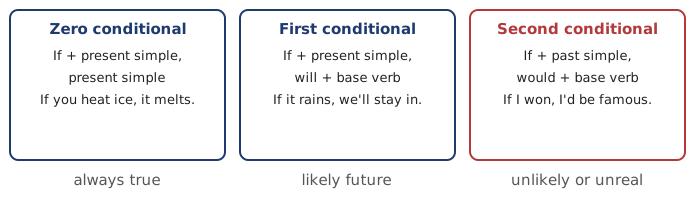
| Type | If-clause | Main clause | Use |
|---|---|---|---|
| Zero | present simple | present simple | facts and general truths; "if" can be replaced by "when" |
| First | present simple | will + base verb | something likely to happen now or in the future |
| Second | past simple | would + base verb | things that will probably not or cannot happen; advice with "If I were you" |
Example: same topic, three conditionals
Zero: If a football player is shown a red card, he leaves the pitch.First: If my team wins the match, I'll be thrilled.
Second: If I won an Olympic gold medal, I'd be famous.
- When the if-clause comes first, put a comma after it.
- In the second conditional we usually use were for all persons: "If Luke were better at football, he'd be on the team."
- Instead of will or would we can use can, could, may, might in the main clause: "If John scores, we might win." "Jack could win the race if he trained harder."
- The first conditional can also have an imperative: "If you aren't doing anything tonight, watch the match at my house."
Never put will or would in the if-clause: "If I would have time, I'd help you" should be "If I had time, I'd help you."
Write the verb in brackets in the correct form.
(a) If you ______ (eat) too much, you get fat.
(b) If we get Dad to drive us, we ______ (make) it on time.
(c) If I ______ (be) you, I ______ (not play) either.
(a) If you ______ (eat) too much, you get fat.
(b) If we get Dad to drive us, we ______ (make) it on time.
(c) If I ______ (be) you, I ______ (not play) either.
Show answerHide answer
(a) eat (zero: a general truth)
(b) will make / 'll make (first conditional)
(c) were ... wouldn't play (second conditional, advice)
(b) will make / 'll make (first conditional)
(c) were ... wouldn't play (second conditional, advice)
5.4Unless
Based on p.77 and Grammar Reference 6.4, p.167.
Unless means if ... not. It is used in first and second conditionals, and the verb after it is positive.
| With if ... not | With unless |
|---|---|
| If Stella doesn't start practising, she won't play in the match. | Unless Stella starts practising, she won't play in the match. |
| If you don't get lots of exercise, you might get fat. | Unless you get lots of exercise, you might get fat. |
Do not use a second negative after unless: "Unless you don't hurry ..." is wrong. Write "Unless you hurry ...".
5.5Modals of ability, possibility and certainty
Based on pp.99 and 103 and Grammar Reference 8.1 to 8.7, pp.168-169.
| Modal | Meaning | Example |
|---|---|---|
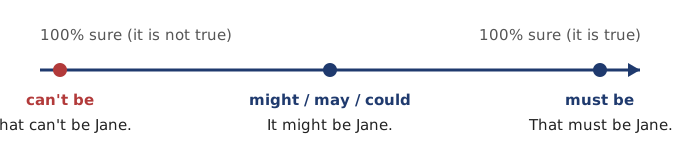
| can / can't | general ability; requests; permission; can't = sure it is not true | My grandad can speak seven languages. That can't be Jane. |
| could | general ability in the past; possibility; polite requests; suggestions | Karen could run very fast when she was at school. We could go to the cinema. |
| was / were able to | a specific success in the past (could is not used here) | Francis was able to go climbing at the weekend. |
| may / might | possibility in the future; may for polite permission | I may travel abroad next year. May we have another ice cream? |
| must | sure that something is true | You've been exercising all morning. You must be tired. |
Past ability for one occasion: "They weren't able to open the window" or "couldn't" (negative is fine). For a positive single success use was able to.
"His football boots aren't here. I'm certain he's in the park." Rewrite with a modal.
Show answerHide answer
His football boots aren't here, so he must be in the park. (certain = must be)
5.6Modals of obligation, prohibition and advice
Based on pp.99 and 103 and Grammar Reference 8.3 to 8.9, p.169.
| Modal | Meaning | Example |
|---|---|---|
| must / have to | necessary; obligation | You have to rehearse your part every day. |
| mustn't | not allowed | You mustn't park your car here. |
| don't have to / needn't | not necessary | You needn't buy any milk. We don't have to go if we don't want to. |
| should / ought to | advice | You should eat more fruit. You ought to see a doctor. |
| would | regular past actions; polite requests | I would always go for a run before work. Would you please ...? |
mustn't = not allowed. don't have to = not necessary. "You mustn't play basketball with us" means you are forbidden; "You don't have to play" means you can choose. Also, needn't is not used in affirmative sentences, and it takes no "to": "You needn't to come" should be "You needn't come".
Choose the correct word.
(a) Players (mustn't / don't have to) kick the ball in basketball.
(b) It's OK. You (needn't / mustn't) come early.
(c) You ought (not to / not) go swimming today.
(a) Players (mustn't / don't have to) kick the ball in basketball.
(b) It's OK. You (needn't / mustn't) come early.
(c) You ought (not to / not) go swimming today.
Show answerHide answer
(a) mustn't (not allowed)
(b) needn't (not necessary)
(c) not to ("ought not to")
(b) needn't (not necessary)
(c) not to ("ought not to")
5.7Exam skill: Paper 1 Part 2 grammar
| Step | What to do |
|---|---|
| 1 | Read the whole sentence. Find the time word (tomorrow, if, by, yesterday). |
| 2 | Ask what the speaker means: a plan, a rule, advice, a guess? |
| 3 | Check the pattern: modal + base verb; if + present, will + base; if + past, would + base. |
| 4 | Read the sentence with your answer to see if it sounds right. |
In transformation tasks (second sentence must mean the same, three words at most), name the grammar first: unless = if not, mustn't, don't have to, ought to = should.
Summary
| Point | Remember |
|---|---|
| will | sudden decisions, offers, promises, threats, predictions without proof |
| going to | plans; predictions from evidence |
| time clauses | when, after, until, as soon as + present tense |
| will be doing / will have done | in progress at a future time / finished by a future time |
| zero / first / second | if + present, present / if + present, will / if + past, would |
| unless | = if not; no second negative |
| can't be / might be / must be | sure not / not sure / sure |
| mustn't vs don't have to | not allowed vs not necessary |