Information transfer from a text
What this chapter covers
- I can describe Paper 1 Part 3 in Form 3 and its rule of "no more than three words and/or a number" (7.1)
- I can read the labels first and predict the type of answer, such as a number with a unit, a name, a place or a reason (7.2)
- I can use a six-step method to move details from a longer text into notes or a table (7.3)
- I can match a label to words in the text that mean the same thing in a different form (7.4)
- I can spot traps such as changed plans, contrast words, similar numbers and the wrong person (7.5)
- I can copy numbers, units, names and word forms exactly and keep to the word limit (7.6)
- I can decide whether a statement about a text is true or false by comparing the meaning (7.7)
- I can complete a full Part 3 task from an article in about 20 minutes (7.8)
In Paper 1 Part 3 you read one longer text and move eight details from it into a form, a table or a set of notes. You do not write sentences. You find the right words and copy them exactly. In Form 3 the text is longer, the labels use different words from the text, and more wrong answers sit close to the right ones. This unit gives you a method for that. The readings in Units 3, 4, 9 and 12 of the Close-up B1 Student's Book are the practice material.
7.1What Part 3 looks like in Form 3
| Part 3 at a glance | Details |
|---|---|
| Questions | 8, one mark each |
| Time | about 20 minutes, including reading the text |
| Text | one linear text, a little longer than in Form 1: an article, a report, a letter or email, or a talk |
| Task | complete notes, a table or a graphic organiser from a linear text; the textbook also gives T (true) or F (false) practice on the same readings |
| The rule | no more than three words and/or a number for each answer |
| Step up from Form 1 | labels are paraphrased ("Share of the reef open to visitors", not "Visitors"), numbers sometimes need a simple sum or comparison, and some answers must be changed to the right word form |
The textbook's Exam Close-up boxes give the same reading skills. The first one is about knowing what kind of text you are reading.
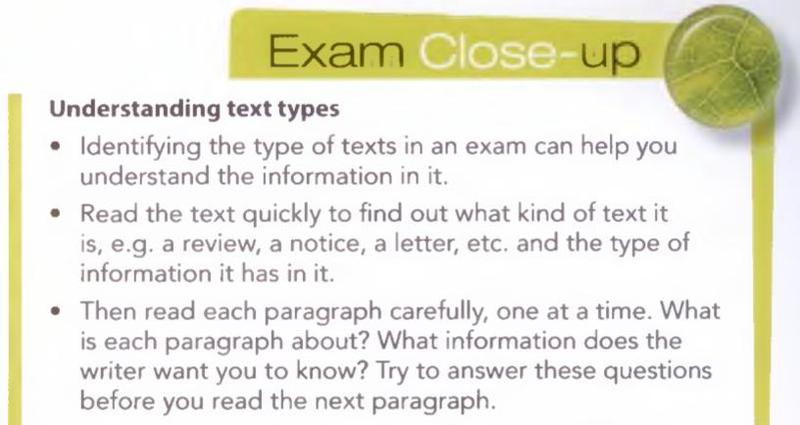
Textbook box: Close-up B1 Student's Book (Form 3), Unit 3, p.33.
7.2Labels: predict before you read
Read the title and every label before the text. Each label tells you what kind of answer to look for. Write a tiny note beside it.
| Label says | Predict | Look for in the text |
|---|---|---|
| Length / height / speed / weight | a number + a unit | digits, kilometres, kg, per hour |
| How many / Number of | a number | digits or number words (nine months) |
| How often / Share / Percentage | a percentage or a fraction | %, per cent, out of, half |
| Who / Name of | a name or a job | capital letters, called, known as |
| Where / Place | a place name | capital letters, in, at, near |
| Reason / Why | a short noun phrase | because, so that, due to |
| Effect / Result / Danger | a noun phrase or a verb phrase | causes, leads to, kills, damages |
Show answerHide answer
7.3The method, step by step
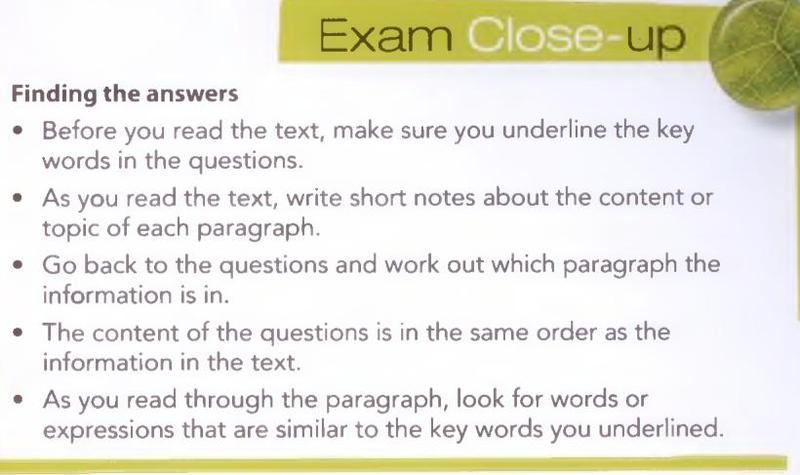
Textbook box: Close-up B1 Student's Book (Form 3), Unit 9, p.111.
| Step | What you do |
|---|---|
| 1. Read the labels | Underline the key words in each label and predict the type of answer (7.2). |
| 2. Skim the text | Read once, quickly. Write two or three words beside each paragraph: what it is about. |
| 3. Match labels to paragraphs | The labels follow the order of the text, so label 1 is early and label 8 is late. |
| 4. Look for similar words | The text rarely uses the same words as the label (7.4). Look for words with the same meaning. |
| 5. Check the traps | Read the sentence before and after your answer (7.5). |
| 6. Copy, count and check | Copy the words exactly. At most three words and/or a number. Check spelling, capital letters, units and word form. |
7.4Same meaning, different words
At this level the label and the text say the same thing differently. Learn to hear the match.
| Label (or question) | Words in the text | Answer |
|---|---|---|
| Part of the reef visitors may enter | "visitors can only visit 5% of the reef" | 5% |
| Animals that build the reef | "coral polyps ... have been building underwater cities" | coral polyps |
| Time for lifeguards to reach him | "Just 16 seconds after Poseidon noticed ... the lifeguards pulled him from the pool" | 16 seconds |
| Where the system was installed | "a surveillance system called Poseidon had been put in the pool" | the pool / swimming pool |
| Reward for rescue dogs | "will do any job if the reward afterwards is playtime" | playtime |
Text. "Tourists may enter only 5% of the Great Barrier Reef, so the rest of it stays protected for future generations. The reef stretches for about 2,000 kilometres along the coast of Australia."
| Label | Predict | Answer and reason |
|---|---|---|
| Share of the reef open to tourists | a percentage | 5%: "may enter only 5%" |
| Size of the reef from end to end | number + unit | 2,000 kilometres (or 2,000 km): "stretches for about 2,000 kilometres" |
| Country beside the reef | a place | Australia |
Show answerHide answer
7.5Traps to watch for
| Trap | What it looks like | How to beat it |
|---|---|---|
| Changed plan | "We first planned ..., but now ..."; "instead of" | Take the new detail |
| Contrast word | however, although, but, even so | The answer is often after the contrast word |
| Two similar numbers | 4,000 types of mollusc; 1,500 species of fish; 400 types of coral | Match the number to its noun in the label |
| Time and duration | "nine months earlier"; "16 seconds after"; "in four minutes" | Ask: when or how long? |
| Wrong person | Tiffy gets yoghurt; guide dogs help the blind | Check the name in the label |
| True or false with a twist | "Britain has fewer cameras than France" | Underline comparatives and quantity words |
- Choosing the first number you see. Check that the noun beside the number matches the label.
- Writing the cause when the label asks for the effect (or the other way round).
- Marking a statement True because the same words appear in the text. Check the meaning: "only", "all", "never" and "fewer" can reverse it.
- Writing "not enough information" when the text says it in other words. Look for a paraphrase first.
Show answerHide answer
7.6Numbers, units and word forms
| Rule | Example |
|---|---|
| A number and its unit are a good answer (the number counts as a number, the unit as one word) | 2,000 kilometres, 84%, 16 seconds |
| Numbers in words are fine if the text uses words | four minutes (or 4 minutes) |
| Copy proper names with capital letters | Beagle Brigade, Great Barrier Reef, Norman Siegel |
| Keep to three words: drop the, a and prepositions if you need to | "in the swimming pool" becomes swimming pool |
| Fit the grammar of the label | Label "Fishermen use ____ to stun the fish": a noun, so cyanide, not "poisonous" |
Show answerHide answer
7.7True or false statements
Some Form 3 tasks give you statements to mark T or F. Treat each statement like a label: find the paragraph, then compare the meaning, not only the words.
| Statement | Text says | Answer |
|---|---|---|
| A camera must be real for a sign to work. | Some owners put up "Video Surveillance Is In Operation" signs where there are no cameras. | F |
| Poseidon was installed less than a year before the rescue. | It had been put in nine months earlier. | T |
Text. "Jessie, a whippet, visits sick children in hospital. She shows love for the patients and encourages them to exercise, and she cheers them up when they feel down. Service dogs, in contrast, are trained to help people with a physical disability. They can open doors, switch lights on and off and pull wheelchairs."
| Label | Answer |
|---|---|
| Where Jessie works | hospital |
| Kind of dog Jessie is | whippet |
| People service dogs help | people with (a) physical disability / physical disabilities |
| Object a service dog can pull | wheelchairs (or wheelchair) |
7.8Practice: fast scan
The brain has about 100 billion microscopic cells called neurons. When a bee lands on your foot, neurons in your skin send the news to your brain at more than 240 kilometres an hour. Your brain then sends the order to shake it off, at more than 320 kilometres an hour. All your neurons together make enough electricity to power a light bulb. Every new thought changes the structure of the brain. If you are stuck on a difficult homework problem, exercise first: afterwards your body makes a chemical that helps you learn, so you may then solve it.
Complete the notes. (a) Number of neurons. (b) Speed of the message from the skin. (c) Thing the neurons together can power. (d) What changes with every new thought. (e) Advice for a hard homework problem.
Show answerHide answer
Facts from Close-up B1 Student's Book (Form 3), Unit 12, pp.148-149; Unit 9, pp.110-111; Unit 4, pp.44-45; Unit 3, pp.32-33. The practice passages are rewritten in new words.
Summary
- Part 3: 8 answers, no more than three words and/or a number, about 20 minutes.
- Read the labels first and predict the answer type: number + unit, name, place, reason or effect.
- Skim, note each paragraph's topic, then scan for each label in order.
- Expect paraphrase: the label and the text use different words for the same idea.
- Traps: changed plan, contrast words, similar numbers, wrong person, and statements that reverse the meaning.
- Copy exactly; keep the key noun; check units, capital letters, spelling and word form.