Reading charts, timetables and other non-linear texts
What this chapter covers
- {'I can say what a non-linear text is and name its common types': 'posters, adverts, notices, timetables, charts, forms and mind maps (8.1)'}
- I can read a poster or advert by finding the title, the main details and the small print (8.2)
- I can find a detail in a table or timetable and work out times, prices and totals from it (8.3)
- I can read bar charts, pie charts and line graphs by checking the title, axes, key and units (8.4)
- I can use similar words and the process of elimination to choose the answer to a multiple-choice question (8.5)
- I can complete notes or a form by predicting the missing word and keeping to three words and/or a number (8.6)
- I can list advantages and disadvantages, compare options and make a decision in a speaking task (8.7)
Most reading in daily life is not a paragraph from top to bottom. You read a poster, a timetable, a chart, a form or a mind map, and the facts sit in boxes, rows and columns. These are non-linear texts. In Paper 1 Part 4 you read them for details and answer questions. The Close-up Student's Book gives practice in the short texts and Exam Tasks of Units 5, 8, 9 and 10, and in the speaking tasks where you compare options.
8.1What is a non-linear text?
| Type | What it gives you | Where to look first |
|---|---|---|
| Poster or advert | an event, a product or a sale: when, where, how much | the biggest words, then the small print |
| Notice or sign | a rule, a warning or a change of plan | the first line and any times or dates |
| Timetable | times for trains, buses, ferries or classes | the row and the column headings |
| Chart or graph | numbers shown as bars, slices or a line | the title, the axes and the key |
| Form or notes | facts with gaps to fill in | the heading, then the words around each gap |
| Mind map | one topic with several branches | the centre, then each branch |
The textbook says to read all the short texts first and think about where each one comes from before you look at the questions (Exam Close-up, Eliminating answers, p.59). In the Exam Task on p.59 the five texts are a "To Let" advert, a text message, a gym notice, an email and a note about a plumber. Each is a different text type.
8.2Posters and adverts
A poster puts the most important idea in large letters. The numbers that decide the answer are often in a table or in the small print under a star (*). Use three passes.
| Pass | Ask |
|---|---|
| 1. Main idea | What is it for? (an expo, a concert, a sale) |
| 2. Details | When? Where? How much? Who can come? |
| 3. Small print | What does the star say? Is there a limit, a deadline or a rule? |
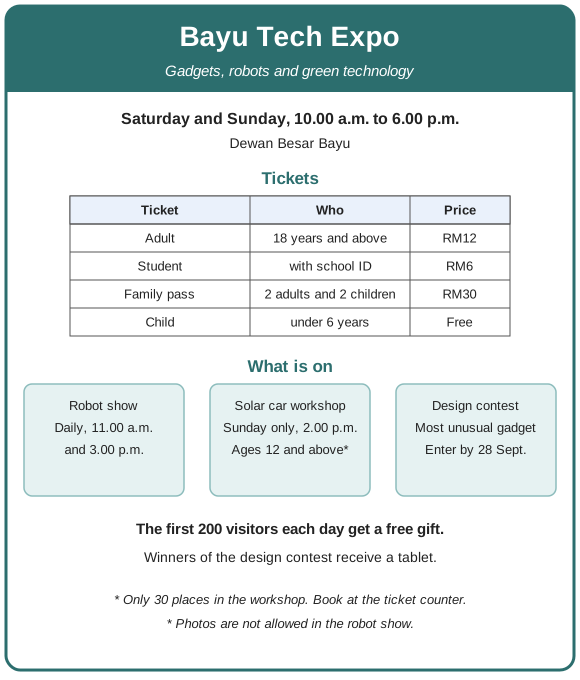
| Question | Answer and reason |
|---|---|
| How much is a ticket for a pupil with a school ID? | RM6: the "Student" row. |
| On which day can Hafiz, aged 13, join the solar car workshop? | Sunday: it is Sunday only, and 13 is above the minimum age of 12. |
| A family of 2 adults and 2 children (aged 10, with school ID) buys single tickets. How much more is this than the family pass? | 2 × RM12 + 2 × RM6 = RM36. RM36 − RM30 = RM6 more. |
| Can Mei take photos at the robot show? | No: the small print says photos are not allowed. |
Show answerHide answer
8.3Tables and timetables
A timetable is a grid. Put one finger on the row (a station, a day or a trip) and one on the column (a train or a time) and read where they meet. Many timetables use the 24-hour clock.
| 24-hour clock | 12-hour clock |
|---|---|
| 06:40 | 6.40 a.m. |
| 13:05 | 1.05 p.m. (13 − 12 = 1) |
| 18:35 | 6.35 p.m. |
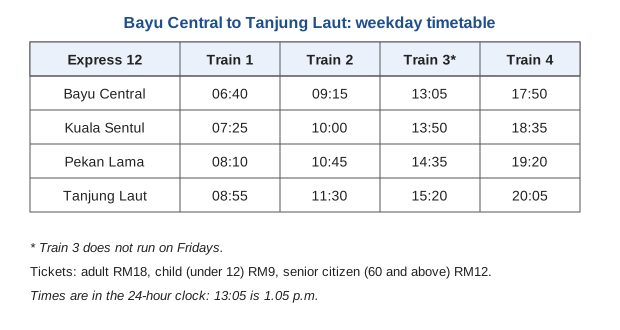
| Question | Working | Answer |
|---|---|---|
| When does Train 2 reach Pekan Lama? | Train 2 column, Pekan Lama row | 10:45 (10.45 a.m.) |
| How long does Train 2 take from Bayu Central to Tanjung Laut? | 09:15 to 11:30: 09:15 to 10:15 is 1 hour, then 10:15 to 11:30 is 1 h 15 min | 2 hours 15 minutes |
| Which train can Aini catch on a Friday afternoon? | Train 3 does not run on Fridays (the star) | Train 4 (17:50) |
| Cost for 2 adults and 1 child aged 8 | 2 × RM18 + RM9 = RM36 + RM9 | RM45 |
Show answerHide answer
8.4Charts and graphs
| Chart | Best for | How to read it |
|---|---|---|
| Bar chart | comparing groups | read the height of the bar against the scale on the vertical axis |
| Pie chart | parts of a whole | each slice is a share; all slices add up to 100% |
| Line graph | change over time | follow the line from left to right; steeper means a faster change |
Before you answer, always check four things: the title, the labels on the axes, the key (which colour means what) and the units.
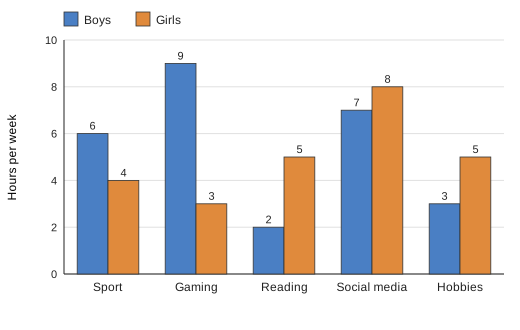
| Question | Answer |
|---|---|
| Which activity do the boys spend most time on? | Gaming, 9 hours a week. |
| How many more hours than the girls do the boys spend on gaming? | 9 − 3 = 6 hours. |
| How many hours a week do the girls spend on all five activities? | 4 + 3 + 5 + 8 + 5 = 25 hours (boys: 27). |
| How many times more do girls read than boys? | 5 ÷ 2 = 2.5 times. |
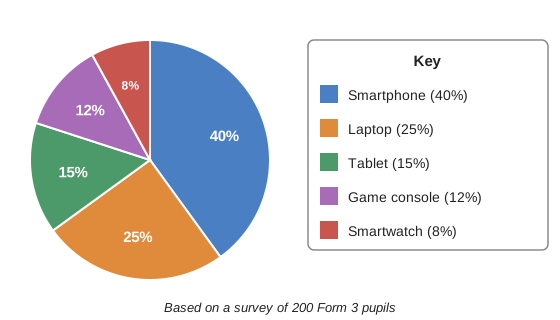
A pie chart gives percentages, so turn a percentage into a number of pupils by taking that share of the total: 40% of 200 = 0.40 × 200 = 80 pupils use a smartphone. Laptop: 25% of 200 = 50. Tablet: 15% of 200 = 30.
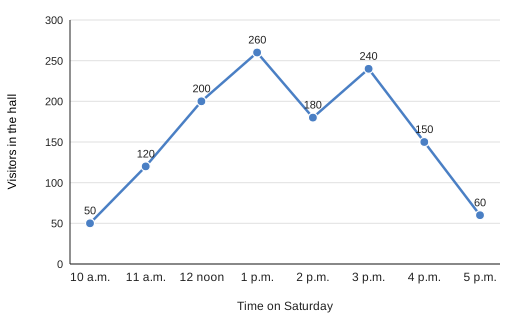
| Question | Answer |
|---|---|
| When was the hall busiest? | At 1 p.m., with 260 visitors. |
| How did the number change from 1 p.m. to 2 p.m.? | It fell by 80 (260 − 180). |
| Which hour had the biggest rise? | Subtract each pair: +70, +80, +60, then a fall, +60. The biggest rise was 11 a.m. to 12 noon (+80). |
- Reading the wrong bar (boys instead of girls). Check the key.
- Giving the percentage when the question asks "how many pupils".
- Saying "the highest" when the question asks for the biggest change. Subtract first.
- Forgetting the unit, such as hours, pupils or RM.
Show answerHide answer
8.5Similar words and eliminating answers
In a multiple-choice question about a short text, the options often use words from the text. Two Exam Close-ups in the book teach you what to do.
| Skill | What to do | Textbook |
|---|---|---|
| Eliminating answers | Read all the texts. Underline key words in the options. Look for similar information in the text. If there is none for an option, eliminate it. Check the options you kept. | p.59 |
| Checking similar words | Be careful with words that are the same in the option and in the text: they often say something different. Read the whole sentence and compare the meaning. | p.123 |
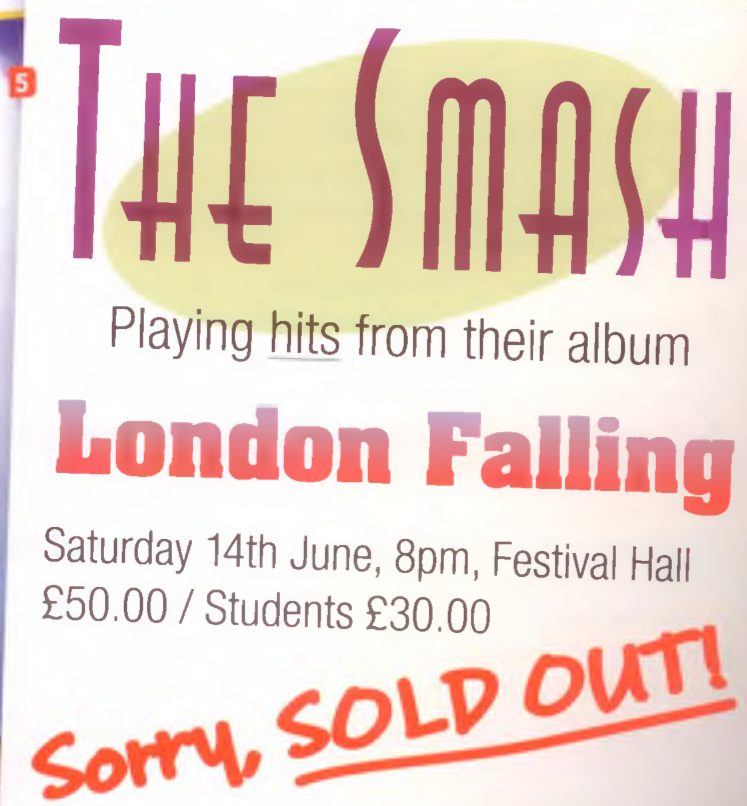
Textbook advert: Close-up B1 Student's Book (Form 3), Unit 10, p.123.
Question: The advert says that (a) the band is playing in a theatre, (b) there are no tickets left, (c) students pay the same as adults.
| Option | Look for | Decision |
|---|---|---|
| (a) a theatre | The advert says Festival Hall, not a theatre. | Eliminate |
| (b) no tickets left | "Sorry, SOLD OUT!" means there are none left. | Keep: answer |
| (c) the same price | Adults pay 50 pounds; students pay 30 pounds. | Eliminate |
Show answerHide answer
8.6Completing notes and forms
A form or a set of notes has a heading and short lines with gaps. The textbook's Exam Close-up on Completing information (p.126) gives these rules.
| Rule | Why |
|---|---|
| Read the instructions first | They tell you the topic and how many words are allowed. |
| Read the heading and the lines and imagine what could fit each gap | You will hear or find the word more easily. |
| Write numbers as 10 or ten | Both are accepted. |
| Write the exact words and no more than three words | Extra words can lose the mark. |
| Check the spelling and the grammar | The answer must fit the line. |
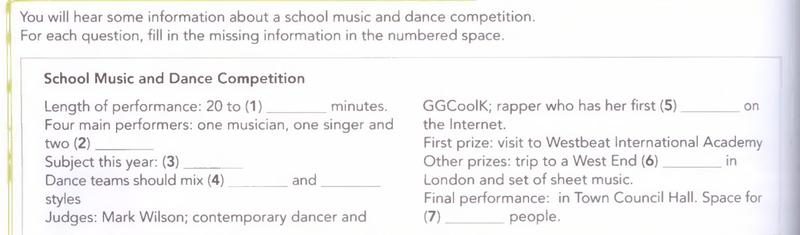
Textbook form: Close-up B1 Student's Book (Form 3), Unit 10, p.126.
| Gap | Line | Predict |
|---|---|---|
| (1) | Length of performance: 20 to ____ minutes | a number |
| (2) | one musician, one singer and two ____ | a plural noun for a kind of performer |
| (4) | mix ____ and ____ styles | two describing words for styles |
| (7) | Space for ____ people | a number |
Show answerHide answer
8.7Advantages, disadvantages and deciding
In the speaking tasks you also work with a non-linear text: a list or a mind map. You talk about each item and then decide. A useful way to talk about an item is to give an advantage (A) and a disadvantage (D).
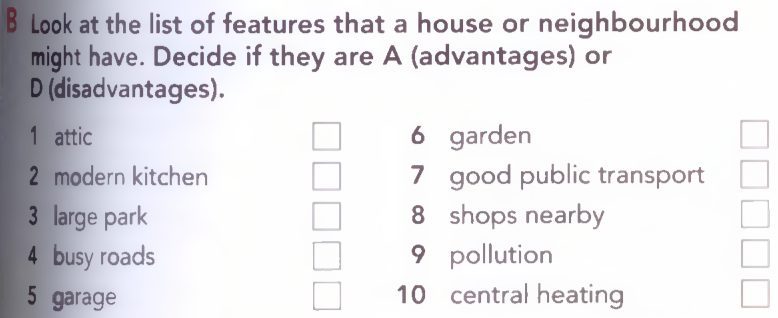
Textbook list: Close-up B1 Student's Book (Form 3), Unit 5, p.63.
Items such as busy roads and pollution are disadvantages. Good public transport, shops nearby and a modern kitchen are advantages.
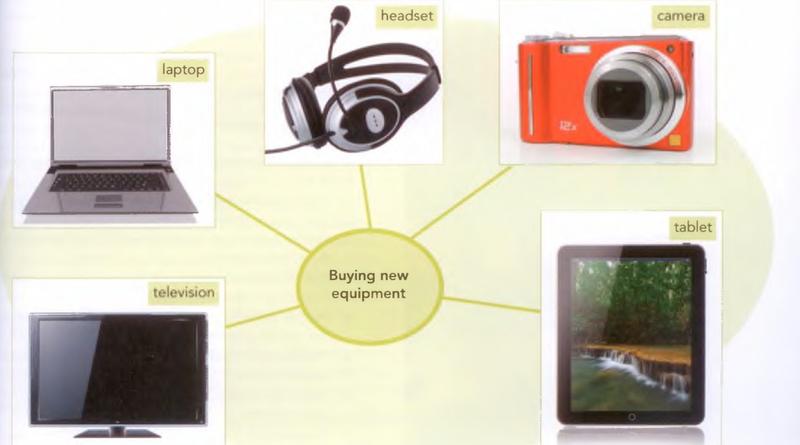
Textbook task: Close-up B1 Student's Book (Form 3), Unit 9, p.115.
| Step | What you do | Useful language (pp.115, 182-183) |
|---|---|---|
| 1. Open | Start with the first option. | Shall we start with this ...? / Let's begin by looking at ... / First of all, ... |
| 2. Compare | Say why an option might be good, then why it might not be the best. Ask your partner. | I think ... is a good idea because ... / I don't think ... would be a good idea because ... / What do you think? |
| 3. Move on | Talk about all the options before you decide. | Let's move on to ... / Shall we talk about ... now? |
| 4. Decide | Choose one and give a reason. | So, to sum up ... / Do we agree that ... is the best one? / In the end we think ... because ... |
B: I think a laptop is a good idea because every pupil can use it for research. But it is expensive.
A: Yes. A tablet is cheaper, but I don't think it would be as good for typing a long report. What do you think?
B: I agree. So, to sum up, do we agree that the laptop is the best one?
A: Yes, in the end we think the laptop is best because it is useful for every subject.
Show answerHide answer
Summary
- A non-linear text (poster, notice, timetable, chart, form, mind map) is read by moving around, not line by line.
- Posters: main idea, details, then the small print.
- Timetables: row and column; convert the 24-hour clock; subtract times in two steps.
- Charts: title, axes, key and units; compute differences, totals and shares; give units.
- Multiple choice: eliminate options with no support; beware of similar words that change the meaning (pp.59, 123).
- Forms: predict the missing word; exact words, no more than three words and/or a number (p.126).
- Speaking: advantage, disadvantage, ask your partner, then decide (pp.63, 115, 182-183).