Gapped texts and how texts hold together
What this chapter covers
- I know what Paper 1 Part 5 looks like - one text, six gaps (35 to 40), eight sentences A to H with two extra, 6 marks (9.1)
- I can use the Exam Close-up "Reading around the gap" - skim, think of a word, test the options and read before and after the gap (9.2)
- I can tell what kind of word is missing (noun, verb form, preposition or linking word) from the words next to the gap (9.2)
- I can find what he, they, it, this, which, such, one and the latter point to, including a whole idea, and use them to match a sentence to a gap (9.3)
- I can use synonyms and general words, such as storm and the bad weather, to see how two sentences join (9.3)
- I can say what job a linking word does (adding, contrast, alternative, result, reason, example, time, sudden, concluding) and use however, nevertheless, although and despite correctly (9.4)
- I can use the plan of an email, story, review or report and the topic sentence of a paragraph to predict a missing sentence (9.5)
- I can check order and tense in a story (past simple, past continuous, past perfect) and use suspense expressions (9.6)
- I can follow a six-step method and rule out sentences that fail the pointer, link, topic, order, repetition or contradiction check (9.7, 9.8)
In Paper 1 Part 5 sentences have been taken out of a text, and you put them back in the right places. In Form 3 the texts are longer and the clues are less obvious than in Form 1: a pointer may refer to a whole idea, not just a noun, and two sentences may both look possible. This unit shows how a text holds together (cohesion) and gives you a method for every gapped text. It follows the Close-up B1 book: reading around the gap (Unit 8, p.97), finding synonyms (Unit 11, p.137), checking spelling and reviewing your writing (Unit 7, pp.88 and 93) and the linking words in the Writing Reference (pp.176 to 181).
9.1What Part 5 looks like
| Part 5 at a glance | Details |
|---|---|
| Questions | 6 (Questions 35 to 40), 1 mark each, 6 marks in all |
| Time | part of the timed Paper 1; a fair guide is about 1.5 minutes for each gap, so about 10 minutes |
| Texts | one short text with six gaps. In Form 3 expect a story or recount, an article, an informal email or a short report (the text types in the Writing Reference) |
| Sentences | eight sentences, A to H, are given for the six gaps. Six sentences fit the gaps and two are extra: you do not use them, so do not expect every letter to be used |
| Answer | blacken one letter for each gap |
| Form 1 texts | Form 3 texts |
|---|---|
| 8 gaps in two texts, no extra sentences | 6 gaps in one text, 8 sentences with two extra |
| short sentences, one clue for each gap | longer sentences; two or three clues for each gap, and the clue after the gap is often the key |
| it, they point to a noun | this, which, such point to a whole idea; the former and the latter |
| however, so, then | nevertheless, as a result, meanwhile, alternatively, in conclusion |
| past simple in stories | past simple, past continuous and past perfect together |
9.2Reading around the gap: word gaps
The textbook uses a gapped text in which you choose a single word for each gap (Unit 8, p.97). The same skill helps in sentence gaps: you must read the words around the gap, not only the gap itself.
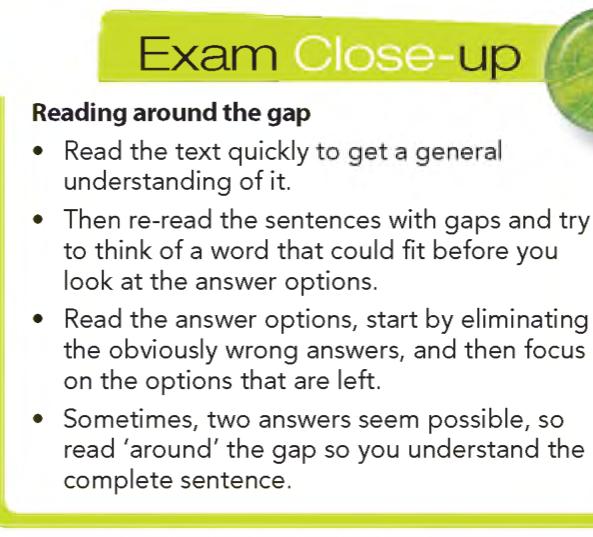
Figure: Close-up B1 Student's Book (Form 3), p.97.
| Step | What you do |
|---|---|
| 1 | Read the whole text quickly for the general idea. Do not stop at the gaps. |
| 2 | Go back to each gap and think of a word before you look at the options. |
| 3 | Read the options. Cross out the obviously wrong ones, then test the rest. |
| 4 | If two seem possible, read the sentence before and after the gap, and check that the whole sentence is correct. |
What kind of word is missing?
| Look at the words next to the gap | The gap needs | Example |
|---|---|---|
| a, an, the, or an adjective before it | a noun | a long journey |
| to, can, must, will before it | the base form of a verb | We must leave early. |
| has, have, had before it | a past participle | She has lived here for years. |
| is, are, was, were before it | -ing form or past participle (active or passive) | The road is being repaired. |
| a preposition before it | a noun or an -ing form | good at drawing |
| a verb or adjective that takes a fixed preposition | the correct preposition | cope with, depend on |
| a clause on each side | a linking word | It was late, so we went home. |
"Orang utans spend most of their lives in the (1) ______ of tall trees. They (2) ______ a new nest every evening from branches and leaves. Sadly, their forest is being (3) ______ down for palm oil farms."
(1) a. roots b. tops c. floor d. holes
(2) a. build b. builds c. building d. built
(3) a. cut b. cutting c. cuts d. cutted
(1) b: orang utans live in trees, so the tops; the others are on the ground. (2) a: They is plural and the sentence is a routine in the present simple, so build. (3) a: is being needs a past participle, and the participle of cut is cut.
(1) go / going / went / gone (2) In / At / As / On (3) after / before / until / while
Show answerHide answer
9.3Reference words and other glue
A reference word points back to something said before (or, sometimes, forward). A sentence that begins with a reference word needs its target just before the gap. In Form 3 the target can be an idea.
| Reference word | Points to | Example |
|---|---|---|
| he, she, it, they, them, his, their | a person, thing or group (check singular or plural, male or female) | The workers finished early. They were paid extra. |
| this, that | a whole idea, event or fact | The bridge was closed for a month. This upset many drivers. |
| this / these / such + noun | a named idea, summed up by a noun | Many beaches are covered with plastic. This problem is getting worse. Such pollution kills turtles. |
| which (after a comma) | the whole clause before it | He passed, which surprised everybody. |
| one, ones, so, do so | replace a noun, an adjective or a verb phrase | I lost my pen, so I bought a new one. Will it rain? I hope so. |
| the former, the latter | the first or the second of two things just named | A tent or a hotel? The latter costs more. |
| both, neither, either | two things or people just named | Ali and Ben applied. Both were accepted. |
Repeated words and synonyms
Writers avoid repeating a word by using a synonym (a word with the same meaning) or a more general word: a storm then the bad weather; a plane then the aircraft. The textbook trains this in finding synonyms (Unit 11, p.137). If the sentence after the gap uses the bad weather, the gap sentence must have named a storm, rain or wind.
Our school will stop selling drinks in plastic bottles next term. (gap) Pupils will be asked to bring their own bottles.
A This is part of a plan to reduce rubbish at the canteen.
B He said that the canteen would also close on Fridays.
The first sentence is about a decision, so we need This (the decision), and the plan leads on to Pupils will be asked to bring their own bottles. He in B has no man or boy to point to, and closing on Fridays is a different topic. The answer is A.
Show answerHide answer
9.4Linking words by job
A linking word shows how two ideas connect. When the gap sentence begins with one, check that the sentence before the gap gives the right kind of idea; when the sentence after the gap begins with one, the gap sentence must supply what it needs. The plans in the Writing Reference (pp.176 to 181) give several of them (in addition, as for, alternatively, however, on the other hand, suddenly, eventually, to sum up), and the Learning box on p.104 groups the adding, reason and example words. The rest are common in Form 3 texts.
| Job | Linking words and phrases | The sentence before gives ... |
|---|---|---|
| Adding | also, in addition, besides, as for, what is more | a point of the same kind |
| Contrast | however, nevertheless, even so, on the other hand, whereas, while | an idea that goes the other way |
| Alternative | alternatively, another possibility, instead | a first option that was described |
| Result | so, as a result, therefore, that is why | a cause |
| Reason | because, since, as, because of this | a result (the reason follows) |
| Example | for example, for instance, such as, one example is | a general idea |
| Time order | at first, then, after that, meanwhile, eventually, at last, by the time | an earlier step or another event at the same time |
| Sudden event | suddenly, all of a sudden, just then, at that point | a calm or normal situation |
| Concluding | in conclusion, to sum up, for these reasons | all the points have been discussed |
Grammar and punctuation of contrast words
| Word | Pattern | Example |
|---|---|---|
| However / Nevertheless | start a new sentence; comma after | It rained all day. Nevertheless, the match went ahead. |
| although / even though | join two clauses in one sentence; never with but | Although it rained, the match went ahead. |
| despite / in spite of | followed by a noun or an -ing form | Despite the rain, the match went ahead. |
| whereas / while | contrast two things in one sentence | Ali is quiet, whereas his brother is noisy. |
(a) The beach was crowded. ______, we found a quiet corner. (b) Ali was cooking dinner. ______, his sister was setting the table. (c) The factory dumped waste in the river. ______, many fish died. (d) Some fruits are rich in vitamin C. ______, guavas have more than oranges. (e) ______ the heavy rain, the match went ahead.
Show answerHide answer
9.5Paragraph plans and topic sentences
Each text type in the Writing Reference has a plan, and gaps usually fall on the plan's key moves. If you know the plan, you can predict what kind of sentence is missing.
| Text type (page) | Plan | Typical gap sentences |
|---|---|---|
| Informal email (p.176, p.177) | greeting, thanks and reason for writing, more details, extra information, signing off | Thanks for your email. / I'm writing to ... / In addition, ... / As for ... / Write back soon! |
| Story (p.179) | set the scene, background, main events in order, a twist, an ending and feelings | At first, ... / Meanwhile, ... / Suddenly, ... / Eventually, ... |
| Review (p.180) | introduce, describe with examples, recommendation | For example, ... / On the other hand, ... / I highly recommend ... |
| Report (p.181) | purpose, first option, second option, conclusion | The aim of this report is to ... / Alternatively, ... / In conclusion, ... |
A topic sentence states the main idea of a paragraph and usually comes first. A gap at the start of a paragraph needs a sentence that introduces everything that follows. A gap in the middle needs a detail, an example or a reason. A gap at the end needs a result, a feeling or a conclusion.
(gap) First, it keeps you fit without costing any money. Second, it is faster than a bus in a busy town. Finally, it does not pollute the air.
A Cycling to school has three clear advantages.
B My bicycle was a present from my uncle.
The paragraph lists First, Second, Finally: three points. A names the topic and says "three advantages", so the list that follows develops it. B is about the same topic but gives a different, personal detail and does not lead to a list.
Show answerHide answer
9.6Order, tense and suspense
The gap sentence must happen at the right time and use a tense that fits. In stories the Writing Reference (p.179) tells you to use narrative tenses:
| Tense | Use in a story | Example |
|---|---|---|
| past simple | the main events, one after another | We reached the hut and made a fire. |
| past continuous | the background, or an event in progress | It was raining while we were walking. |
| past perfect | something that happened before the story time | When we arrived, the others had already left. |
By the time and by then often go with the past perfect. A present tense sentence does not belong in a story set in the past.
The textbook also gives expressions that create suspense in a story (Unit 7, p.93). Most of them expect a calm or normal moment before them and a reaction after them.
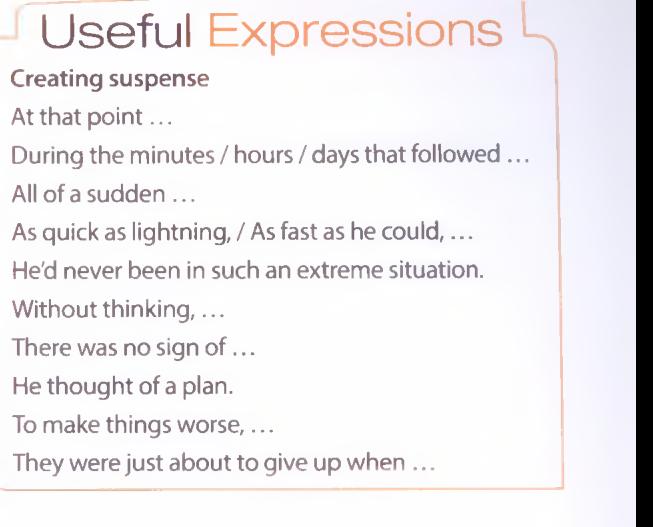
Figure: Close-up B1 Student's Book (Form 3), p.93.
We were crossing the lake in a small boat. The water was calm. (gap) The engine coughed and stopped.
A All of a sudden, there was a strong smell of smoke.
B Every morning, we crossed the lake before breakfast.
A gives the sudden event that leads to the engine problem. B is a habit in a different time (every morning), so it breaks the story.
Show answerHide answer
9.7The method and a worked example
| Step | What you do |
|---|---|
| 1. Skim | Read the title and the whole text quickly. Who? What type of text? Which tense? |
| 2. Circle | In the sentences, circle reference words, linking words and tenses. |
| 3. Look both ways | For each gap, read the sentence before and the sentence after. The word after the gap (This, However, They) often decides it. |
| 4. Strongest first | Fill the gap with the clearest clue, then cross the sentence out. |
| 5. Narrow down | With fewer sentences left, check the clues again for the rest. |
| 6. Read it again | Read every paragraph with your sentences in it. Does it sound natural? Are the pointers and tenses right? |
Read the text below. Six sentences have been removed from the text.
Choose from the sentences (A - H) to fit each gap (35 - 40).
Plastic in the Ocean
Every year, about eight million tonnes of plastic end up in the world's oceans. (35) ______ Unlike paper or food, plastic does not rot. Most of it breaks into tiny pieces, which stay in the water for hundreds of years.
Sea animals suffer most. (36) ______ Turtles, for example, often mistake floating plastic bags for jellyfish, which are their favourite food.
(37) ______ However, scientists have developed a special enzyme that breaks down plastic bottles in a few days. (38) ______ Both ideas are promising, but they are still too expensive for most countries.
The most effective answer, though, is to stop plastic from reaching the sea in the first place. (39) ______ If everyone refused single-use bags, bottles and straws, far less waste would be thrown away.
(40) ______ Small choices, repeated by millions of people, can keep the oceans alive for the future.
A That is roughly one rubbish truck emptied into the sea every minute.
B Cleaning the oceans is extremely difficult, because the waste is spread over millions of square kilometres.
C In addition, some companies now make packaging from seaweed.
D Many of them swallow pieces of plastic or become trapped in old fishing nets.
E This means that every one of us has a part to play, not only governments and factories.
F To sum up, we cannot wait for someone else to solve the problem.
G He told us that he would collect bottles on the beach.
H Most of them are used for only a few minutes before they are thrown away.
| Gap | Clues before and after | Answer |
|---|---|---|
| (35) | The sentence before gives an amount (eight million tonnes). That in A points to this amount, and one rubbish truck every minute makes it easier to imagine. | A |
| (36) | The sentence before is a general idea (Sea animals suffer most). Many of them in D points to the animals, and Turtles, for example is one example of it. | D |
| (37) | After the gap, However introduces good news, so the gap needs a problem. B is a difficulty about cleaning the oceans, and the paragraph is about solutions. | B |
| (38) | It follows the enzyme, so In addition adds a second solution. After the gap, Both ideas needs two ideas: the enzyme and the seaweed packaging. | C |
| (39) | The sentence before gives the answer (stop plastic reaching the sea). This means in E explains what it means for people. After the gap, If everyone refused ... develops every one of us. | E |
| (40) | The last paragraph needs a conclusion. To sum up in F closes the text, and Small choices follows from the problem being ours to solve. | F |
The two extra sentences. G has He, but no man or boy is named in the text (pointer check). H has them, which could point to plastic bottles at gap 38, but it gives no second idea for Both ideas, and at gap 36 Most of them would mean the sea animals, which are not thrown away (topic check); at gap 39 them has no plural noun just before it (pointer check). Step 6: read the text again. The pointers (that, many of them, this, both), the linking words (however, in addition, to sum up) all fit. Answers: 35 A, 36 D, 37 B, 38 C, 39 E, 40 F. G and H are not used.
9.8Ruling out sentences that do not fit
When two sentences seem to fit, test each one against these checks. A sentence that fails one check is wrong for that gap.
| Check | The sentence is wrong if ... | Example |
|---|---|---|
| Pointer | its reference word has no matching target | "They were delicious." after "Mum made a chocolate cake." |
| Link | its linking word does the wrong job | "As a result, we won." after "Our best player was sick." |
| Topic | it belongs to another paragraph's idea | a sentence about lunch in a paragraph about the morning walk |
| Order and tense | it is too early, too late or in a different tense | "We go home happily." in a story set in the past |
| Repetition | it only repeats something already said | "We left at 7.00." when the time is already given |
| Contradiction | it disagrees with the sentence after the gap | "It was very easy." before "I tried five times before I got it right." |
Kavitha joined the school choir in January. (gap) Now she is not afraid of singing on stage.
E At first, she was very shy and sang softly.
F She has always loved singing in front of people.
The sentence after the gap says Now she is not afraid of singing: she was afraid before. E gives the "before" picture. F contradicts it, because someone who always loved singing was never afraid. The answer is E.
"Every Saturday, Haziq helps his grandfather at the pasar tani. (a) ______ It sells bananas, papayas and pineapples from their farm. By noon, most of the fruit is sold. (b) ______ They pack up and go home."
E His grandfather has a small fruit stall there.
F It is in a car park near the mosque.
G Haziq and his grandfather are happy with the morning's work.
H Last month, he won a prize for his school project.
Show answerHide answer
Summary
| Point | Remember |
|---|---|
| Part 5 format | one text, 6 gaps (35 to 40), 8 sentences A to H with 2 extra, 6 marks, about 10 minutes. |
| Reading around the gap | Skim, predict a word or idea, then read the options and test them with the words before and after the gap (p.97). |
| Reference | he, she, it, they, this, which, such, the latter: the target must be just before the gap; this and which can point to a whole idea. |
| Linking words | adding, contrast, alternative, result, reason, example, time, sudden, concluding; the sentence before must give the matching kind of idea. |
| Plans | email, story, review and report each have a plan (pp.176 to 181); the gap usually sits on a key move. |
| Order and tense | narrative tenses: past simple, past continuous and past perfect; not too early, not too late. |
| Method | Skim, circle clues, look both ways, strongest first, narrow down, read it again. |