Writing short messages: emails, notes and letters
What this chapter covers
- I can describe Paper 2 Part 1 of the UASA - one short message, usually an email reply to a friend, about 80 words, 20 marks, about 20 minutes (10.1)
- I can read a task and find who I am writing to, why I am writing and every content point I must cover, using the Exam Close-up "Including all the information" (10.2)
- I can lay out an email, an informal letter and a postcard with the plans in the Writing Reference, and use abbreviations such as Mr, Dr, 10th, am, pm, e.g. and Rd correctly (10.3)
- I can reply to a letter by reacting to each thing the writer said, in a similar order, and accept, decline, give news or make suggestions politely (10.4)
- I can write a postcard that says where I am, what I have done and what I am going to do, and ask the reader a question (10.5)
- I can join ideas with also, as well as, because, since, for example and for instance, and I know which of them can start a sentence (10.5)
- I can keep an informal, friendly style with contractions and useful expressions, and avoid texting language (10.6)
- I can explain how the four parts of the rating scale - content, communicative achievement, organisation and language - give my 20 marks, and I can follow a six-step method to write and check a full Part 1 answer (10.7, 10.8)
In this unit you will learn to write the short message in Paper 2 Part 1: an informal email, a letter or a postcard to a friend or a relative. You will learn to find every content point in the task, to follow the plan of each text type, to react to what the other person wrote, to link your ideas and to keep a friendly informal style. You will also see how the examiner gives you your 20 marks.
10.1Paper 2 Part 1 at a glance
Paper 2 (Writing) takes 1 hour and has two parts. Part 1 is a short message. Part 2 is a longer text from notes (Unit 11).
| What | Details |
|---|---|
| Task | 1 task: read a short message from a friend (usually an email), then write a reply |
| Marks | 20 marks (half of Paper 2) |
| Time | About 20 minutes, so you have 40 minutes left for Part 2 |
| Length | About 80 words in the UASA. Always read the number in the task: the textbook's Exam Tasks ask for 35 to 45 words (emails and postcards) and 100 words (letters). |
| Text types | An informal email, an informal letter, a postcard or a note to a friend or relative |
| Level | CEFR B1 in Form 3: clear, connected paragraphs with a friendly style, not just short sentences |
| Textbook support | Unit 1 pp.14-15 (email invitation), Unit 5 pp.66-67 (replying to a letter), Unit 8 pp.104-105 (postcard), Writing Reference pp.176-178 |
In the UASA, the task usually looks like this (this one is new, but it has the same shape):
My cousin from Australia is coming to stay with us for two weeks in the school holidays. I want to show him the best of Malaysia. Where should I take him? What food should he try? And what can we do if it rains?
Write soon!
Haziq
10.2Reading the task: find every content point
Close-up B1 Student's Book (Form 3), p.14, Exercises B and C.
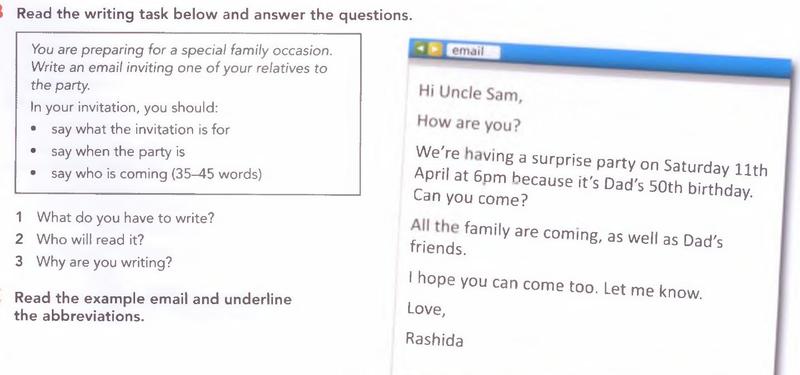
Before you write one word, ask four questions. The textbook asks the same: What do you have to write? Who will read it? Why are you writing?
| Ask yourself | In the invitation task above |
|---|---|
| What do I write? | An email |
| Who will read it? | One of my relatives (informal, friendly, but not rude) |
| Why am I writing? | To invite him or her to a family party |
| What must I include? | Three content points: what the invitation is for, when the party is, who is coming |
The Exam Close-up on p.15, Including all the information, gives three habits:
- Read the exam question carefully.
- Underline the information you need to include.
- When you finish, read the question again and check that every point is in your answer.
Each point needs an answer and a reason or detail. "Take him to Penang" is thin. "Take him to Penang because the street food is famous" is a full answer.
- Answering two of three questions. A missing point costs marks in Content.
- Writing about the topic but not answering what was asked (a long story about your holiday, when the task wants advice).
- Copying whole sentences from the friend's email. Use your own words.
Show answerHide answer
10.3The shape of an email, a letter and a postcard
The Writing Reference at the back of the book (pp.176-178) gives a plan for each text type. Every plan has a greeting, paragraphs, and a way of signing off.
| Part | Email (p.176) | Informal letter or email (p.177) | Postcard (p.178) |
|---|---|---|---|
| Greeting | Hi ...! / Hello ...! / Dear ..., | Dear ..., / Hi ... | Dear Eric, / Hi, Eric |
| Paragraph 1 | Polite phrases: thank the reader or ask about them, then say why you are writing | Ask about the person and explain why you are writing | The holiday so far: how it is, what you have done |
| Paragraph 2 | More details about why you are writing | Paragraphs 2 and 3: more details about the subject, and what you want to find out or do | Future plans: what you are going to do |
| Paragraph 3 | More information (In addition, Also, As for ...) | (see Paragraphs 2 and 3 above) | A question to the reader |
| Paragraph 4 | (none in the plan) | Further questions, and what needs to be done next | (none: go to the closing) |
| Signing off | See you soon! / Keep in touch. / Write back soon! | Love, ... / Talk to you later! | Bye. See you soon. |
An email plan in use
Rashida's email on p.14 is only about 40 words, but it follows the plan exactly. Here it is split into its parts, in my own words.
| Part | What Rashida does |
|---|---|
| Greeting | Hi Uncle Sam, |
| Paragraph 1 | Asks How are you? |
| Paragraph 2 | Gives the reason: a surprise party for her father's 50th birthday, with the date and the time |
| Paragraph 3 | Says who is coming: the family and her father's friends |
| Paragraph 4 | Asks him to reply: I hope you can come too. Let me know. |
| Signing off | Love, Rashida |
Abbreviations
The Learning box on p.14 lists the short forms we use in notes, emails and postcards.
| Kind | Examples |
|---|---|
| Times | am (morning), pm (afternoon, evening) |
| Titles | Mr, Mrs, Miss, Ms, Dr |
| Ordinal numbers | 10th (tenth), 40th (fortieth) |
| Language | e.g. (for example), etc. (and so on), i.e. (that is to say) |
| Countries | USA, UK, UAE |
| Addresses | Rd (road), Ave (avenue), St (street) |
- e.g. and i.e. are not the same. Fruit, e.g. mangoes and papayas gives examples; my uncle, i.e. my mother's brother explains.
- Writing 5st or 2th. The ordinals are 1st, 2nd, 3rd, 4th, 5th ...
- Writing the date and time only in numbers in a long message. In a sentence, write on Saturday 11th April at 6 pm clearly.
Show answerHide answer
10.4Replying to a letter: react to what the writer said
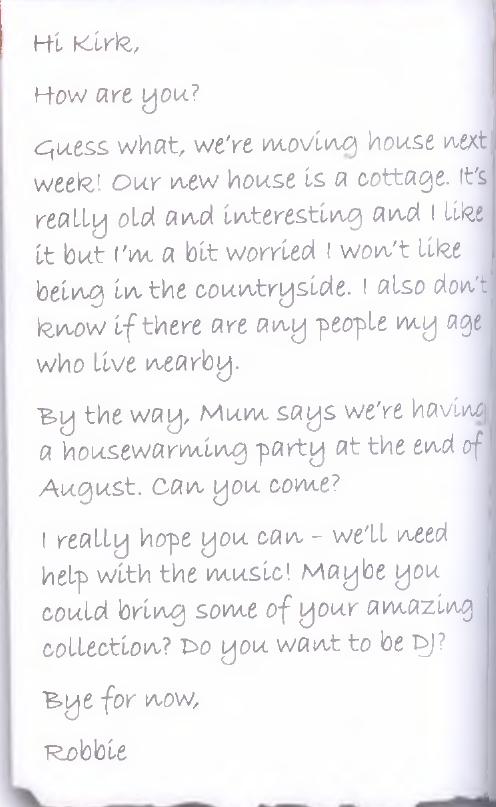
Close-up B1 Student's Book (Form 3), p.66, Robbie's letter.
The Learning box on p.66 explains the main idea: when you reply, react to what the writer said. Read the letter carefully and see whether you have to:
- apologise or give an explanation;
- show that you are excited (express enthusiasm);
- ask for or give information;
- thank the sender;
- accept or decline a request, and accept or reject an invitation.
You can organise your reply by answering the writer's comments in a similar order.
Mark up the letter
| What Robbie says | What he needs from Kirk |
|---|---|
| We're moving house next week! The new house is an old cottage. | A reaction to the news (excitement) |
| I'm worried I won't like the countryside, and I don't know anyone my age nearby. | Comfort and a suggestion for making friends |
| We're having a housewarming party at the end of August. Can you come? | Accept or decline the invitation |
| Maybe you could bring some of your music. Do you want to be DJ? | Answer the request and the question |
A reply in the same order
It's great to hear from you! I think moving to a cottage sounds exciting. You can cycle around the countryside and watch the stars at night.
Don't worry about making friends. Why don't you join a local football team? You are very friendly, so people will like you.
I'd love to come to your housewarming party. Of course I'll be your DJ! I'll bring lots of music so everybody can dance. Have you chosen a date yet?
Bye for now,
Kirk
This reply has 83 words. Every comment gets a response, in the same order as the letter, and none of Robbie's sentences are copied.
Useful expressions (p.67)
| Job | Expressions |
|---|---|
| Making suggestions | If I were you, I'd ... / I wouldn't ... / Why don't you ...? / How about ...? / What about ...? |
| Accepting an invitation | I'd love to come ... / I'll definitely be there. |
| Rejecting an invitation | I'm sorry, I can't make it. / Unfortunately, I won't be able to come. |
| Responding to news | What exciting / sad / great ... news! / I'm really pleased for ... / I'm proud of ... / It'll be fun / great ...! |
- Skipping a question because it is in the middle of a paragraph. Underline every question mark.
- Saying "no" to an invitation with no reason. Give a short reason and, if you can, offer something instead.
- Answering the news with a long retelling of your own news. React in one sentence, then move on.
- suggest you to go is wrong; say I suggest you go or I suggest going.
Show answerHide answer
10.5Postcards and linking words
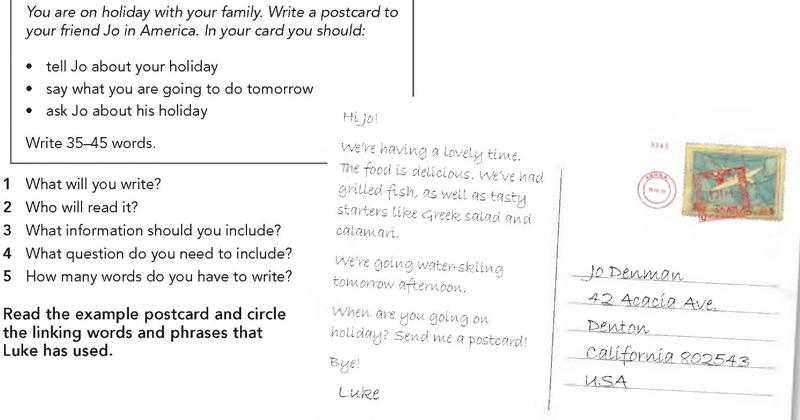
Close-up B1 Student's Book (Form 3), p.104, postcard task and Luke's postcard.
A postcard is very short (35 to 45 words in the textbook), so every sentence must count. The Writing Reference (p.178) says: open and close in a friendly way, use informal language, use linking words, and explain the good points about your holiday.
| Part | Content | Examples |
|---|---|---|
| Opening | Informal greeting | Hi Jo! / Dear Ed, |
| Paragraph 1 | The holiday so far | We're having a lovely time. The food is delicious. We've had grilled fish. |
| Paragraph 2 | Plans for the future | We're going water-skiing tomorrow afternoon. |
| Paragraph 3 | A question | When are you going on holiday? How is your holiday going? |
| Closing | Informal closing, then your name | Bye! / See you soon. Luke |
Linking words (Learning box, p.104)
| Job | Words | Example |
|---|---|---|
| Add similar ideas | also, as well, and, too, as well as | We've had fresh fish as well as tasty starters. |
| Give a reason | as, since, because | I'll bring my camera because the view is amazing. |
| Give examples | like, such as, for example, for instance | There are lots of activities, such as kayaking and cycling. |
- Starting a sentence with Such as ... or Like ... when giving examples.
- Using because and so in the same sentence: "Because it rained, so we stayed in." Use one: "It rained, so we stayed in."
- Using and every time. Mix also, besides, as well as, since.
Show answerHide answer
10.6Informal language and tone
The Exam Close-up on p.67 says your letters will always need to be informal: use friendly expressions, contractions and the useful expressions we usually use in informal letters and emails. The Writing Reference (p.176) adds: be friendly, do not use texting language, and make the style suit the situation and the reader.
| Too formal or too strange | Better informal English |
|---|---|
| I am writing to inform you that I am unable to attend. | I'm really sorry, but I can't come. |
| I do not know whether I will like it. | I'm not sure I'll like it. |
| Please respond at your earliest convenience. | Let me know soon! |
| Thx 4 ur email. cant wait lol | Thanks for your email. I can't wait! |
Check your writing: the three Writing Reference checklists (pp.176-178)
- Have you followed the plan?
- Have you used grammatically correct forms?
- Have you checked spelling and punctuation?
- Have you used informal language, such as short forms of verbs?
- Is your style suitable for the situation and the reader?
- Have you used linking words? (and for a postcard: have you asked a question? have you included all the information you were given?)
| Mistake | Better |
|---|---|
| I am agree with you. | I agree with you. |
| Let's discuss about the party. | Let's discuss the party. / Let's talk about the party. |
| She suggest me to go there. | She suggests (that) I go there. |
| We have been to the old town yesterday. | We went to the old town yesterday. (yesterday needs the past simple) |
| The food are delicious. | The food is delicious. |
Show answerHide answer
10.7How you are marked: the rating scale
The examiner does not count mistakes. They read the whole message and give 0 to 5 in each of four areas, so the total is 20 marks.
| Area | What the examiner asks | A 5 looks like |
|---|---|---|
| Content | Are all the points covered? Is the reader fully informed? | Every point answered, with a reason or detail; nothing off-topic |
| Communicative achievement | Is the style right for the reader? Does it do its job (invite, advise, reply)? | Friendly, suitable tone; greeting, opening, closing, sign-off and name |
| Organisation | Is it clearly arranged and linked? | Short paragraphs in a sensible order; varied linking words; pronouns |
| Language | Is the grammar, vocabulary and spelling good enough for the job? | A good range of structures with very few errors |
Two answers, marked
Task: Mei Ling's class wants to hold a bake sale for the local animal shelter. She asks where to hold it, what to sell, and how to get more people to come.
Thanks for your email. I think we should do the bake sale at the school because many student is there. We can sell cupcakes and drinks.
I think put poster is a good idea to get more peoples.
Take care,
Aisyah
| Area | Mark | Why |
|---|---|---|
| Content | 3 | All three points answered, but the replies are short with little detail (no reason for the food) |
| Communicative achievement | 3 | Friendly, with a greeting, an opening and a sign-off; no clear closing sentence |
| Organisation | 2 | Only one linking word; I think repeated; little length |
| Language | 2 | many student is, I think put poster, more peoples: errors in agreement, a missing verb form and a plural noun |
| Total | 10 / 20 | |
Thanks for your email. A bake sale is a great idea!
I think we should hold it at school during recess, because hundreds of students are already there. Also, parents will come on Open Day.
We could sell cupcakes, curry puffs and cold drinks, since they are cheap and easy to make. To attract more people, let's put up posters and send a message to the class group chat.
Let me know what you think.
Best wishes,
Aisyah
Answer Y covers all three points with reasons, uses because, also, since and to attract, has clear paragraphs, and has no errors. It would score 20 / 20 on this scale.
10.8Six steps to a top Part 1 answer
| Step | What to do | Time |
|---|---|---|
| 1. Read | Read the task. Who is the reader? Why am I writing? How many words? Underline every question and request. | 2 min |
| 2. List the points | Number the content points in the margin: 1, 2, 3. | 1 min |
| 3. Plan | Next to each point, write your answer and one reason in a few words. Choose a linking word for each. | 3 min |
| 4. Write | Greeting, opening, one short paragraph per point, closing, sign-off, name. | 10 min |
| 5. Check content | Read the task again (p.15). Tick each point. About 80 words? | 2 min |
| 6. Check language | Capitals, full stops, question marks; he/she + verb-s; tenses; spelling; contractions; no texting language. | 2 min |
Step 3: the plan
| Point | My notes | Linking word |
|---|---|---|
| 1. Place | Penang: street food, history, easy by bus | because, besides |
| 2. Food | char kuey teow, cendol; cook nasi lemak at home | like, also |
| 3. If it rains | museum or mall | instead |
Thanks for your email. It's wonderful that your cousin is coming to stay!
I think you should take him to Penang. He can try famous street food like char kuey teow and cendol. Besides, it's easy to travel there by bus.
If it rains, you could go to a museum or a shopping mall instead. Why don't you also cook nasi lemak together at home? It would be fun, and he can learn something new.
Write back soon!
Take care,
Zara
Show answerHide answer
Summary
- Paper 2 Part 1: one short message, usually an email reply to a friend, about 80 words, 20 marks, about 20 minutes.
- Ask what, who, why and which content points. Underline the information and check it again at the end (p.15).
- Follow the plan in the Writing Reference: greeting, paragraphs, signing off (pp.176-178). Abbreviations are for titles, times, ordinals and addresses (p.14).
- When replying to a letter, react to every comment in a similar order: news, worries, invitation, requests (p.66).
- In a postcard say how things are, what you have done, what you are going to do, and ask a question (p.178). Link with also, as well as, because, since, for example, such as (p.104).
- Informal style: contractions, friendly expressions, no texting language (pp.67 and 176).
- The scale gives 0 to 5 for Content, Communicative achievement, Organisation and Language: 20 marks.
- Six steps: read, list the points, plan, write, check content, check language.