Writing from notes: stories, reviews and reports
What this chapter covers
- I can read a writing task, underline the key words and decide the text type, the reader, what must be included and the length (11.1)
- I can plan a text with one job for each paragraph, using the textbook plan for a story, a review or a report (11.2)
- I can write a story that uses the given sentence, narrative tenses, linking words, suspense and an ending with feelings (11.3)
- I can write a review with a title, adjectives in the correct order, an opinion and a recommendation (11.4)
- I can write a report with headings, formal language, suggestions and a conclusion, and use both, either and neither correctly (11.5)
- I can see how model texts use the plans, and write about 100 words from a plan in 25 to 30 minutes (11.6)
- I can check my writing against a checklist before I hand it in (11.7)
In Paper 2 Part 2 you are given a short task, and often some notes, and you write a longer text of about 100 words. In Form 3 the text is usually a story, a review or a report. This unit shows you how to read the task, plan the paragraphs, use the right language for each text type and check your work. The ideas come from the writing lessons of Units 2, 7, 10, 11 and 12 of the textbook and from the Writing Reference at the back (pp.176 to 181).
11.1Reading the task
Every writing task in the textbook is built the same way. Before you write a word, find these four things. The textbook asks you to underline the key words in the task, and then to say what you will write, who will read it and how long it must be.
| Ask | Look for | Example task |
|---|---|---|
| 1. What text type? | story, review, report, letter, email | Write a review of the restaurant (review) |
| 2. Who is the reader? | school magazine, teacher, friend, principal | for your school magazine (students your age) |
| 3. What must it include? | the content words: opinion, reason, suggestions, a given sentence | giving your opinion and saying why you would or wouldn't recommend it |
| 4. How long? | the number in brackets | (100 words); the report task says (100 to 120 words) |
What: a report. About: two school facilities. Two things it must include: the opinions of students and suggestions for improvement. Language: formal, because the reader is someone in charge of the school.
Textbook: Unit 11 writing, pp.144 to 145.
You recently had a meal in a new restaurant. Write a review of the restaurant for your school magazine giving your opinion and saying why you would or wouldn't recommend it. (100 words)
Show answerHide answer
11.2Planning: one job for each paragraph
Spend a few minutes making notes before you write. The Writing Reference gives a plan for each text type, and each paragraph has one job. Use it as a checklist for your own plan.
| Text | Paragraph plan |
|---|---|
| Story | 1 set the scene and meet the characters; 2 background; 3 main events in order; 4 a twist (if it fits); 5 the ending and how people felt |
| Review | 1 introduce what you are reviewing and catch the reader's attention; 2 describe it with details; 3 more details; 4 your opinion and recommendation |
| Report | 1 why you are writing; 2 the first point or option; 3 the second point or option; 4 sum up and recommend |
The word limit of about 100 to 120 words has no space for a long text. For a 100-word task, three or four short paragraphs of 25 to 30 words each are enough. If the plan has five paragraphs, join two of them (for example background and events).
11.3Writing a story
The plan
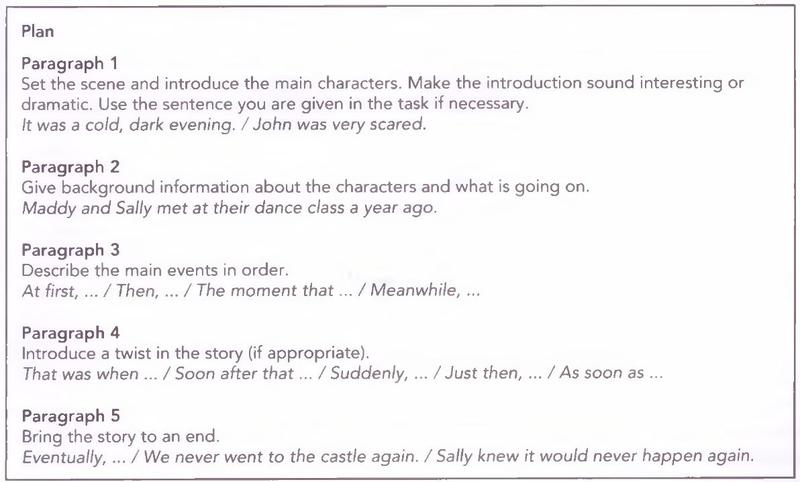
Close-up B1 Student's Book (Form 3), p.179 (Writing Reference: Story), cropped.
A story task often gives you the first sentence, for example Everyone was scared to death or Nobody knew where they were. You must use that sentence exactly as it is, and the story must follow from it. It tells you what the story is about, so decide quickly who the characters are and what the problem is.
Narrative tenses
| Tense | Use in a story | Example |
|---|---|---|
| Past simple | events one after another; moving the story on | He stopped, took out the phone and called his mum. |
| Past continuous | setting the scene; an action in progress when another happened | The family were sitting in the garden when they heard the blast. |
| Past perfect simple | something that happened before the main events | Toby had never been in such an extreme situation. |
| Past perfect continuous | an action in progress for some time before another past event; a cause | They were exhausted because they had been running for miles. |
Textbook: Unit 7 writing, p.92; see also Unit 2 of these notes.
Linking and ordering the events
| Job | Words | Example |
|---|---|---|
| start | First of all, At first | First of all, the actor came onto the stage. |
| two things at the same time | while, meanwhile | The audience listened while he sang. |
| one after another | then, after that, after, before | After he had finished, the curtain closed. |
| a twist or a sudden event | All of a sudden, Just then, That was when, At that point | All of a sudden, the lights went out. |
| last event | Finally, In the end, Eventually | In the end, everyone was safe. |
Textbook: Unit 10 writing, p.130; Unit 7 Useful Expressions, p.93; Writing Reference: Story, p.179.
Making a story interesting
| Technique | Example |
|---|---|
| dramatic opening sentence | Today was the day when Hannah was going to meet her sister for the first time. |
| descriptive adjectives and adverbs | He jumped quickly out of bed and opened the door nervously. |
| direct speech | 'Don't worry,' she said. 'Rescue teams are already looking for you.' |
| short dramatic sentence | He stopped and stared. |
| idiomatic expression | The two cousins have never seen eye to eye. |
| a twist | Something unexpected happens and changes the story. |
| words that create suspense | To make things worse, ... / They were just about to give up when ... / There was no sign of ... |
Textbook: Unit 12 writing, p.156; Unit 7 writing, pp.92 to 93. The examples are the textbook's, shortened.
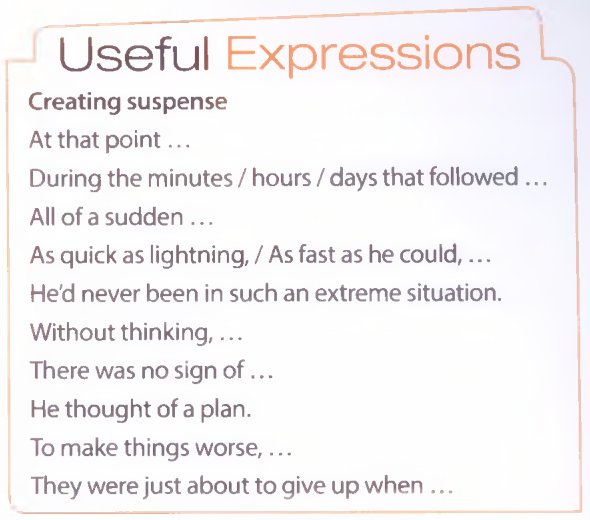
Close-up B1 Student's Book (Form 3), p.93 (Useful Expressions), cropped.
Changing to the present tense in the middle:
Forgetting the given sentence, or using it in a different form.
Telling the events as a list with no feelings. The Writing Reference reminds you to say how the people felt in the end.
Using and then ten times. Mix your linking words.
(a) Everyone was exhausted because they ______ (run / had been running) for miles.
(b) The family ______ (sat / were sitting) in the garden when they heard the blast.
(c) Jane could not believe that she ______ (made / had made) such a dangerous journey alone.
Show answerHide answer
11.4Writing a review
A review tells the reader what something is like and gives your opinion. It may be about a restaurant, a book, a film or a place. The Writing Reference says: think of a suitable title, catch the reader's attention in paragraph 1, and give a clear positive or negative opinion at the end.
| Part | What to do | Useful language (from the textbook) |
|---|---|---|
| Title | short, and says what the review is about | Gino's: a good choice for hungry shoppers |
| Paragraph 1 | introduce it; a question or a direct address catches the reader | Why not try ...? / If you like ... / ... is worth a try |
| Paragraphs 2 and 3 | describe it with details and examples | For example, ... / For instance, ... / On the other hand, ... / ... is ideal for ... |
| Last paragraph | give your opinion and a recommendation | I highly recommend ... / I wouldn't recommend ... / It's the perfect place for ... |
Textbook: Unit 2 writing, pp.26 to 27; Writing Reference: Review, p.180.
Adjectives in the right order
A review needs adjectives. When two or more come before a noun, put them in the order opinion, size, age, shape, colour, origin, material. When two adjectives are of the same kind, join them with and.
| Wrong | Right | Why |
|---|---|---|
| nice blue uniforms | opinion before colour | |
| the fantastic new Chinese restaurant | opinion, age, origin | |
| interesting modern pictures | opinion before age | |
| dirty old tablecloth | opinion before age |
Textbook: Unit 2 writing, p.26 (Ordering adjectives). Three of the sentences are from the textbook exercise.
Use different adjectives each time. The Exam Close-up on p.27 says that varied vocabulary makes writing more interesting, so avoid repeating nice and good.
| Describing food | Describing a place or service |
|---|---|
| positive: delicious, tasty, colourful, healthy | positive: trendy, bright, friendly |
| negative: bland, tasteless, bitter, undercooked, overcooked, unhealthy | negative: scruffy, dirty, old-fashioned, slow, rude, unfriendly, expensive |
Giving no reason:
Mixing opinions: a positive paragraph 2 and a final sentence that says you would not recommend it.
Ending without a recommendation. The reader wants to know if they should go.
Wrong adjective order:
Show answerHide answer
11.5Writing a report
A report gives information and recommendations to a reader in charge, such as the principal. It is more formal than a story or a review.
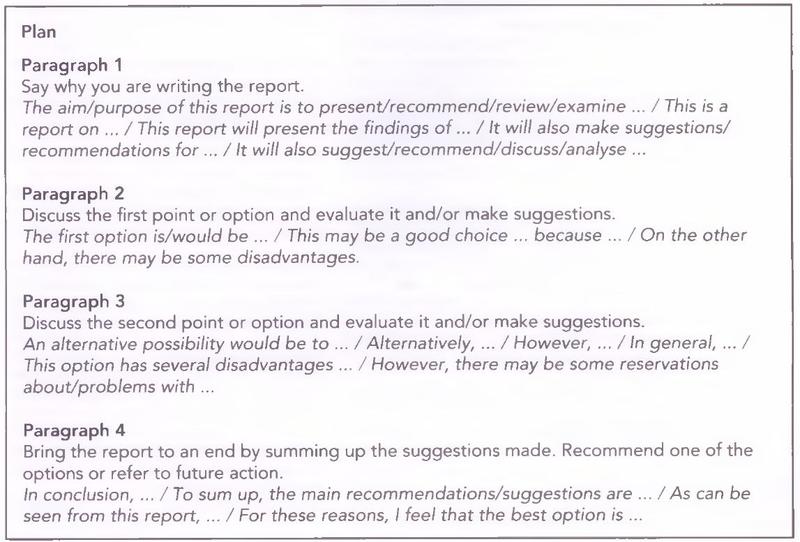
Close-up B1 Student's Book (Form 3), p.181 (Writing Reference: Report), cropped.
- Use a suitable title and a heading for each part.
- Use formal language and long forms: is not, not isn't; students felt, not kids said.
- Say the purpose: The aim of this report is to ... / This report will present the findings of ...
- For each point, give the opinion and then a suggestion: Students felt ... A better location would be ...
- End with To sum up, the main recommendations are ... or In conclusion, ...
Both, either and neither
These words are used in reports when you compare two things.
| Word | Meaning | Patterns |
|---|---|---|
| both | the two together, positive | both + plural noun; both of + plural noun; both A and B |
| either | one of the two | either + singular noun; either A or B |
| neither | not one and not the other, negative | neither + singular noun; neither A nor B |
Textbook: Unit 11 writing, p.144 (Remembering common errors).
Informal language:
Only problems and no suggestions. The task says "suggest how these could be improved".
No headings, so the reader cannot find the points quickly.
(a) The library is ______ big enough nor well equipped.
(b) We could move it to ______ the old science lab or the common room.
(c) ______ of these rooms are much bigger than the library.
Show answerHide answer
11.6Worked examples
These three texts use the plans above. They are written for these notes, and each has about 100 words.
It was a quiet Saturday afternoon and my cousins and I were playing board games at my grandmother's house in Taiping. Everyone was laughing when, all of a sudden, the lights went out.
At first, we thought it was a joke. Then we heard thunder and realised that a storm had knocked out the power. My grandmother had been cooking in the kitchen, so she hurried to find some candles.
In the end, we ate dinner by candlelight and told funny stories until the power came back. It was the most exciting evening I had ever had.
| Feature | Where you can see it |
|---|---|
| Scene and characters | paragraph 1: the afternoon, the house, my cousins and I |
| Narrative tenses | were playing (scene), went out (event), had knocked out and had been cooking (earlier) |
| Linking | all of a sudden, At first, Then, so, In the end, until |
| Ending with a feeling | the most exciting evening I had ever had |
Warung Pak Din: a friendly place for hungry students
Are you tired of the same old fast food? Why not try Warung Pak Din, the friendly little cafe near our school?
I went there with my friends last Friday for lunch. The nasi kerabu was colourful and tasty, and the grilled fish was fresh and spicy. The cafe is small, but it has bright red tables, cheerful pictures and polite young waiters.
The only problem is that it can be crowded at lunch time. However, the staff are helpful, and the prices are low, so it is ideal for students. I highly recommend it.
| Feature | Where you can see it |
|---|---|
| Title and attention | a title that names the place; a question in paragraph 1 (Why not try ...?) |
| Adjectives | colourful, tasty, fresh, spicy, bright red, cheerful, polite young (correct order) |
| Balance | one small problem (crowded) and then However, ... |
| Recommendation | I highly recommend it. |
The purpose of this report is to present the findings of a survey on two school facilities and to make suggestions for improvement.
Library
Most students think the library is too small. As a result, many of them do not use it. It would be a good idea to move it to the old science lab, which is much bigger.
Canteen
Students like the food, but they complained that the canteen is crowded. As a result, some students have too little time to eat. Either more tables or a longer break would help.
Conclusion
To sum up, the main recommendations are to move the library and to provide more tables in the canteen.
| Feature | Where you can see it |
|---|---|
| Purpose | first sentence: The purpose of this report is to ... |
| Two facilities, with headings | Library, Canteen |
| Opinion then suggestion | too small → move it; crowded → more tables or a longer break |
| Formal language, long forms | It would be a good idea, complained, provide |
| Summing up | To sum up, the main recommendations are ... |
11.7Checking your writing
The textbook's Exam Close-ups give three pieces of advice: leave yourself enough time, review the story or text carefully, and check your common errors list. Use the checklist below in the last few minutes.
| Check | Ask yourself |
|---|---|
| Task | Did I answer everything the task asked: given sentence, opinion, both facilities, suggestions? |
| Plan | Did I follow the paragraph plan for this text type? |
| Style | Informal for a story or review (but not texting language); formal for a report? |
| Tenses | Narrative tenses in a story; no change to the present by mistake? |
| Linking | At least three different linking words? |
| Language | Subject and verb agreement, adjective order, both / either / neither, articles, spelling, full stops? |
| Length | About 100 words (or the number in the task)? |
Textbook: Exam Close-ups, pp.27, 93, 131, 145, 157; checklists, Writing Reference pp.179 to 181.
Show answerHide answer
Summary
- Read the task first: text type, reader, what must be included, number of words.
- Plan one job for each paragraph; use the textbook plan for your text type.
- Story: use the given sentence, narrative tenses, linking words, a twist and an ending with feelings.
- Review: a title, an attention-getting opening, varied adjectives in the right order, and a clear recommendation.
- Report: formal language, a heading for each part, opinions and suggestions, and a summing up.
- Check your writing against the task, the plan, tenses, linking words and common errors.