Vocabulary for everyday topics
What this chapter covers
- I can name the topic of each of the 12 units and use the key words of that topic in my own sentences (12.1)
- I can use word formation to change a word into a noun, verb, adjective or adverb, and choose the right form for a gap (12.2)
- I can recognise the common endings of nouns (-tion, -ment, -ness, -er, -or), adjectives (-ful, -y, -ous, -ive, -al, -less) and adverbs (-ly) (12.2)
- I can complete collocations and expressions with make, do, take, keep, pay, get, have, fall and move (12.3)
- I can choose the correct preposition after common verbs and adjectives (12.4)
- I can explain common phrasal verbs and use them with the right meaning in a sentence (12.5)
- I can use a step-by-step method to answer vocabulary gap-fill questions (12.6)
Every unit of Close-up B1 Form 3 has a Vocabulary page. The words come back in the reading, listening and writing tasks. This chapter collects the vocabulary you need for everyday topics: topic words, word formation, collocations, prepositions and phrasal verbs. The book prints its own word lists on pages 184 to 186.
12.1Topic words: what each unit is about
Each unit opener names a topic. When you meet a question, first ask: which topic is this? Then think of the words you know for it.
| Unit | Topic | Useful words and phrases from the book |
|---|---|---|
| 1 Family Ties | family and relationships | pay a compliment, keep a secret, get married, get divorced, have a family, take after |
| 2 Food, Food, Food! | food and restaurants | delicious, bland, spicy, bitter, overcooked, undercooked, processed, grilled, fried, eat out |
| 3 The Wonders of Nature | environment | climate change, fossil fuels, solar power, renewable energy, natural habitat, power station |
| 4 Special Relationships | feelings and friends | respect, trust, jealous, ashamed, proud, let down, get on, hang out, break up |
| 5 A Place to Call Home | home | make a mess, make your bed, do the dishes, do the housework, take a bath, move house |
| 6 Ready, Steady, Go! | sport | competition, competitor, concentration, supervise, warm up, fall over |
| 7 Extreme Situations | danger and survival | keep calm, get lost, go missing, save someone's life, do your best, below freezing |
| 8 Time to Spare | free time | take up, try out for, show off, find out, cut out for, call for |
| 9 High-Tech World | technology and wildlife | log in, try out, endangered species, renewable energy, rely on, communicate with |
| 10 That's Entertainment | shows and music | sell out, turn up, turn down, turn on, turn off, catch on, give out |
| 11 Lessons to Learn | school and education | make progress, make an effort, break the rules, concentrate on, increase in |
| 12 The Body Beautiful | body and health | run out of, back away, hand over, head for, stand out, think over |
Show answerHide answer
12.2Word formation
One idea can have several forms: a noun, a verb, an adjective and an adverb. A gap-fill text gives you the base word in capitals, and you must choose the form that fits the sentence.
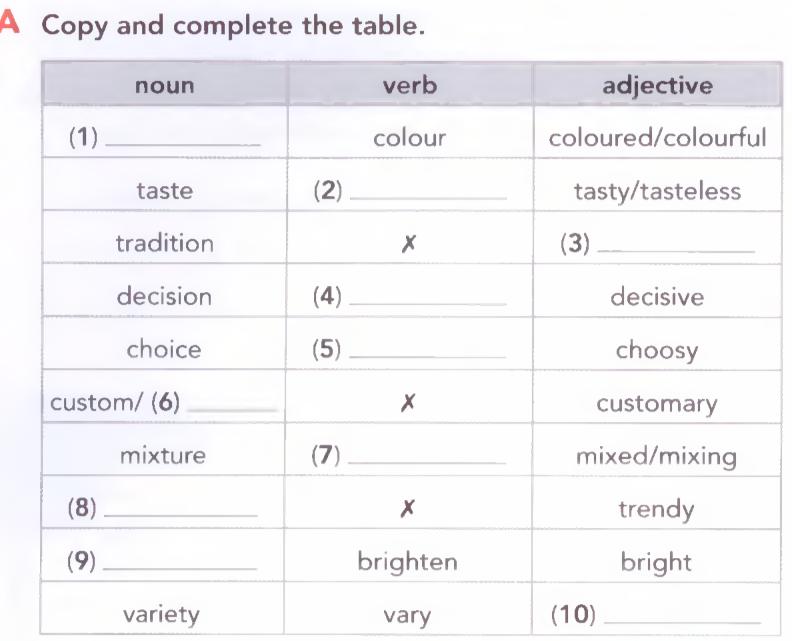
Close-up B1 Student's Book (Form 3), p.24, Word formation, task A.
The completed table of Unit 2 is:
| noun | verb | adjective |
|---|---|---|
| colour | colour | coloured, colourful |
| taste | taste | tasty, tasteless |
| tradition | - | traditional |
| decision | decide | decisive |
| choice | choose | choosy |
| custom, customer | - | customary |
| mixture | mix | mixed, mixing |
| trend | - | trendy |
| brightness | brighten | bright |
| variety | vary | various |
Unit 6 adds a column for the adverb:
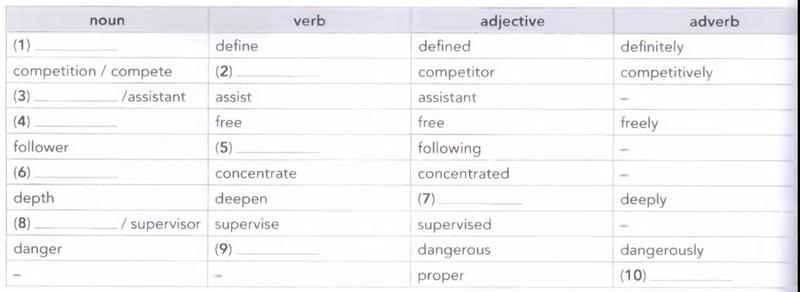
Close-up B1 Student's Book (Form 3), p.76, Word formation, task A.
| noun | verb | adjective | adverb |
|---|---|---|---|
| definition | define | defined | definitely |
| competition, competitor | compete | competitive | competitively |
| assistance, assistant | assist | assistant | - |
| freedom | free | free | freely |
| follower | follow | following | - |
| concentration | concentrate | concentrated | - |
| depth | deepen | deep | deeply |
| supervision, supervisor | supervise | supervised | - |
| danger | endanger | dangerous | dangerously |
| - | - | proper | properly |
Clues from the ending
| Word class | Common endings | Examples |
|---|---|---|
| noun | -tion, -sion, -ment, -ness, -ity, -ance, -er, -or, -ure | decision, assistance, brightness, variety, competitor, mixture |
| verb | -en, -ise, -ify, or the base word | deepen, brighten, supervise |
| adjective | -ful, -less, -y, -ous, -ive, -al, -ed, -ing | colourful, tasteless, tasty, various, decisive, traditional |
| adverb | -ly | freely, deeply, properly, competitively |
"Divers must train under the ___ of a professional. (SUPERVISE)"
The gap comes after the and before of, so it is a noun. The noun of supervise ends in -ion: supervision.
Show answerHide answer
12.3Collocations and expressions
The Collocations & Expressions list (p.184) groups words by the verb. Learn the whole phrase.
| Verb | Phrases | Unit |
|---|---|---|
| make | a mess, your bed, progress, an effort, a journey | 5, 7, 11 |
| do | the dishes, the housework, judo, your best | 5, 7, 9 |
| take | a bath, a break | 5 |
| keep | a diary, a secret, calm | 1, 7 |
| pay | a compliment, a visit | 1 |
| get | married, divorced, lost, the hang of something | 1, 7, 11 |
| have | a family, sympathy | 1 |
| fall | in love with somebody, to pieces | 1 |
| move | house, with the times | 5 |
| go | missing | 7 |
| Expression | Meaning |
|---|---|
| be in someone's good books | the person is pleased with you |
| break the rules | do what you are not supposed to do |
| get the hang of something | learn how to do something new |
| get a taste for something | start to enjoy it |
| move with the times | change as the world changes |
| break the ice | make people feel relaxed when they first meet |
| as quick as lightning | very fast |
| scared to death | very frightened |
Show answerHide answer
12.4Prepositions
Many verbs and adjectives need one fixed preposition (p.185). Learn them as pairs.
| Preposition | Phrases |
|---|---|
| about | talk about, worry about, concerned about, find information about |
| at | good at; at the moment; at the weekend |
| for | wait for, look for something, responsible for, apply for |
| from | suffer from, protect from, disappear from |
| in | interested in, successful in, increase in, appear in |
| of | proud of, jealous of, ashamed of, instead of |
| on | concentrate on, rely on, spend money on, expert on |
| to | listen to, belong to, similar to, close to, beneficial to |
| with | argue with, agree with, angry with, communicate with, cope with, satisfied with |
Prepositions of place and amount also appear in gap-fill texts: above sea level, below freezing, over 32 degrees Celsius, on the planet, in a desert, the top of the mountain.
Show answerHide answer
12.5Phrasal verbs
A phrasal verb is a verb plus a small word (a particle). The meaning is often different from the parts. The book's list is on p.186; here are the ones that appear most often, grouped by use.
| Group | Phrasal verb | Meaning |
|---|---|---|
| Friends and feelings (Unit 4) | look up to | admire, have respect for |
| get on | be friends | |
| let someone down | disappoint someone | |
| put someone down | make someone feel stupid | |
| make up / break up | forgive each other / separate | |
| Free time (Unit 8) | take up | begin a hobby |
| show off | behave in a boastful way | |
| try out for | audition | |
| find out | discover | |
| Entertainment (Unit 10) | sell out | run out of tickets for an event |
| turn up / turn down | increase / decrease the volume | |
| turn on / turn off | switch on / stop something working | |
| turn away | refuse admission | |
| catch on | become popular | |
| Body and health (Unit 12) | run out of | have no more of something left |
| back away | move slowly backwards | |
| hand over / hand out | give / give each person something | |
| head for | start moving towards a place | |
| think over / think up | consider carefully / come up with an idea |
Show answerHide answer
12.6A step-by-step method
- Read the whole sentence (or text) once to see the topic.
- Decide the word class the gap needs: noun, verb, adjective, adverb or preposition.
- Look for a fixed phrase: a verb that always takes the noun (make a mess), or a preposition that always follows the word (good at).
- Fit the form: tense, singular or plural, -ing or -ed.
- Read it again with your answer. Does it sound natural? Is the spelling right?
Keep a vocabulary notebook with the headings of this chapter. Write each new word with a short sentence of your own, not only its meaning.