Hugo : les aventures, les stars et la télévision (passé composé)
What this chapter covers
- I can tell what happened in the past with the passé composé with avoir (J'ai rencontré une star. Il a pris le train fantôme.), including irregular participles (pris, eu, dû, fait, vu) (5.1)
- I can say what I have already done or never done (J'ai déjà visité un parc d'attractions. Je n'ai jamais rencontré de star.) and make the negative with ne … pas and ne … jamais (5.1)
- I can use être as the auxiliary for the 14 verbs of movement and change and for pronominal verbs, and agree the participle with the subject (Elle est née à Chypre. Nous sommes nés le même jour.) (5.2)
- I can give biographical information about a famous person and name jobs in the world of television (animateur, chanteur, acteur, aventurier) (5.2)
- I can place events in time with en + year, d'abord, au début, ensuite, à la fin, pendant (5.3)
- {'I can count to infinity': 'write and say tens, hundreds, thousands and years in letters (quatre-vingts, deux cent cinq, mille huit cent cinquante-sept) (5.3)'}
- I can name the main French TV channels and kinds of programme (un match, le journal télévisé, une série, un dessin animé, un film, une émission de téléréalité) (5.4)
- I can read Roman numerals and say in which century and period of history a person lived (XVIIIe siècle, époque moderne) (5.5)
- I can hear and write the difference between the present and the passé composé (je parle / j'ai parlé, sounds [ə] and [e]) (5.6)
Module 5 of Adosphère 2 is called Hugo. Hugo is a French teenager who loves television and adventure, above all the game show Fort Boyard. In this module he tells his friends what happened to him yesterday, and you learn to talk about the past. By the end you can tell a short story with the passé composé, say when things happened (d'abord, ensuite, pendant, à la fin, en 1990), count to a thousand and beyond, and give the biography of a famous person. In the UASA paper these topics come back in Partie 1 (conjugate verbs in the passé composé, numbers in letters, vocabulary), Partie 2 (reading a biography or a short article, vrai ou faux) and Partie 3 (writing a short biography).
| Lesson | Book pages | You learn to |
|---|---|---|
| Leçon 1 : Les aventures d'Hugo | 62-63 | talk about a past experience; the passé composé with avoir; déjà and jamais |
| Leçon 2 : Mes personnalités préférées | 64-65 | give biographical information; the passé composé with être and agreement; the vocabulary of stars |
| Leçon 3 : Fort Boyard | 66-67 | place events in time; count to infinity (dates, thousands) |
| Leçon 4 : La télévision française | 68 | French channels and kinds of programme |
| Mon cours d'histoire | 69 | centuries, periods of history, Roman numerals |
| Entraîne-toi, Phonétique, Évaluation DELF | 70-72 | practice; the sounds [ə] and [e]; learning to learn; the word list (Ton dico) |
5.1Telling what happened: the passé composé with avoir
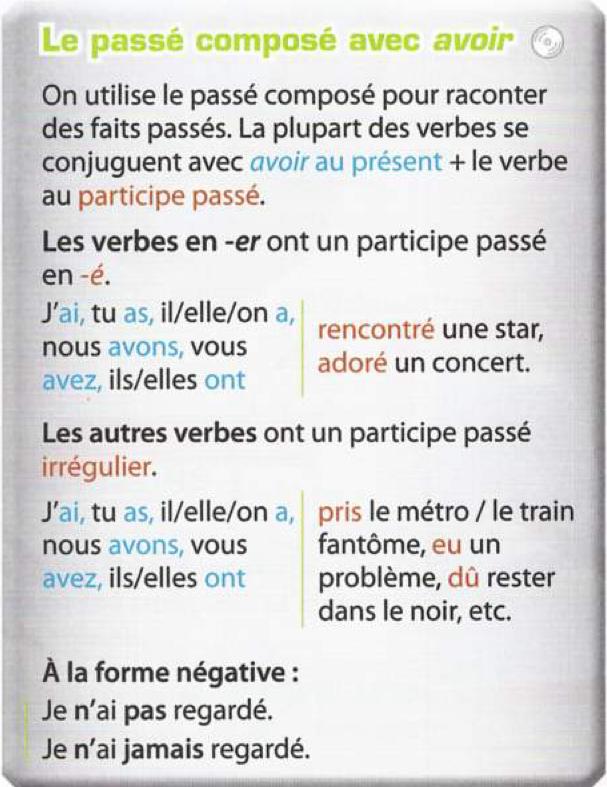
In Lesson 1 (p. 62) Hugo, Émilie and Jeanne are talking about stars they have met. Émilie has seen the singer Diam's in concert. Hugo met André Bouchet, the man who plays the character Passe-Partout in Fort Boyard, in a theme park (un parc d'attractions). The train ride broke down and Hugo had to stay twenty minutes in the dark among spiders and skeletons. Listen for the verbs in the dialogue: j'ai vu, j'ai parlé, j'ai pris, il y a eu, on a dû. They all tell facts that are finished, so they are in the passé composé.
Adosphère 2, p. 63
Auxiliary avoir in the present
| French | English | Example with a regular verb |
|---|---|---|
| j'ai | I have | J'ai regardé (I watched) |
| tu as | you have | Tu as adoré (you loved) |
| il / elle / on a | he / she / one has | Il a rencontré (he met) |
| nous avons | we have | Nous avons écouté (we listened) |
| vous avez | you have | Vous avez parlé (you spoke) |
| ils / elles ont | they have | Elles ont joué (they played) |
The past participle
| Kind of verb | How to form the participle | Examples (prendre, avoir, devoir, faire, voir are from the book) |
|---|---|---|
| Verbs in -er | remove -er, add -é | rencontrer → rencontré, adorer → adoré, parler → parlé, regarder → regardé, imaginer → imaginé, participer → participé |
| Other verbs (irregular) | learn each participle by heart | prendre → pris, avoir → eu, devoir → dû, faire → fait, voir → vu, être → été, entendre → entendu, apprendre → appris |
The negative: ne … pas and ne … jamais
The two negative words wrap the auxiliary, never the participle: Je n'ai pas regardé. (I did not watch.) Je n'ai jamais regardé Fort Boyard. (I have never watched it.) Before a vowel ne becomes n'.
Talking about experiences: déjà and jamais
| Question | Yes | No |
|---|---|---|
| Vous avez déjà rencontré une star ? Have you ever met a star? | Oui, j'ai déjà rencontré une star. Yes, I have already met one. | Non, je n'ai jamais rencontré de star. No, I have never met a star. |
(a) Je regarde un film.
(b) Nous prenons le train.
(c) Hugo n'aime pas les araignées.
(d) Vous voyez un fantôme ?
Show answerHide answer
(b) Nous avons pris le train.
(c) Hugo n'a pas aimé les araignées. (ne … pas around a)
(d) Vous avez vu un fantôme ? (voir → vu)
5.2Biographies: the passé composé with être
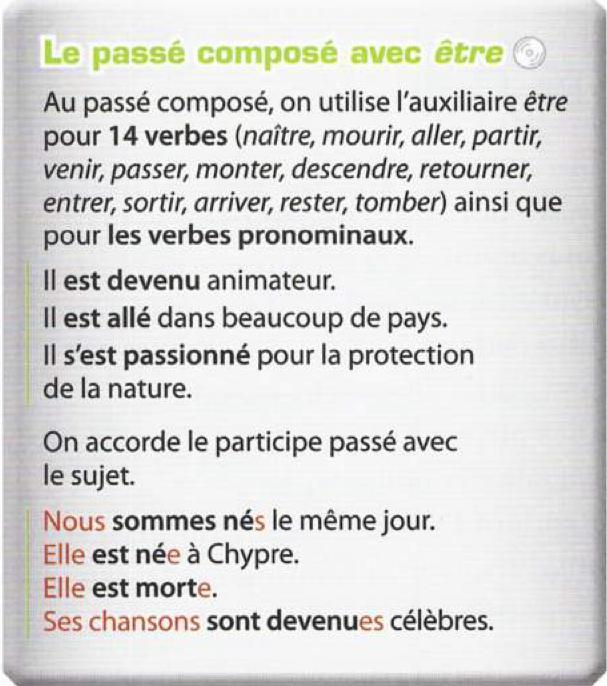
Lesson 2 (p. 64-65) is Hugo's personal page. He presents four people he likes, and each text uses verbs of movement and change: elle est née à Chypre, elle est arrivée en France, elle est allée en voyage, elle est revenue. These verbs do not use avoir. They use être as the auxiliary, and the participle then agrees with the subject.
Adosphère 2, p. 65
The 14 verbs that take être (and the pronominal verbs)
| Infinitive | Participle | English | Infinitive | Participle | English |
|---|---|---|---|---|---|
| naître | né | to be born | mourir | mort | to die |
| aller | allé | to go | partir | parti | to leave |
| venir | venu | to come | arriver | arrivé | to arrive |
| entrer | entré | to go in | sortir | sorti | to go out |
| monter | monté | to go up | descendre | descendu | to go down |
| rester | resté | to stay | tomber | tombé | to fall |
| retourner | retourné | to go back | passer | passé | to pass, to be shown (on TV) |
Agreement: the participle follows the subject
| Subject | Ending | Example (book p. 65) |
|---|---|---|
| masculine singular | nothing added | Il est devenu animateur. |
| feminine singular | + e | Elle est née à Chypre. Elle est morte. |
| masculine plural (or a mixed group) | + s | Nous sommes nés le même jour. (Hugo and a boy or a mixed pair) |
| feminine plural | + es | Ses chansons sont devenues célèbres. |
With avoir the participle does not agree with the subject: Elle a rencontré Diam's. (not
Four stars from Hugo's page (p. 64-65)
| Person | What you learn |
|---|---|
| André Bouchet (Passe-Partout) | born on 30 March, very small, became a TV presenter with Fort Boyard; his character is famous in thirty countries; also singer and actor |
| Diam's (real name Mélanie) | born in Cyprus, came to France at four; her songs became famous; she travelled to Africa and, when she came back, made the album Enfant du désert |
| Nicolas Hulot | presenter (animateur) of Ushuaïa Nature, programmes about nature |
| Cathy Sarraï | born in Tunisia, came to France in 1979 with her family, arrived on French television in 2005, many of her programmes were shown on M6, died in 2010 |
Vocabulary of stars (Lexique, p. 65 and Ton dico, p. 72)
| Masculine | Feminine | English |
|---|---|---|
| un animateur | une animatrice | presenter, host |
| un chanteur | une chanteuse | singer |
| un acteur | une actrice | actor |
| un aventurier | une aventurière | adventurer |
| un écrivain | un écrivain | writer (same word for men and women) |
| né(e), mort(e) | born, dead | |
| la biographie, célèbre, raconter | biography, famous, to tell | |
| une émission, une chaîne, une publicité, la téléréalité | programme, channel, advert, reality TV | |
(a) Diam's (naître) ______ à Chypre.
(b) Ses chansons (devenir) ______ célèbres.
(c) Hugo et sa mère (revenir) ______ en France.
(d) Elle (faire) ______ un album.
Show answerHide answer
(b) sont devenues (chansons is feminine plural)
(c) sont revenus (Hugo and his mother: masculine plural)
(d) a fait (faire takes avoir, so no agreement)
5.3Placing events in time: Fort Boyard
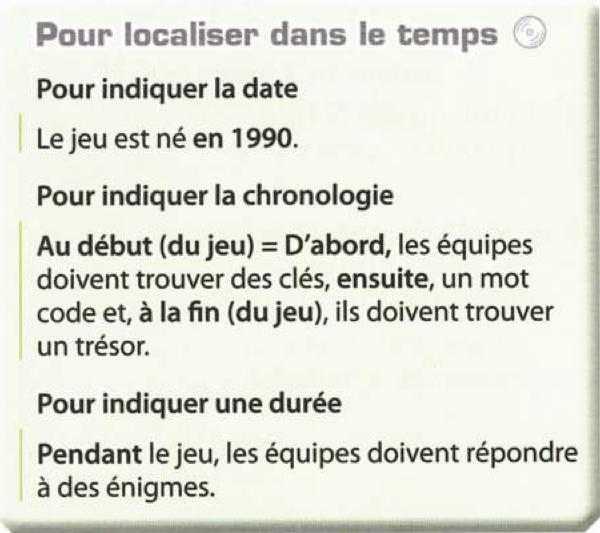
Lesson 3 (p. 66-67) presents the game show Fort Boyard. It was born in 1990 and still existed in 2011. The fort itself dates from 1857. Two teams of candidates (des candidats) go through tests (des épreuves) to find a treasure (un trésor). First they must find the largest number of keys, then a code word. At the end they collect boyards (gold coins) and can win ten thousand euros. During the show they must also solve the riddles (des énigmes) of le père Fouras.
Adosphère 2, p. 67
| You want to say | Use | Example |
|---|---|---|
| the date (year) | en + year | Le jeu est né en 1990. |
| the first step | d'abord / au début (du jeu) | D'abord, les équipes cherchent des clés. |
| the next step | ensuite | Ensuite, elles trouvent un mot code. |
| the last step | à la fin (du jeu) | À la fin, elles gagnent des boyards. |
| how long (during) | pendant + noun | Pendant l'émission, il y a des énigmes. |
Counting to infinity (compter jusqu'à l'infini)
| Number | French | Number | French |
|---|---|---|---|
| 20 | vingt | 70 | soixante-dix (60 + 10) |
| 30 | trente | 80 | quatre-vingts (4 × 20) |
| 40 | quarante | 90 | quatre-vingt-dix (4 × 20 + 10) |
| 50 | cinquante | 100 | cent |
| 60 | soixante | 1 000 | mille |
| 1 000 000 | un million | ||
- Join the tens and units with a hyphen: vingt-deux, trente-cinq, soixante-dix-sept. (With 21, 31, 41, 51, 61, 71 you say et un / et onze: vingt et un, soixante et onze; the 1990 reform also allows hyphens. Be consistent.)
- quatre-vingts and cent take an s only when they are multiplied and nothing follows: quatre-vingts (80), deux cents (200); but quatre-vingt-dix (90), quatre-vingt-trois (83), deux cent cinq (205), cent un (101).
- mille never takes an s: deux mille (2 000), trois mille sept cent cinquante (3 750).
- million is a noun and takes an s: deux millions.
Reading a year
| Year | French |
|---|---|
| 1857 (the fort) | mille huit cent cinquante-sept |
| 1990 (the start of the show) | mille neuf cent quatre-vingt-dix |
| 1789 | mille sept cent quatre-vingt-neuf |
| 2011 | deux mille onze |
(b) Fill in: ______, les candidats cherchent des clés. ______, ils trouvent un mot code. ______ le jeu, ils répondent aux énigmes. (ensuite / d'abord / pendant)
Show answerHide answer
(b) D'abord / Ensuite / Pendant
5.4French television (la télévision française)
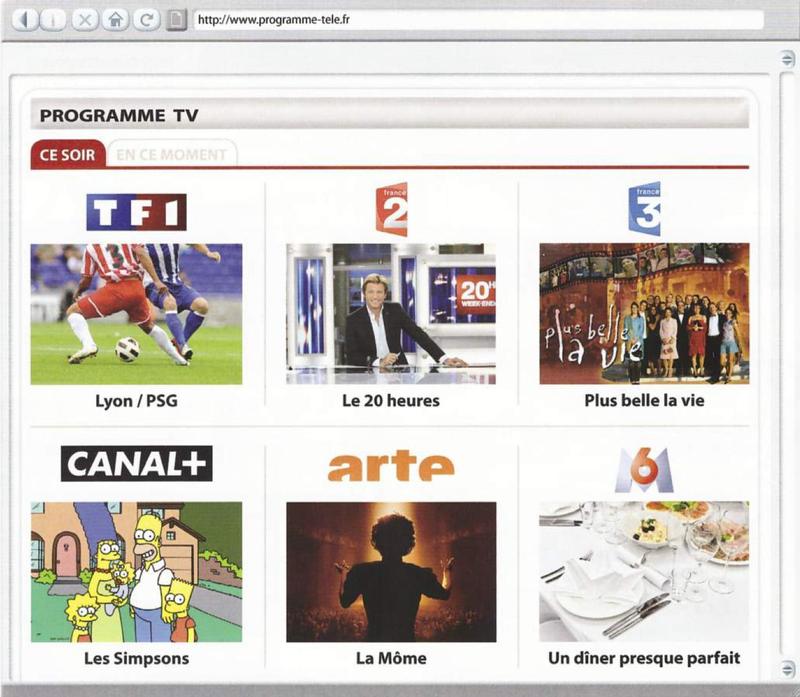
Lesson 4 (p. 68) shows the evening programme page of a French website. Each channel (une chaîne) has a logo and one programme for tonight. You must be able to name the channels and the kind of programme (le genre).
Adosphère 2, p. 68
| Channel | Programme | Genre | English |
|---|---|---|---|
| TF1 | Lyon / PSG | un match | a football match |
| France 2 | Le 20 heures | le journal télévisé | the TV news |
| France 3 | Plus belle la vie | une série | a series |
| Canal+ | Les Simpsons | un dessin animé | a cartoon |
| Arte | La Môme | un film | a film |
| M6 | Un dîner presque parfait | une émission de téléréalité | a reality show |
Show answerHide answer
5.5My history lesson: centuries and periods
The history page (p. 69) links four famous French people to their texts and to a timeline: Louis XVI (a king who lost his head in the Revolution), Coco Chanel (a fashion designer of the 1920s and 1930s), Jeanne d'Arc (who fought the English between 1429 and 1431) and Victor Hugo (a great writer, died in 1885). The page asks you to decide in which century (le siècle) each person lived.

Adosphère 2, p. 69
| Period | French | Centuries |
|---|---|---|
| Middle Ages | le Moyen Âge | VIe - XVe |
| Renaissance | la Renaissance | XVe - XVIe |
| Modern period | l'époque moderne | XVIIe - XVIIIe |
| Contemporary period | l'époque contemporaine | XIXe - XXIe |
The Revolution (la Révolution, 1789) is the break between the modern and the contemporary periods.
Roman numerals and the century of a year
| Number | Roman | Number | Roman |
|---|---|---|---|
| 3 | III | 10 | X |
| 4 | IV (5 - 1) | 16 | XVI (10 + 5 + 1) |
| 5 | V | 18 | XVIII |
| 9 | IX (10 - 1) | 20, 21 | XX, XXI |
Writing 1857 as the XVIIIe century: remember that 18xx belongs to the nineteenth century.
Mixing up IV (4) and VI (6), or IX (9) and XI (11): a smaller numeral before a larger one is subtracted.
(b) In which century and period did Victor Hugo die (1885)?
Show answerHide answer
(b) 18 + 1 = 19: le XIXe siècle, l'époque contemporaine
5.6Sounds [ə] and [e], and learning to learn
Pages 63 and 71 train your ear on the difference between the present and the passé composé. Most of the time it is the same letters: je parle / j'ai parlé.
| Sound | Spelling | Example |
|---|---|---|
| [ə] (a weak, round e) | e in je, le, ne | je parle (je has [ə]; the final -e of parle is silent) |
| [e] (a clear ay) | é, -er, -ez, and the auxiliary j'ai | j'ai parlé, j'ai écouté, j'ai regardé, j'ai joué |
5.7Word list (Ton dico, p. 72)
| Group | Words |
|---|---|
| Time | d'abord, au début de, ensuite, pendant, à la fin de |
| Places and things | le parc d'attractions, le squelette, l'araignée (f.), le fantôme |
| People | l'animateur, l'acteur, le chanteur, l'aventurier, l'écrivain, le candidat |
| Biography | l'autographe, la star, célèbre, né(e), mort(e), la biographie, raconter |
| Movement verbs (être) | rester, passer, monter, descendre, retourner, entrer, sortir |
| The game | le candidat, l'énigme, la solution, le trésor, l'épreuve |
| History | le Moyen Âge, la Renaissance, la Révolution, le siècle, la guerre |
Summary
| Topic | Remember |
|---|---|
| Passé composé | present of avoir or être + past participle; it tells finished facts |
| With avoir | most verbs; -er → -é; irregular pris, eu, dû, fait, vu, été; no agreement with the subject |
| With être | 14 verbs (naître, mourir, aller, partir, venir, passer, monter, descendre, retourner, entrer, sortir, arriver, rester, tomber) and the pronominal verbs; the participle agrees with the subject: né, née, nés, nées |
| Negative | je n'ai pas regardé, je n'ai jamais regardé, je n'ai jamais vu de fantôme |
| Experience | Tu as déjà…? – Oui, j'ai déjà… / Non, je n'ai jamais… |
| Time | en 1990, d'abord / au début, ensuite, à la fin, pendant |
| Numbers | vingt, trente, quarante, cinquante, soixante, soixante-dix, quatre-vingts, quatre-vingt-dix, cent, mille, un million; mille never takes s; quatre-vingts and cents only when nothing follows |
| Centuries | year → hundreds + 1 → Roman numeral + e siècle; 1789 is the XVIIIe |
| Television | une chaîne, une émission, un match, le journal télévisé, une série, un dessin animé, un film, la téléréalité |
| Sounds | je parle [ə] (silent end) / j'ai parlé [e] |
1.
2.
3.
4.
5.