Bahasa Perancis questions, module 1
Nama / NameKelas / ClassTarikh / Date
Hugo : les aventures, les stars et la télévision (passé composé)
44 marks. Use Practice to check each answer as you go, or Exam to answer everything first. The item types follow the school UASA paper: multiple choice, Partie 1 (passé composé, participles, numbers in letters, TV vocabulary), Partie 2 (vrai ou faux, a biography, the periods of history) and Partie 3 (a short biography).
Section A: choix multiple
10 marksChoisissez la bonne réponse A, B, C ou D. Choose the correct answer A, B, C or D.
1
Question 1
Hier, Hugo a ______ une star. Yesterday Hugo met a star. Choose the right form.
Show answerHide answer
A
Rencontrer is an -er verb, so the participle ends in -é: Hugo a rencontré une star. The infinitive rencontrer cannot follow a.
2
Question 2
Quelle phrase est au passé composé ? Which sentence is in the passé composé?
Show answerHide answer
C
The passé composé = avoir in the present + a participle: il a regardé. A is the present, B the near future and D the future.
3
Question 3
Choisissez le bon mot. Choose the right word.
Jeanne n'a ______ regardé le jeu Fort Boyard.
Jeanne n'a ______ regardé le jeu Fort Boyard.
Show answerHide answer
B
ne … jamais means "never": Jeanne n'a jamais regardé Fort Boyard. Déjà ("already") cannot go with ne.
4
Question 4
Choisissez la bonne forme. Choose the correct form.
Diam's ______ en France à l'âge de quatre ans.
Diam's ______ en France à l'âge de quatre ans.
Show answerHide answer
D
Arriver takes être, and Diam's is a woman, so the participle takes an -e: est arrivée.
5
Question 5
Choisissez la bonne forme. Choose the correct form.
Cathy Sarraï ______ en France en 1979 avec sa famille.
Cathy Sarraï ______ en France en 1979 avec sa famille.
Show answerHide answer
B
Venir takes être, and Cathy is a woman, so the participle takes an -e: est venue. A has no -e; C and D use avoir.
6
Question 6
Trouvez l'intrus : quel verbe n'est pas conjugué avec « être » au passé composé ? Find the odd one out: which verb is not conjugated with "être" in the passé composé?
Show answerHide answer
D
Prendre takes avoir (j'ai pris). Naître, aller and arriver are among the 14 verbs with être.
7
Question 7
Quel mot signifie « at first » ? Which word means "at first"?
Show answerHide answer
A
D'abord = at first (the book: au début = d'abord). Pendant = during, à la fin = at the end.
8
Question 8
Quel nombre est « XVI » ? Which number is "XVI"?
Show answerHide answer
C
X = 10, V = 5, I = 1: 10 + 5 + 1 = 16. (4 is IV, 6 is VI, 11 is XI.)
9
Question 9
Quelle phrase est correcte ? Which sentence is correct?
Show answerHide answer
B
B uses être and the plural -s. A needs est allée; C needs sommes arrivés (arriver takes être); D needs allée because elle is feminine.
10
Question 10
Comment écrit-on 1990 en lettres ? How do you write 1990 in letters?
Show answerHide answer
D
cent takes no s when another number follows, quatre-vingt-dix (90) has no s and is joined with hyphens: mille neuf cent quatre-vingt-dix.
Section B: grammaire et vocabulaire (Partie 1)
16 marksRépondez à toutes les questions. Answer all the questions.
11
Question 11
Mettez les phrases au passé composé. Put the sentences in the passé composé.
Example: Je parle avec Hugo. → J'ai parlé avec Hugo.
Example: Je parle avec Hugo. → J'ai parlé avec Hugo.
[1 mark]
(a)Je regarde un film.
Show answerHide answer
regarder → regardé, with j'ai.
Tick each point you got.
[1 mark]
(b)Nous mangeons au restaurant.
Show answerHide answer
Tick each point you got.
[1 mark]
(c)Hugo n'aime pas les araignées.
Show answerHide answer
ne … pas goes round the auxiliary a.
Tick each point you got.
[1 mark]
(d)Elles racontent une histoire.
Show answerHide answer
Tick each point you got.
12
Question 12
Écrivez le participe passé du verbe entre parenthèses. Write the past participle of the verb in brackets.
Example: Hier, j'ai rencontré Jeanne. (rencontrer)
Example: Hier, j'ai rencontré Jeanne. (rencontrer)
[1 mark]
(a)Hier, j'ai ______ le train fantôme. (prendre)
Show answerHide answer
Tick each point you got.
[1 mark]
(b)Il y a ______ un problème. (avoir)
Show answerHide answer
avoir → eu; il y a eu = there was.
Tick each point you got.
[1 mark]
(c)Nous avons ______ rester vingt minutes dans le noir. (devoir)
Show answerHide answer
dû has the circumflex, du means "of the".
Tick each point you got.
[1 mark]
(d)Tu as ______ un album ? (faire)
Show answerHide answer
Tick each point you got.
13
Question 13
Complétez la biographie de Zoé avec les verbes au passé composé. Complete the biography of Zoé with the verbs in the passé composé.
Zoé Lambert
Zoé (naître) ______ (1) à Lyon en 1995. Sa famille (partir) ______ (2) au Canada en 2000. Là-bas, elle (faire) ______ (3) un album. Ensuite, elle (devenir) ______ (4) chanteuse.
[1 mark]
(1)Gap (1)
Show answerHide answer
naître takes être; Zoé is a girl.
Tick each point you got.
[1 mark]
(2)Gap (2)
Show answerHide answer
Tick each point you got.
[1 mark]
(3)Gap (3)
Show answerHide answer
Tick each point you got.
[1 mark]
(4)Gap (4)
Show answerHide answer
Tick each point you got.
14
Question 14
Regardez le programme télé et choisissez le genre de chaque émission. Look at the TV listing and choose the kind of programme.
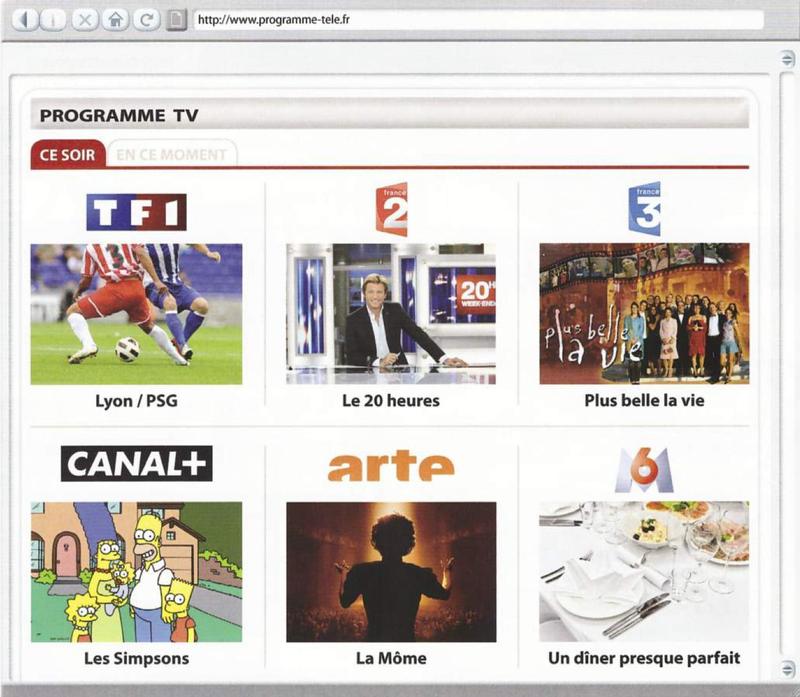
[1 mark]
(a)Lyon / PSG (TF1)
Show answerHide answer
un match
Lyon and PSG are football clubs: un match.
[1 mark]
(b)Le 20 heures (France 2)
Show answerHide answer
le journal télévisé
The 8 p.m. news on France 2.
[1 mark]
(c)Les Simpsons (Canal+)
Show answerHide answer
un dessin animé
A cartoon family.
[1 mark]
(d)Un dîner presque parfait (M6)
Show answerHide answer
une émission de téléréalité
Ordinary people compete at dinner: a reality show.
Section C: compréhension écrite (Partie 2)
12 marksLisez les documents et répondez. Read the documents and answer.
15
Question 15
Lisez le texte et répondez « Vrai » ou « Faux ». Read the text and answer "Vrai" (true) or "Faux" (false).
Le jeu Fort Boyard
Fort Boyard est un jeu de télévision. Il est né en 1990. Deux équipes de candidats participent à des épreuves. D'abord, elles cherchent des clés. Ensuite, elles doivent trouver un mot code. À la fin, une équipe gagne des boyards : ce sont des pièces d'or.
[1 mark]
(a)Le jeu est né en 1990.
Show answerHide answer
Vrai
Il est né en 1990.
[1 mark]
(b)Il y a trois équipes.
Show answerHide answer
Faux
There are two teams (deux équipes).
[1 mark]
(c)D'abord, les équipes cherchent un mot code.
Show answerHide answer
Faux
First they look for keys (des clés); the code word comes ensuite.
[1 mark]
(d)Les boyards sont des pièces d'or.
Show answerHide answer
Vrai
des pièces d'or = gold coins.
16
Question 16
Lisez la biographie et répondez aux questions. Read the biography and answer the questions.
Marc Duval, aventurier
Marc Duval est né en 1980 à Marseille. À l'âge de vingt ans, il est parti en Amérique du Sud. D'abord, il a travaillé dans un restaurant. Ensuite, il a traversé la forêt avec une équipe et il a eu un grand problème. À la fin, il est revenu en France et il a raconté son aventure à la télé. Aujourd'hui, il est animateur sur la chaîne M6.
[1 mark]
(a)En quelle année est-ce que Marc est parti en Amérique du Sud ? In which year did Marc leave for South America?
Show answerHide answer
He was born in 1980 and left at twenty.
Tick each point you got.
[1 mark]
(b)Qu'est-ce que Marc a fait d'abord, en Amérique du Sud ? What did Marc do first in South America?
Show answerHide answer
D'abord marks the first step.
Tick each point you got.
[2 marks]
(c)Relevez deux verbes conjugués avec « être » au passé composé. Copy two verbs conjugated with "être" in the passé composé.
Show answerHide answer
est né, est parti, est revenu all use être; the subject is masculine so there is no -e.
Tick each point you got.
17
Question 17
Observez la frise du document C et choisissez l'époque. Look at the timeline of document C and choose the period.

[1 mark]
(a)Victor Hugo est mort en 1885.
Show answerHide answer
l'époque contemporaine
1885 is the XIXe century (18 + 1), which belongs to the contemporary period.
[1 mark]
(b)Louis XVI a vécu au XVIIIe siècle.
Show answerHide answer
l'époque moderne
XVIIe-XVIIIe = modern period.
[1 mark]
(c)Un chevalier a vécu au XIIe siècle.
Show answerHide answer
le Moyen Âge
The Middle Ages run from the VIe to the XVe century.
[1 mark]
(d)Un artiste a vécu en 1550.
Show answerHide answer
la Renaissance
1550 → 15 + 1 = XVIe siècle, the Renaissance.
Section D: production écrite (Partie 3)
6 marksÉcrivez en français. Write in French.
18
Question 18
Écrivez une petite biographie de vous-même (40 à 55 mots) au passé composé. Write a short biography of yourself (40 to 55 words) in the passé composé.
- Dites où et quand vous êtes né(e). Say where and when you were born.
- Racontez deux événements de votre vie avec « avoir ». Tell two events with "avoir".
- Racontez un voyage ou un déménagement avec « être ». Tell a trip or a move with "être".
- Utilisez au moins deux mots comme « d'abord », « ensuite », « pendant », « en… ». Use at least two time words.
[6 marks]
(a)Your biography
Show answerHide answer
Model answer: Je suis née en 2010 à Kuala Lumpur. À l'âge de cinq ans, je suis allée à l'école. D'abord, j'ai appris à lire ; ensuite, j'ai joué du piano. Pendant les vacances, nous sommes partis à Penang et j'ai vu la mer. En 2023, j'ai commencé le français. (about 50 words)
Tick each point you got.