Bahasa Perancis questions, module 4
Nama / NameKelas / ClassTarikh / Date
Jeanne : la météo, les saisons et l'avenir
44 marks. Use Practice to check each answer as you go, or Exam to answer everything first. The item types follow the school UASA paper: multiple choice, Partie 1 (futur simple, comparisons, weather maps), Partie 2 (a text on Mars, vrai ou faux, a table to read) and Partie 3 (a short text about 2030).
Section A: choix multiple
10 marksChoisissez la bonne réponse A, B, C ou D. Choose the correct answer A, B, C or D.
1
Question 1
Il y a de l'eau qui tombe du ciel. Quelle phrase est correcte ? Water is falling from the sky. Which sentence is correct?
Show answerHide answer
B
Il pleut = it is raining. Il neige is for snow.
2
Question 2
Quand le pôle Nord est plus près du Soleil, quelle saison est-ce dans l'hémisphère nord ? When the North Pole is nearer the Sun, which season is it in the northern hemisphere?
Show answerHide answer
C
Nearer the Sun means hot: c'est l'été (summer), as in France in the dialogue.
3
Question 3
Complétez : « Les pays près de l'équateur sont des pays… » Complete: "Countries near the equator are countries…"
Show answerHide answer
A
They always face the Sun, so it is always hot, it never snows and there is no spring or autumn.
4
Question 4
Choisissez le bon mot. Choose the right word.
Je voudrais visiter un pays ______ il pleut beaucoup.
Je voudrais visiter un pays ______ il pleut beaucoup.
Show answerHide answer
D
A country is a place, and the second part is a full sentence (il pleut), so the relative pronoun of place où is needed.
5
Question 5
Choisissez la bonne forme du futur simple. Choose the correct futur simple form.
Demain, nous ______ de la vie sur Mars.
Demain, nous ______ de la vie sur Mars.
Show answerHide answer
B
nous + parler- + -ons = nous parlerons. Parlons is the present.
6
Question 6
Choisissez la bonne forme. Choose the correct form.
En 2030, dans ma chambre, j'______ un mur écran.
En 2030, dans ma chambre, j'______ un mur écran.
Show answerHide answer
C
Avoir (to have) has the irregular stem aur-: j'aurai un mur écran (Jeanne's page, p. 100). Serai is être, irai is aller, ferai is faire.
7
Question 7
Quelle phrase est correcte ? Mars is smaller than the Earth. Which sentence says this correctly in French?
Show answerHide answer
A
moins + adjective + que. B says the opposite, and de is never used with an adjective (C, D).
8
Question 8
Choisissez la bonne réponse. Choose the right answer.
La planète rouge a deux lunes et la Terre une lune. Mars a ______ lunes que la Terre.
La planète rouge a deux lunes et la Terre une lune. Mars a ______ lunes que la Terre.
Show answerHide answer
D
Mars has more moons, and lunes is a noun, so plus de … que.
9
Question 9
Trouvez l'intrus : une de ces choses n'est pas une planète. Find the odd one out: one of these is not a planet.
Show answerHide answer
C
The Moon turns around the Earth; Venus, Mars and the Earth turn around the Sun, so they are planets.
10
Question 10
Quelle phrase est correcte ? Which sentence is correct?
Show answerHide answer
A
B: tu needs -as (tu voyageras). C: plural subject needs -ont (existeront). D: je needs -ai (j'irai).
Section B: grammaire et vocabulaire (Partie 1)
17 marksRépondez à toutes les questions. Answer all the questions.
11
Question 11
Conjuguez les verbes au futur simple. Put the verbs in the futur simple.
Example: Plus tard, nous parlerons (parler) martien.
Example: Plus tard, nous parlerons (parler) martien.
[1 mark]
(a)Demain, je ______ (visiter) le musée.
Show answerHide answer
Tick each point you got.
[1 mark]
(b)Tu ______ (prendre) le taxi volant ?
Show answerHide answer
Verbs in -re lose the final e: prendr-.
Tick each point you got.
[1 mark]
(c)Nous ______ (transmettre) la liste à mon portable.
Show answerHide answer
Tick each point you got.
[1 mark]
(d)Les robots ______ (aider) beaucoup à la maison.
Show answerHide answer
les robots = ils: -ont.
Tick each point you got.
[1 mark]
(e)Vous ______ (regarder) des films en quatre dimensions.
Show answerHide answer
Tick each point you got.
12
Question 12
Écrivez la forme du futur simple. Attention aux radicaux irréguliers. Write the futur simple form. Watch the irregular stems.
[1 mark]
(a)nous (aller)
Show answerHide answer
Stem ir- + -ons.
Tick each point you got.
[1 mark]
(b)il y a → il y ______ (avoir)
Show answerHide answer
Stem aur- + -a: il y aura = there will be.
Tick each point you got.
[1 mark]
(c)vous (être)
Show answerHide answer
Tick each point you got.
[1 mark]
(d)elles (faire)
Show answerHide answer
Tick each point you got.
13
Question 13
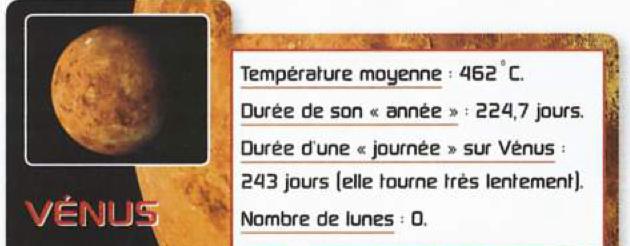
Comparez Vénus à Mars avec « plus » ou « moins » (+ « de » si nécessaire) et « que ». Compare Venus with Mars with "plus" or "moins" (+ "de" if needed) and "que".
| Mars | Vénus | |
|---|---|---|
| Température moyenne | -63 °C | 462 °C |
| Une année | 686 jours | 224,7 jours |
| Un jour | 24 h 37 min | 243 jours |
| Lunes | 2 | 0 |
[1 mark]
(a)Vénus est ______ chaude ______ Mars.
Show answerHide answer
462 °C is higher than -63 °C.
Tick each point you got.
[1 mark]
(b)Vénus a ______ lunes ______ Mars.
Show answerHide answer
0 moons against 2; a noun needs de.
Tick each point you got.
[1 mark]
(c)L'année de Vénus est ______ longue ______ l'année de Mars.
Show answerHide answer
224.7 days is shorter than 686 days.
Tick each point you got.
[1 mark]
(d)Un jour sur Vénus est ______ long ______ un jour sur Mars.
Show answerHide answer
243 days is longer than 24 h 37 min.
Tick each point you got.
[1 mark]
(e)Calculate how many degrees warmer Venus is than Mars.
Show answerHide answer
Subtracting a negative number means adding.
Tick each point you got.
14
Question 14
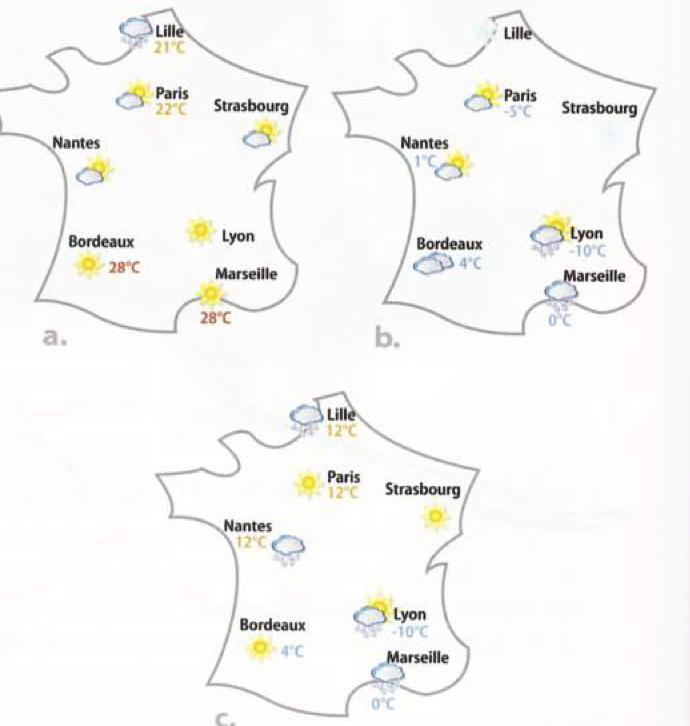
Associez chaque phrase à la bonne carte. Match each sentence with the right map.
[1 mark]
(a)Il fait très chaud à Bordeaux et à Marseille : vingt-huit degrés.
Show answerHide answer
a
Bordeaux 28 °C and Marseille 28 °C are on map a.
[1 mark]
(b)À Paris, il fait moins cinq degrés.
Show answerHide answer
b
Paris -5 °C is on map b.
[1 mark]
(c)À Paris et à Lille, il fait douze degrés.
Show answerHide answer
c
Paris 12 °C and Lille 12 °C are on map c.
Section C: compréhension écrite (Partie 2)
11 marksLisez les documents et répondez. Read the documents and answer.
15
Question 15
Lisez le texte et répondez « Vrai » ou « Faux ». Read the text and answer "Vrai" (true) or "Faux" (false).
Mars
Mars est une planète rouge. Elle est deux fois moins grande que la Terre. Un jour martien dure vingt-quatre heures et trente-sept minutes : c'est un peu plus long qu'un jour terrestre. Mars est loin du Soleil, donc l'année martienne est de six cent quatre-vingt-six jours et il fait très froid : moins soixante-trois degrés en moyenne. Il n'y a pas d'eau à la surface, mais il y a de la glace dans le sol.
[1 mark]
(a)Mars est plus grande que la Terre.
Show answerHide answer
Faux
Mars is deux fois moins grande than the Earth.
[1 mark]
(b)Un jour sur Mars dure un peu plus de 24 heures.
Show answerHide answer
Vrai
vingt-quatre heures et trente-sept minutes.
[1 mark]
(c)Il fait plus chaud sur Mars que sur la Terre.
Show answerHide answer
Faux
The average is -63 °C: it is much colder.
[1 mark]
(d)L'année martienne est plus longue que l'année terrestre.
Show answerHide answer
Vrai
686 days is longer than an Earth year.
[1 mark]
(e)Il y a de l'eau liquide à la surface de Mars.
Show answerHide answer
Faux
There is no water on the surface; there is ice in the ground.
16
Question 16
Relisez le texte sur Mars et répondez. Read the text on Mars again and answer.
[1 mark]
(a)Pourquoi est-ce qu'il fait très froid sur Mars ? Why is it so cold on Mars?
Show answerHide answer
Tick each point you got.
[1 mark]
(b)Où est l'eau de Mars ? Where is the water of Mars?
Show answerHide answer
Tick each point you got.
[1 mark]
(c)The year on Venus lasts 224.7 days. How many days longer is the year on Mars (686 days)?
Show answerHide answer
Tick each point you got.
17
Question 17
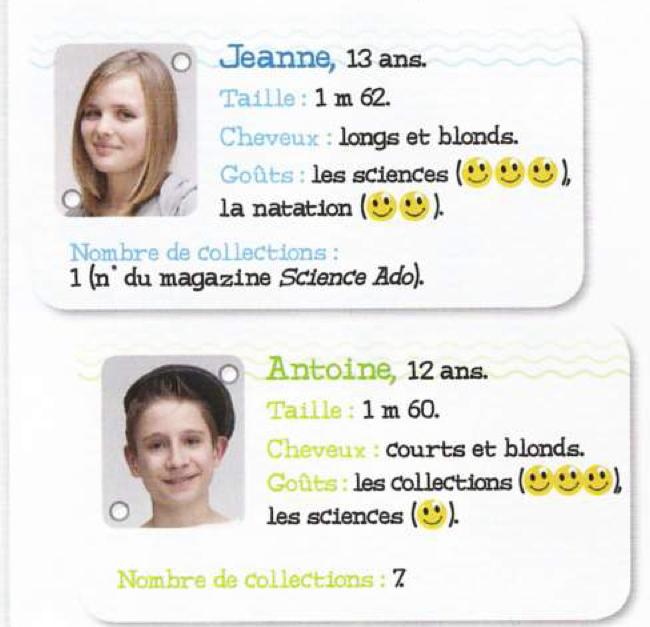
Regardez les deux fiches et complétez avec « plus », « moins », « de », « que » ou « qu' ». Look at the two cards and complete with "plus", "moins" or "de", "que" or "qu'".
[1 mark]
(a)Jeanne est ______ grande ______ Antoine.
Show answerHide answer
1 m 62 is taller than 1 m 60.
Tick each point you got.
[1 mark]
(b)Antoine a ______ collections ______ Jeanne.
Show answerHide answer
7 collections against 1.
Tick each point you got.
[1 mark]
(c)Antoine est ______ jeune ______ Jeanne.
Show answerHide answer
Antoine is 12 and Jeanne is 13, so he is younger. The adjective takes no de.
Tick each point you got.
Section D: production écrite (Partie 3)
6 marksÉcrivez en français. Write in French.
18
Question 18
Répondez à l'annonce du magazine « Science Ado » : « Comment imaginez-vous l'ado de 2030 ? » Écrivez cinq phrases. Reply to the magazine announcement "How do you imagine the teenager of 2030?" Write five sentences.
- Utilisez le futur simple. Use the futur simple.
- Utilisez un verbe irrégulier (être, avoir, aller, faire, pouvoir). Use an irregular verb (être, avoir, aller, faire, pouvoir).
- Utilisez une comparaison ou « où ». Use a comparison or "où".
[6 marks]
(a)Your five sentences
Show answerHide answer
Model answer: En 2030, les ados auront des murs écrans dans leur chambre. Ils iront au collège en taxi volant. Les robots feront le ménage, donc nous aurons plus de temps libre que maintenant. Nous pourrons regarder des films en 4D. Je serai optimiste : ce sera un monde où il y aura moins de maladies ! (55 words)
Tick each point you got.