Jeanne : la météo, les saisons et l'avenir
What this chapter covers
- I can talk about the weather and name the seasons (Il fait beau. Il pleut. Il neige. Il fait chaud / froid. Il fait douze degrés. le printemps, l'été, l'automne, l'hiver) (8.1)
- I can give details about a place with the relative pronoun où (Ce sont des pays où il n'y a pas de printemps.) (8.2)
- I can form the futur simple of regular -er and -re verbs (je parlerai, tu prendras, nous parlerons, ils prendront) (8.3)
- I can use the main irregular futur simple stems (j'aurai, je serai, je ferai, j'irai, je pourrai, je devrai, il y aura) (8.3)
- I can imagine and describe my life in 2030, as an optimist or a pessimist (Les robots feront les courses. Les voitures n'existeront plus.) (8.3)
- I can compare two things with plus / moins + adjective + que and plus de / moins de + noun + que (Mars est moins grande que la Terre. Mars a plus de lunes que la Terre.) (8.4)
- I can read a short science article on Mars and Venus and name the parts of the solar system (une planète, le Soleil, la Lune, une navette spatiale) (8.5)
- I can read about science fiction and a thunderstorm experiment (un éclair, le tonnerre, l'électricité statique) (8.6)
- I can hear and say the silent e of the futur (je visiterai, tu feras, les voitures n'existeront plus) and use listening strategies (8.7)
Module 8 of Adosphère 2 is called Jeanne. Jeanne is a curious 13-year-old who loves science. She asks a radio programme why there are seasons, imagines her life in 2030, reads about the planet Mars and even does an experiment on thunderstorms. Through her questions you learn to give details about a place (où), to talk about the weather, to speak about the future (le futur simple) and to compare two things. In the UASA paper these points come back in Partie 1 (grammar and vocabulary), Partie 2 (a short text, vrai ou faux, questions) and Partie 3 (writing a few sentences).
| Lesson | Book pages | You learn to |
|---|---|---|
| Leçon 1 : Pourquoi est-ce qu'il y a des saisons ? | 98-99 | talk about the weather and the seasons; the relative pronoun où |
| Leçon 2 : Ma vie en 2030 | 100-101 | talk about the future; le futur simple, regular and irregular verbs |
| Leçon 3 : Mars 2030 | 102-103 | read a science article; compare with plus / moins; the solar system |
| Leçon 4 : Sciences et fiction | 104 | science and science fiction in France |
| Mon cours de sciences, Entraîne-toi, Évaluation DELF | 105-108 | a thunderstorm experiment, practice, the e that is not pronounced, a DELF-style test and Ton dico |
8.1The weather and the seasons
Lesson 1 starts at home. It is raining hard and Akiko and Antoine listen to the radio programme Science Ado. Jeanne asks: « Pourquoi est-ce qu'il y a des saisons ? » (book p. 98). The journalist explains it in four ideas.
- The Earth turns around the Sun on a tilted axis (un axe incliné).
- When the North Pole is nearer the Sun, it is summer in the northern hemisphere (l'hémisphère nord, for example France), so it is hot and often fine.
- At the same time the southern hemisphere (l'hémisphère sud) is in winter: it is cold because those countries are not facing the Sun.
- Countries near the equator (l'équateur) always face the Sun. It is always hot there, it never snows, and there is no spring and no autumn.
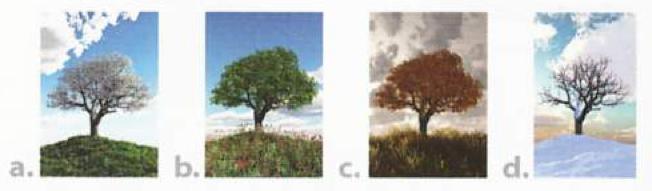
Adosphère 2, p. 98
| French | English | Use |
|---|---|---|
| le printemps | spring | au printemps |
| l'été (m.) | summer | en été |
| l'automne (m.) | autumn | en automne |
| l'hiver (m.) | winter | en hiver |
| la saison | season | Il y a quatre saisons. |
Saying what the weather is like
The book (p. 99, ex. 5) gives the box Pour parler du temps qu'il fait. The question is Quel temps fait-il ? (What is the weather like?). Every answer starts with il, which means nothing: it is just the weather.
| French | English | Pattern |
|---|---|---|
| Il fait beau. | It is fine / the weather is nice. | il fait + adjective or number |
| Il fait chaud. | It is hot. | |
| Il fait froid. | It is cold. | |
| Il fait douze degrés. | It is twelve degrees. | |
| Il pleut. | It is raining. | a verb: pleuvoir |
| Il neige. | It is snowing. | a verb: neiger |
| Il y a du soleil. Il y a des nuages. Il y a de l'orage. | It is sunny. It is cloudy. There is a storm. | il y a + noun (le soleil, un nuage, l'orage) |
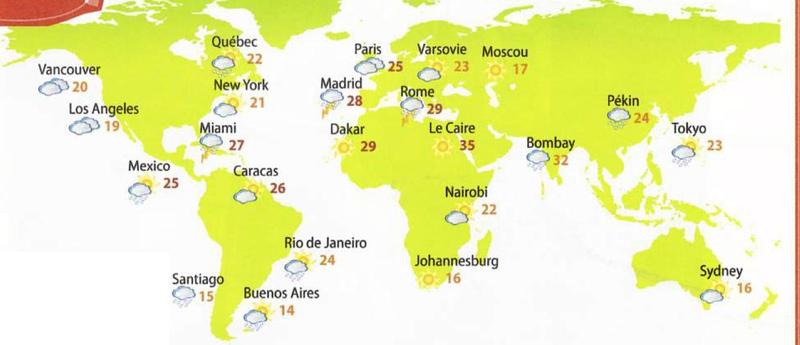
Adosphère 2, p. 99
Show answerHide answer
(b) Il pleut.
(c) Il fait chaud. Il fait trente-cinq degrés. Il fait beau.
8.2The relative pronoun où
The book's box (p. 99, ex. 7): we use the relative pronoun où to give more detail about a place. It joins two sentences, and it replaces a phrase of place such as dans ce pays or sur cette planète.
| Two short sentences | One sentence with où |
|---|---|
| Il y a des pays. Dans ces pays, il fait toujours chaud. | Il y a des pays où il fait toujours chaud. |
| Ce sont des pays. Dans ces pays, il n'y a pas de printemps. | Ce sont des pays où il n'y a pas de printemps. |
| Je voudrais visiter une ville. Dans cette ville, il neige beaucoup. | Je voudrais visiter une ville où il neige beaucoup. |
Show answerHide answer
8.3The futur simple
Lesson 2 opens with Jeanne's page Ma vie en 2030 (book p. 100). She imagines flying taxis, a trip to Mars, a wall screen in her room and robots at home. She uses the futur simple, the tense for what will happen.
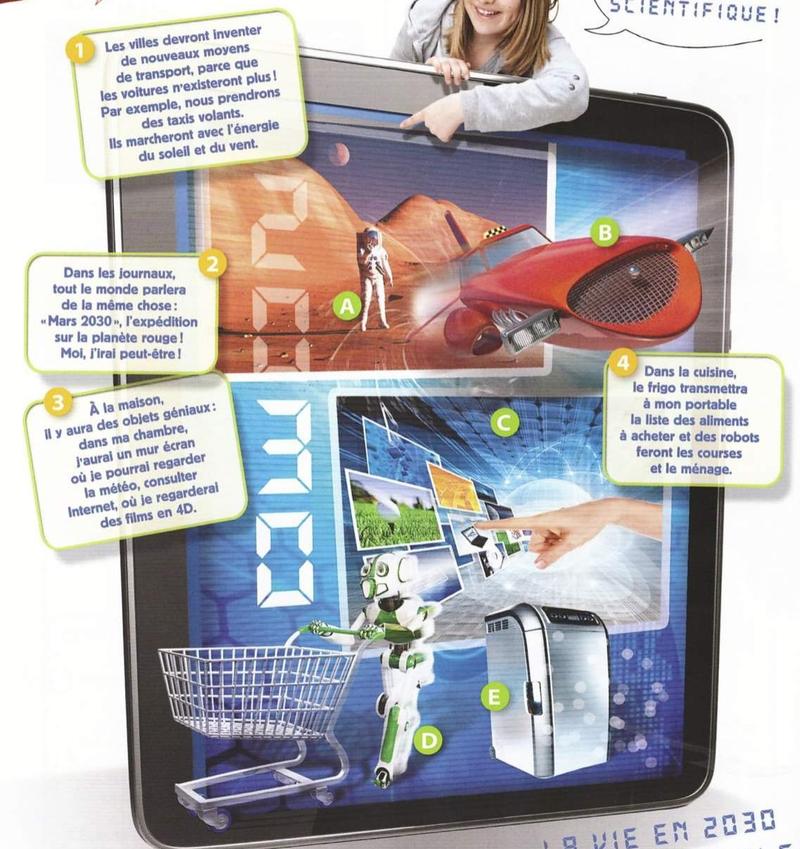
Adosphère 2, p. 100
Regular verbs
Take the whole infinitive and add the endings. For verbs in -re, drop the final e first (book p. 101, box Le futur simple).
| parler (verbs in -er) | prendre (verbs in -re) | Ending | |
|---|---|---|---|
| je | parlerai | prendrai | -ai |
| tu | parleras | prendras | -as |
| il / elle / on | parlera | prendra | -a |
| nous | parlerons | prendrons | -ons |
| vous | parlerez | prendrez | -ez |
| ils / elles | parleront | prendront | -ont |
Irregular stems
Irregular verbs change the stem, but the endings are exactly the same (book p. 101, ex. 7). Every stem ends in -r and you hear that r.
| Infinitive | Stem | je form | Example from Jeanne's page |
|---|---|---|---|
| avoir | aur- | j'aurai | Dans ma chambre, j'aurai un mur écran. Il y aura des objets géniaux. |
| être | ser- | je serai | Je serai une grande scientifique. |
| faire | fer- | je ferai | Des robots feront les courses. |
| aller | ir- | j'irai | Moi, j'irai peut-être sur Mars ! |
| pouvoir | pourr- | je pourrai | Un mur écran où je pourrai regarder la météo. |
| devoir | devr- | je devrai | Les villes devront inventer de nouveaux moyens de transport. |
In ex. 8-9 (p. 101) Antoine is pessimistic (pessimiste: he thinks the future will be bad, for example the Earth will be very ill) and Jeanne is optimistic (optimiste: « Il n'y aura plus beaucoup de maladies. Nous vivrons très vieux ! »). The final task (ex. 10) is to write a short text, Imagine ta vie en 2030.
Show answerHide answer
(b) prendras (prendr- + -as)
(c) serez (stem ser-)
(d) feront (stem fer-, plural -ont)
8.4Comparing two things
In Lesson 3 (book pp. 102-103) you read the article Mars 2030 from the magazine Science Ado. To compare two things the book gives the box Pour comparer deux éléments (p. 103).
| You compare | Pattern | Example |
|---|---|---|
| an adjective or adverb | plus / moins + adjective or adverb + que | La planète rouge est moins grande que la planète bleue. Mars est plus loin du Soleil que la Terre. |
| a noun | plus de / moins de + noun + que | La planète rouge a plus de lunes que la planète bleue. |
| a verb or an amount of time | Il faut plus de temps pour… | Il faut plus de temps à Mars pour faire le tour du Soleil. |
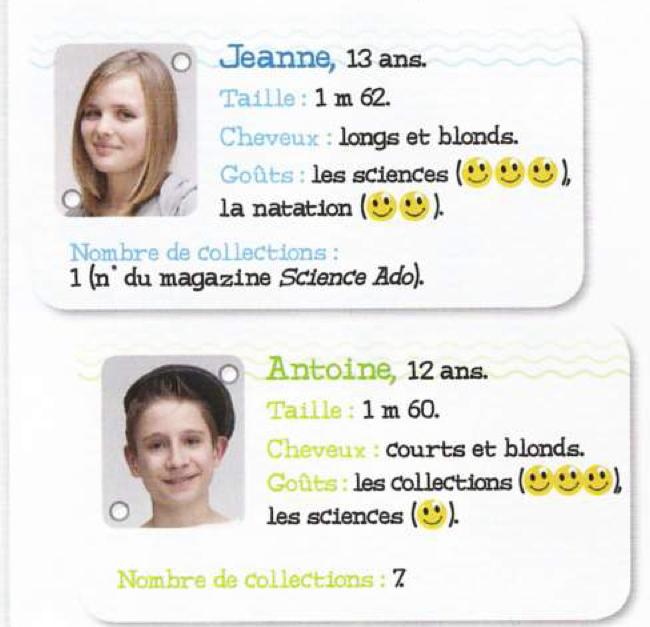
Adosphère 2, p. 107
Show answerHide answer
(b) moins de … que (fewer moons: noun, so de)
8.5Mars, Venus and the solar system
The article asks why people have always dreamed of going to Mars. The answer: Mars looks like the Earth in some ways (it has seasons and storms), but it is very different in others. Read the facts in the box and compare them yourself.
| Mars (p. 102) | Venus (p. 103) | |
|---|---|---|
| Average temperature | -63 °C | 462 °C |
| A year (une année) | 686 days | 224.7 days |
| A day (un jour) | 24 h 37 min | 243 days (it turns very slowly) |
| Moons (lunes) | 2 | 0 |
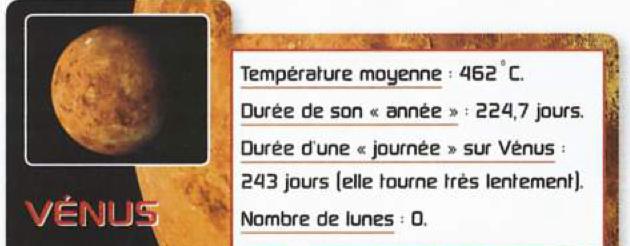
Adosphère 2, p. 103
Why is Mars so cold with a long year? It is farther from the Sun than the Earth (Mars est plus loin du Soleil que la Terre), so it needs more time to go round the Sun, and it is much colder. It looks like a big desert because the water is not on the surface but in the ground as ice (sous forme de glace). A question for scientists: there may once have been an ocean on Mars, so why is there no more water? The 2030 expedition may answer this.
The solar system (le système solaire)
| French | English | Remember |
|---|---|---|
| le Soleil | the Sun | the planets turn around it |
| une planète | a planet | Mars, Vénus, la Terre (la planète rouge, la planète bleue) |
| la Lune | the Moon | it turns around the Earth |
| une étoile | a star | the Sun is a star |
| une navette spatiale, une fusée | a space shuttle, a rocket | transport to another planet |
| une expédition, un satellite | an expedition, a satellite | l'expédition spatiale de 2030 |
Show answerHide answer
(b) Mars a plus de lunes que Vénus. (2 against 0)
(c) L'année de Mars est plus longue que l'année de Vénus. (686 days against 224.7 days)
8.6Science and fiction, and a thunderstorm
Lesson 4: Sciences et fiction (p. 104)
Science fiction (la science-fiction) imagines a future world. The timeline in the book mixes works of fiction and real science.
| Year | Event | Science or fiction? |
|---|---|---|
| 1865 | De la Terre à la Lune, a novel by Jules Verne about a trip to the Moon | fiction (one of the first science-fiction novels) |
| 1902 | Voyage dans la Lune, a silent film of 12 minutes by Georges Méliès | fiction |
| 1954 | On a marché sur la Lune, a Tintin comic by Hergé | fiction |
| 1979 | first flight of the Ariane rocket (193 flights and 271 satellites so far) | science |
Mon cours de sciences: Qu'est-ce qu'un orage ? (p. 105)
A storm (un orage) happens when the temperature changes too fast. The clouds are full of static electricity (l'électricité statique). To release it they make a flash of light (un éclair) and a noise (le tonnerre). You always hear the thunder some seconds after the flash because light travels faster than sound. The book's experiment rubs a plate on a plastic bag in the dark to make a small spark and a small bang.
| French | English |
|---|---|
| un orage | a thunderstorm |
| un éclair | a flash of lightning |
| le tonnerre | thunder |
| un nuage | a cloud |
| la température, un degré | temperature, a degree |
8.7Sounds and learning to learn
Le e caduc (p. 101, ex. 6; p. 107, ex. 10)
In the futur simple, the e before the ending is usually not pronounced. Say je visit(e)rai [vizitʁɛ], on parl(e)ra [parlʁa]. Read aloud without the written e: Jeanne observ(e)ra les étoiles. Les voitures n'exist(e)ront plus. La Terre s(e)ra très malade ! The spelling stays the same: only the pronunciation changes.
Learning to learn (p. 107)
How to understand a conversation in French when everyone speaks at the same time: (1) look for the general subject, (2) do not try to hear everybody, (3) concentrate on one or two people, (4) take part and ask questions.
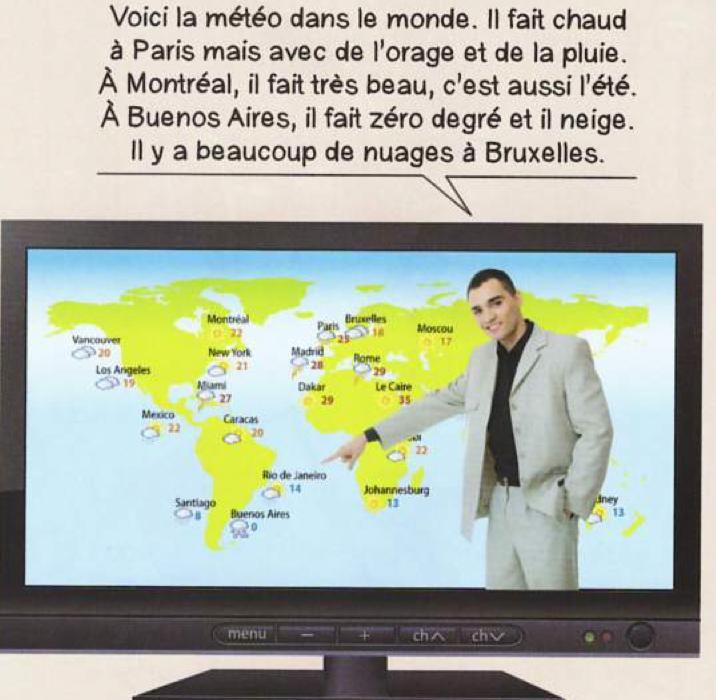
Adosphère 2, p. 108
Summary
| Topic | Remember |
|---|---|
| Weather | Quel temps fait-il ? Il fait beau / chaud / froid / douze degrés. Il pleut. Il neige. Il y a des nuages. |
| Seasons | le printemps, l'été, l'automne, l'hiver: au printemps, en été, en automne, en hiver |
| Why seasons? | Earth turns round the Sun on a tilted axis; north and south hemispheres have opposite seasons; near the equator it is always hot |
| où | joins two sentences and replaces a place: un pays où il fait chaud (not ou) |
| Futur simple (regular) | infinitive (without the final e for -re) + -ai, -as, -a, -ons, -ez, -ont |
| Irregular stems | aur-, ser-, fer-, ir-, pourr-, devr- + the same endings; il y aura |
| Comparing | plus / moins + adjective + que; plus de / moins de + noun + que |
| Mars | -63 °C, year 686 days, day 24 h 37 min, two moons, ice in the ground |
| Storm | un éclair (light), le tonnerre (noise), l'électricité statique |
| Sounds | the e before the ending is not pronounced: je visit(e)rai |
1.
2.
3.
4.
5.