Wassim : les métiers, les qualités et la nécessité
What this chapter covers
- I can use the present of pouvoir (and devoir, vouloir) followed by an infinitive (Je peux répondre. Vous devez partir.) (3.2)
- I can ask and give possibilities with pouvoir and politely ask for help (Pouvez-vous nous parler de votre métier ?) (3.2)
- I can ask a formal question by inverting the verb and the subject, in the present and the passé composé (Aimez-vous votre métier ? Quels métiers avez-vous faits ?) (3.3)
- I can interview someone about the jobs they have done and how they became what they are (J'ai été vendeur. Je suis devenu réalisateur.) (3.1)
- I can say what is necessary with il faut + infinitive and il ne faut pas (Il faut être patient.) (3.4)
- I can talk about the qualities needed for a job (créatif, curieux, organisé, résistant, savoir écouter les gens) with the masculine and feminine forms (3.4)
- I can name jobs and their feminine forms, the seven job families and the place where people work (infirmier / infirmière, chanteur / chanteuse, un hôpital, un chantier) (3.5)
- I can hear and say the sounds [ø] (deux, veux) and [œ] (heure, chanteur) (3.6)
- I can read about French cinema (the Palme d'or, Festival de Cannes) and how a cartoon is made (3.7)
Module 7 of Adosphère 2 is called Wassim. Wassim is a French teenager who loves cinema and wants to make films, but he has not yet decided which job to choose. In this module he interviews a film director, thinks about the jobs he could do later and the qualities each job needs, and plays a game with job cards. By the end you can interview a professional with formal questions, say what is possible or necessary (pouvoir, il faut), and describe the job of your dreams. In the UASA paper these topics come back in Partie 1 (verbs, word banks, jobs and families), Partie 2 (an interview or a job card with vrai ou faux) and Partie 3 (a short text about a job).
| Lesson | Book pages | You learn to |
|---|---|---|
| Leçon 1 : Pouvez-vous nous parler de votre métier ? | 86-87 | interview someone; pouvoir; formal questions |
| Leçon 2 : Plus tard, je voudrais… | 88-89 | talk about the qualities for a job; il faut + infinitive |
| Leçon 3 : Le jeu des métiers | 90-91 | name jobs and job families; masculine and feminine jobs; the sounds [ø] and [œ] |
| Leçon 4 : Le cinéma français, Mon cours d'arts plastiques | 92-93 | French films, the Palme d'or, how a cartoon is made |
| Entraîne-toi, Évaluation DELF, Ton dico | 94-96 | practice, a DELF-style test and the word list |
3.1Interviewing a professional
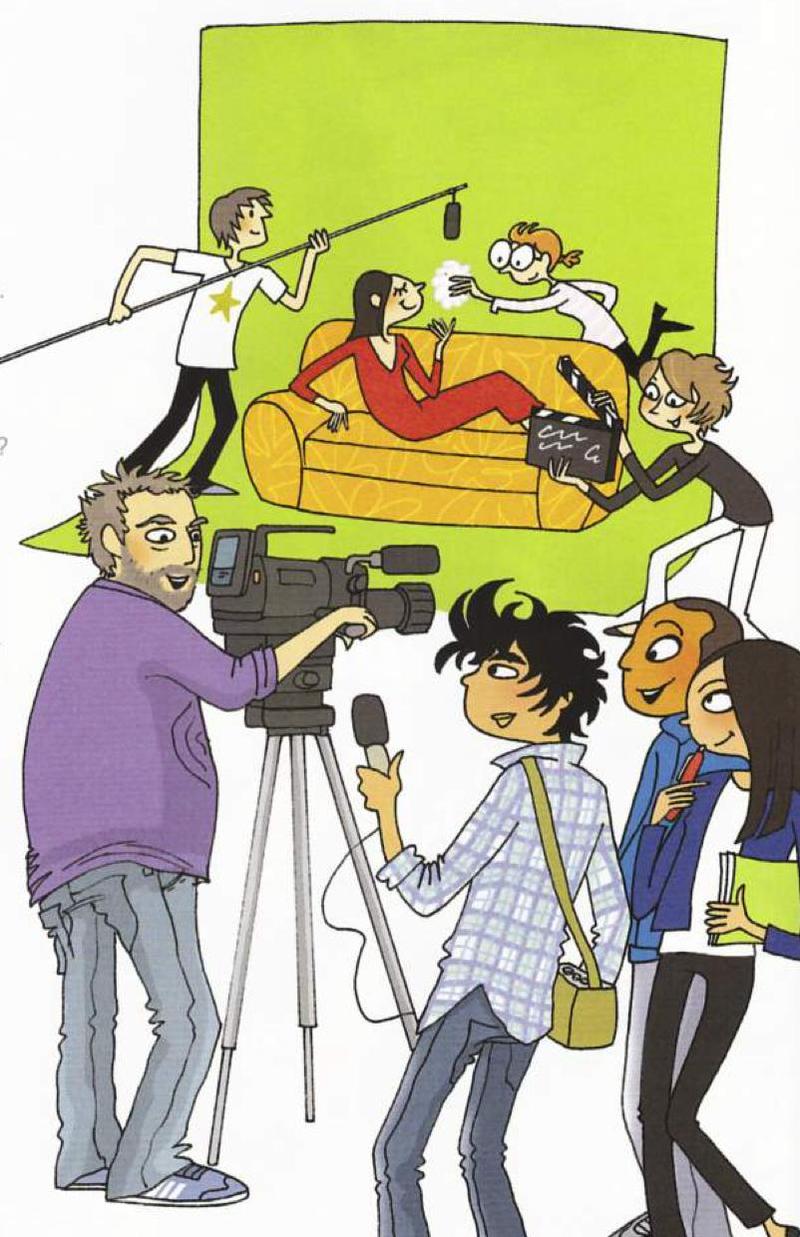
In Lesson 1 (book p. 86) Wassim, Hugo and Manon interview monsieur Basson for their school. He is a film director (un réalisateur), but he was not always one. The cartoon shows the film crew: the camera operator, the microphone on a long pole and the clapperboard.
Adosphère 2, p. 86
M. Basson's path in order
| Step | What he says (retold in the past, own words) | English |
|---|---|---|
| 1 | J'ai été vendeur dans un magasin de musique. | I was a shop assistant in a music shop. |
| 2 | J'ai étudié la musique et je suis devenu guitariste. | I studied music and became a guitarist. |
| 3 | J'ai eu envie de faire le tour du monde. Je suis allé en Amérique du Sud. | I felt like travelling round the world. I went to South America. |
| 4 | J'ai rencontré des gens passionnants. On m'a proposé de faire une musique pour un film. | I met fascinating people. I was asked to write music for a film. |
| 5 | J'ai décidé de passer derrière la caméra. | I decided to go behind the camera (to become a director). |
(a) Nous (étudier) le cinéma.
(b) Elle (devenir) pompier. (she is a woman)
(c) J'(être) vendeur.
Show answerHide answer
(b) Elle est devenue pompier. (with être and an extra -e)
(c) J'ai été vendeur.
3.2Saying what is possible: pouvoir
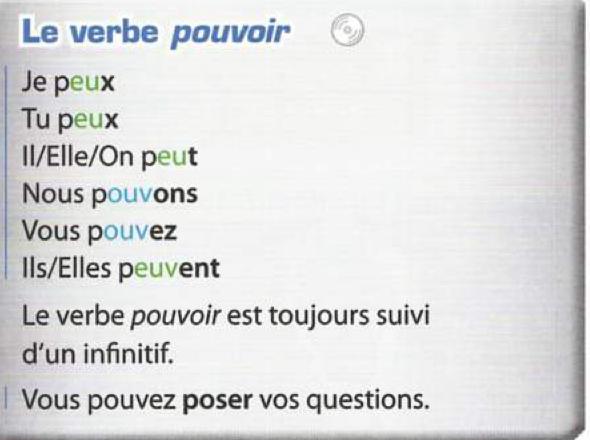
To ask for permission or say that something is possible, French uses pouvoir. In the interview Wassim says « Pouvons-nous vous poser des questions ? » and M. Basson answers « Je peux faire une pause. »
Adosphère 2, p. 87
| pouvoir (can) | devoir (must, have to) | vouloir (want) | |
|---|---|---|---|
| je | peux | dois | veux |
| tu | peux | dois | veux |
| il / elle / on | peut | doit | veut |
| nous | pouvons | devons | voulons |
| vous | pouvez | devez | voulez |
| ils / elles | peuvent | doivent | veulent |
– Non, je ne peux pas. Je dois partir.
– Nous pouvons revenir plus tard ?
– Si vous voulez, mais d'autres personnes de mon équipe peuvent vous répondre.
(a) Si tu ______ être médecin, tu ______ étudier longtemps. (want / must)
(b) Les femmes ______ être pompiers. (can)
(c) Nous ne ______ pas rester. (can)
Show answerHide answer
(b) peuvent (plural, -ent)
(c) pouvons
3.3Formal questions (la question formelle)
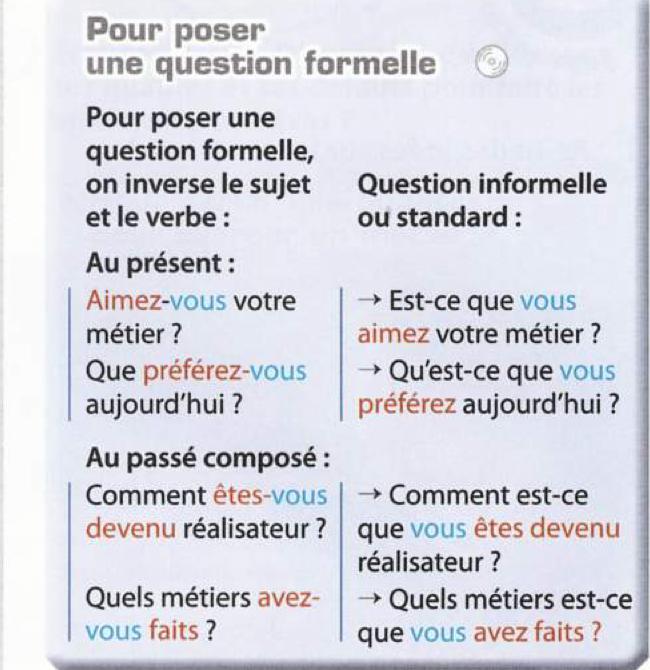
When you speak to an adult you do not know, to a professional or in a written interview, you can ask a formal question: you invert the subject and the verb and put a hyphen between them. The informal (standard) question uses est-ce que or qu'est-ce que (book p. 87).
Adosphère 2, p. 87
| Tense | Formal question (inversion) | Informal question |
|---|---|---|
| Present | Aimez-vous votre métier ? | Est-ce que vous aimez votre métier ? |
| Present | Que préférez-vous aujourd'hui ? | Qu'est-ce que vous préférez aujourd'hui ? |
| Passé composé | Comment êtes-vous devenu réalisateur ? | Comment est-ce que vous êtes devenu réalisateur ? |
| Passé composé | Quels métiers avez-vous faits ? | Quels métiers est-ce que vous avez faits ? |
More examples from the Entraîne-toi page (p. 94)
| Informal | Formal |
|---|---|
| Où est-ce que vous travaillez ? | Où travaillez-vous ? |
| Quel métier est-ce que vous voulez faire ? | Quel métier voulez-vous faire ? |
| Pourquoi est-ce que tu veux le rencontrer ? | Pourquoi veux-tu le rencontrer ? |
| Est-ce que vous avez pris votre appareil photo ? | Avez-vous pris votre appareil photo ? |
| Vous vous appelez comment ? | Comment vous appelez-vous ? |
Do not forget the hyphen, and keep the question mark.
(a) Est-ce que vous pouvez nous parler de votre métier ?
(b) Qu'est-ce que vous avez fait avant ?
(c) Put in order: rencontré – réalisateur – ce – as – comment – tu – ?
Show answerHide answer
(b) Qu'avez-vous fait avant ? (que becomes qu' before a vowel)
(c) Comment as-tu rencontré ce réalisateur ?
3.4The qualities for a job and il faut
Lesson 2 (p. 88) is Wassim's personal page: « Plus tard, je voudrais… » He sees himself in the photos of a World Cup team and of a film festival, then reads ten conditions: « Pour faire ces métiers, il faut… »
| Quality | Masculine / feminine | English |
|---|---|---|
| créatif / créative | -if → -ive | creative |
| curieux / curieuse | -eux → -euse | curious |
| organisé / organisée, cultivé / cultivée | add -e | organised, well-read |
| patient / patiente, résistant / résistante | add -e | patient, tough |
| sociable, rapide | the same for both | sociable, fast |
| sportif / sportive, timide | -if → -ive; timide stays | sporty, shy |
Adosphère 2, p. 89
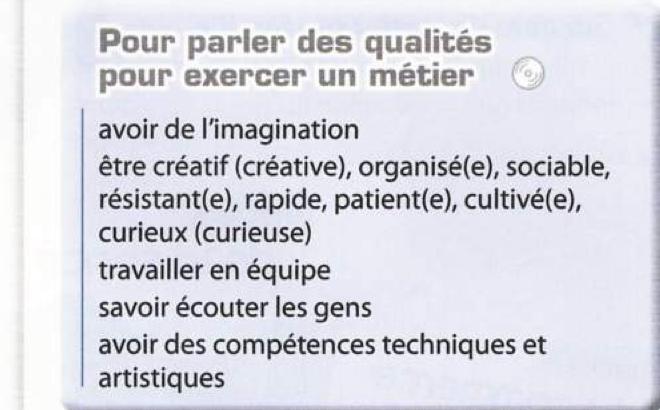
| Expression | English |
|---|---|
| avoir de l'imagination | to have imagination |
| travailler en équipe | to work in a team |
| savoir écouter les gens | to know how to listen to people |
| avoir des compétences techniques et artistiques | to have technical and artistic skills |
| aimer les compétitions, être toujours dehors | to like competitions, to be outdoors all the time |
Il faut + infinitive
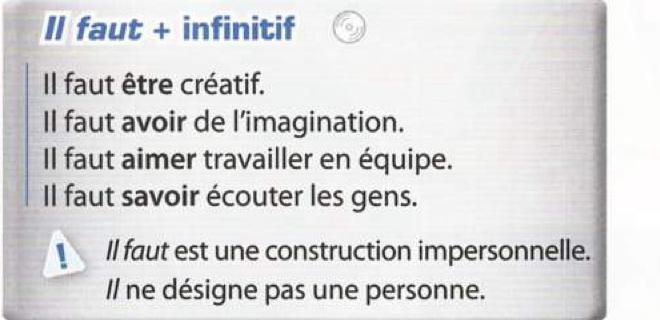
Adosphère 2, p. 89
| Pattern | Example | English |
|---|---|---|
| il faut être + quality | Il faut être créatif. | You must be creative. |
| il faut avoir + noun | Il faut avoir de l'imagination. | You must have imagination. |
| il faut aimer + infinitive | Il faut aimer travailler en équipe. | You must like working in a team. |
| il faut savoir + infinitive | Il faut savoir écouter les gens. | You must know how to listen. |
| il ne faut pas + infinitive | Il ne faut pas être stressé. | You must not be stressed. |
Which job needs which qualities? (book pp. 88 and 95)
| Qualities | A job that fits |
|---|---|
| like teamwork, sporty, like competitions | footballeur / footballeuse |
| patient, tough, love nature, work outside | jardinier / jardinière |
| imagination, creative, like drawing | styliste, peintre |
| technical skills, like computers | informaticien / informaticienne, ingénieur |
| sociable, like talking to people | vendeur / vendeuse, libraire |
| want to help sick people, know how to listen | médecin, infirmier / infirmière |
Show answerHide answer
Si tu es malade, il faut rester à la maison.
3.5Jobs and job families (les métiers)
In Lesson 3 (p. 90) the game of jobs has seven families of cards, each with a symbol. Find one job in each family.
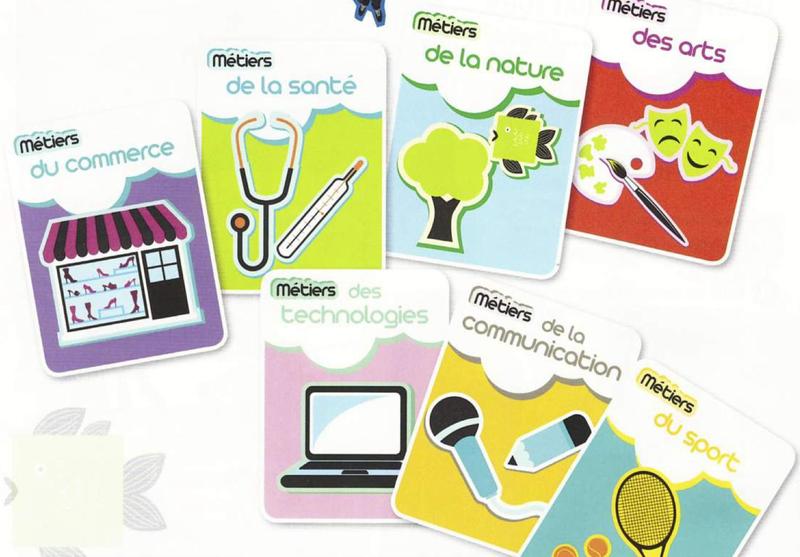
Adosphère 2, p. 90
| Family | English | Jobs from the module |
|---|---|---|
| métiers du commerce | trade, shops | vendeur, libraire, boulanger |
| métiers de la santé | health | médecin, infirmier |
| métiers de la nature | nature | jardinier |
| métiers des arts | arts | acteur, styliste, musicien |
| métiers des technologies | technology | informaticien, ingénieur |
| métiers de la communication | communication, media | journaliste, écrivain, photographe, animateur |
| métiers du sport | sport | footballeur, nageur |
Masculine and feminine jobs
| Pattern | Masculine | Feminine |
|---|---|---|
| add -e | un musicien, un informaticien | une musicienne, une informaticienne (double n) |
| -er / -ier → -ère / -ière | un boulanger, un infirmier | une boulangère, une infirmière |
| -eur → -euse | un chanteur, un vendeur, un nageur, un footballeur | une chanteuse, une vendeuse, une nageuse, une footballeuse |
| -teur → -trice | un animateur, un réalisateur, un acteur | une animatrice, une réalisatrice, une actrice |
| the same word | un journaliste, un styliste, un photographe | une journaliste, une styliste, une photographe (change the article only) |
| no feminine form in the book | un médecin, un ingénieur, un écrivain | une femme médecin or simply une médecin |
Where do they work?
| Job | Place |
|---|---|
| un infirmier / un médecin | un hôpital |
| un professeur | une école |
| un jardinier | un jardin |
| un vendeur / un libraire / un boulanger | un magasin |
| un ingénieur | un bureau, un chantier (building site) |
| un nageur | une piscine |
Use the pattern of the book (p. 94, ex. 6): Elle travaille dans une école. Elle est professeur.
Reading a job card (book p. 90)
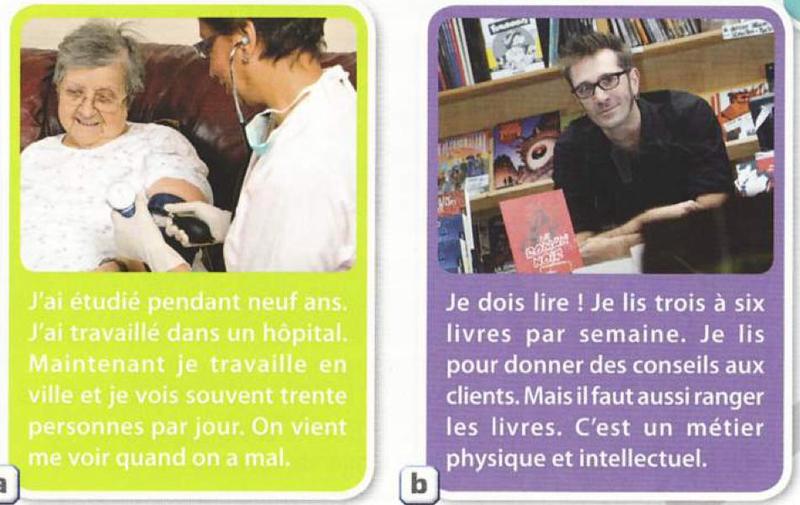
Adosphère 2, p. 90
| Card | What the person says (summary) | Job |
|---|---|---|
| a | studied for nine years, worked in a hospital, now works in the town and sees thirty people a day | a health job, probably un médecin (family: health) |
| b | reads three to six books a week to advise customers, also has to put the books in order; a physical and intellectual job | un libraire (family: trade) |
Show answerHide answer
(b) une actrice; métiers des arts
(c) une footballeuse; métiers du sport
3.6Sounds [ø] and [œ] (« eu »)
The letters eu make two sounds. [ø] is a closed sound, like deux, with rounded lips. [œ] is more open, like heure. Book p. 91, ex. 6, gives the pairs.
| Sound | When | Examples |
|---|---|---|
| [ø] | at the end of a word or syllable; before [z] (-euse) | deux, veux, peux, peut, chanteuse, curieuse |
| [œ] | before a pronounced consonant, especially r or l (-eur, -eul) | heure, chanteur, vendeur, professeur, veulent, peuvent, seul |
Show answerHide answer
3.7French cinema and cartoons (culture, pp. 92-93)
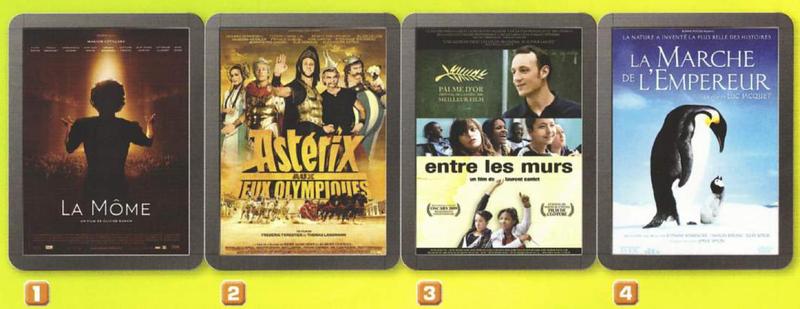
Adosphère 2, p. 92
| Film | What it is about (summary) |
|---|---|
| La Môme | the life of the singer Édith Piaf, from Paris to New York |
| Astérix aux Jeux olympiques | the Gauls help a friend to take part in the Olympic Games, in 50 BC |
| Entre les murs | a class at a French school and its young teacher of French; this film won the Palme d'or |
| La Marche de l'empereur | the story of a people of animals living in Antarctica (emperor penguins), about love and courage |
An optical illusion and the cartoon (p. 93)
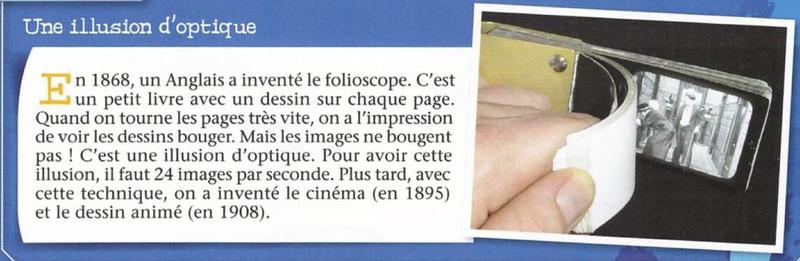
Adosphère 2, p. 93
| Date | What happened |
|---|---|
| 1868 | an Englishman invented the folioscope: a little book with a drawing on every page; if you turn the pages quickly, the pictures seem to move |
| 1895 | cinema was invented with this technique |
| 1908 | the dessin animé (cartoon) was invented |
The illusion needs 24 images per second. To make a cartoon, a class (document B) must: (1) invent a simple story, characters and sets; (2) cut the story into fifteen or twenty sequences and draw each image; (3) record the dialogue, music and noises and put them with the pictures in a computer.
3.8Exam help: the DELF page (p. 96)
| Task | What to do | Language you need |
|---|---|---|
| Listening | listen to a boy speak about his father's job and say vrai or faux | the qualities (rapide, dynamique, patient, compétences techniques) |
| Speaking | find five ways to speak French well and give your opinion | Pour bien parler français, il faut… écouter de la musique, lire… |
| Reading | find five ways to get information about jobs | Pour m'informer sur les métiers, je peux… poser des questions, faire une enquête, lire le dico des métiers |
| Writing | write five more formal questions for a survey of pupils on cinema | Combien de films avez-vous vus cette année ? and similar |
Summary
| Topic | Remember |
|---|---|
| pouvoir | je peux, tu peux, il/elle/on peut, nous pouvons, vous pouvez, ils/elles peuvent + infinitive |
| devoir, vouloir | je dois, nous devons, ils doivent; je veux, nous voulons, ils veulent |
| Formal question | verb + hyphen + pronoun: Aimez-vous… ? Où travaillez-vous ? Avez-vous fait… ? |
| Necessity | il faut + infinitive; il ne faut pas + infinitive |
| Qualities | créatif/créative, curieux/curieuse, patient(e), résistant(e), organisé(e), sociable, rapide |
| Jobs | -eur/-euse, -teur/-trice, -er/-ère, -ien/-ienne; journaliste, photographe stay the same |
| Families | commerce, santé, nature, arts, technologies, communication, sport |
| Sounds | [ø] in deux, veux, chanteuse; [œ] in heure, chanteur, peuvent |
| Culture | Palme d'or at the Festival de Cannes; the folioscope (1868); 24 images per second |
1.
2.
3.
4.
5.