Émilie : l'aide humanitaire, les besoins et la santé
What this chapter covers
- I can organise a collection for a charity and talk about it (une collecte, une association, aider, donner, collecter) (1.1)
- I can avoid repeating a person with the indirect object pronouns lui and leur and put them in the right place in the present, the near future and the passé composé (Je lui téléphone. Je vais leur téléphoner. Je leur ai téléphoné.) (1.2, 3.1)
- I can express a condition with si + present and a present or an imperative (Si tu as faim, mange !) (3.1)
- I can express needs and feelings (avoir faim, soif, chaud, froid, mal, peur, besoin de, envie de; être fatigué(e), malade, content(e)) (2.1)
- I can use quelqu'un, quelque chose, ne… personne, ne… rien in affirmative and negative sentences (3.1)
- I can talk about accidents, first aid and health (une brûlure, une coupure, une chute, les secours, les pompiers, l'infirmerie) (2.1, 4.1)
- I can present a project and take part in a group project (Nous voulons aider… Nous allons leur donner…) (4.1, 5.1)
- I can pronounce the sound [ɥ] in huit, lui, aujourd'hui, cuisine (1.6)
- I can describe how French people help others and how to protect myself against microbes (1.7)
Module 6 of Adosphère 2 is called Émilie. Émilie belongs to the Club Solidarité of her collège: the club collects food for a charity, runs a race against illness and learns first aid. Through her projects you learn to avoid repeating a person (lui, leur), to say what you need and how you feel, to give a condition with si, and to use quelqu'un, quelque chose, personne, rien. In the UASA paper these points come back in Partie 1 (grammar and vocabulary), Partie 2 (short texts, vrai ou faux, questions) and Partie 3 (writing a short message).
| Lesson | Book pages | You learn to |
|---|---|---|
| Leçon 1 : Une collecte au collège | 74-75 | organise a collection; the pronouns lui and leur (COI) |
| Leçon 2 : J'ai participé à la course contre la maladie | 76-77 | read a school newspaper; si + present; needs and sensations |
| Leçon 3 : Es-tu un bon secouriste ? | 78-79 | first aid; quelqu'un, quelque chose, personne, rien |
| Leçon 4 : Les Français et l'humanitaire | 80 | charities in France |
| Mon cours de sciences | 81 | microbes and rules of hygiene |
| Entraîne-toi, Évaluation DELF, Ton dico | 82-84 | practice, sounds, group project, the module test |
2.1Organising a collection (une collecte)
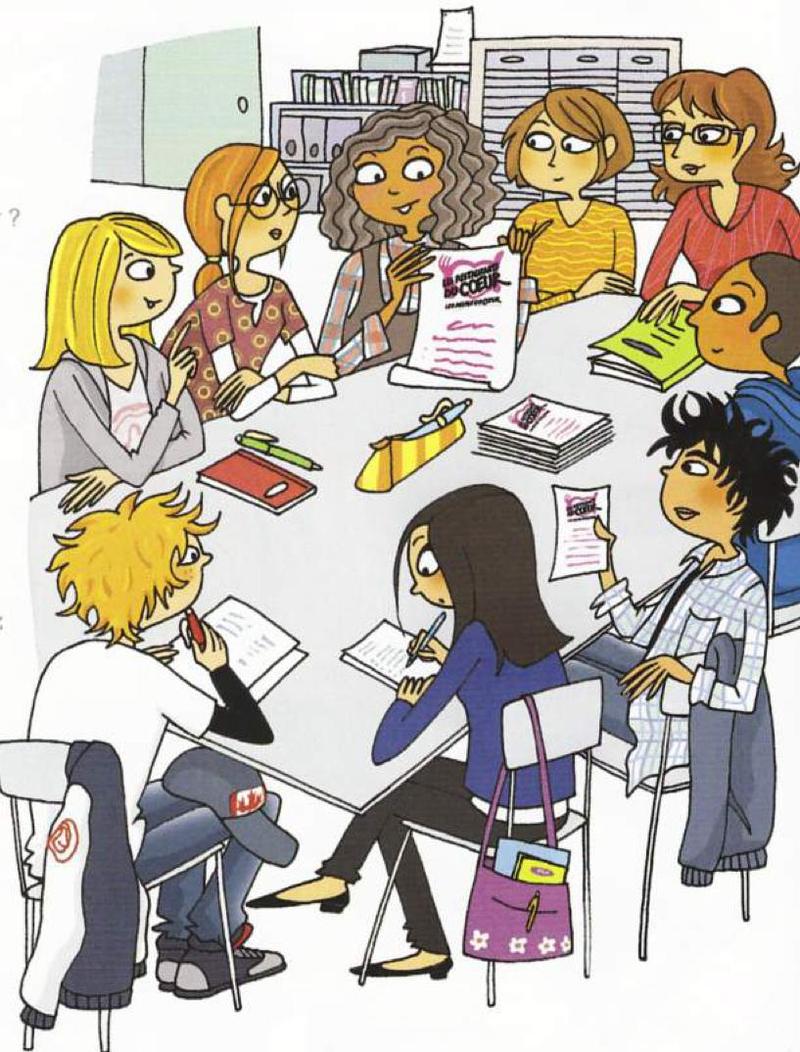
In Lesson 1 the Club Solidarité meets round a table. Émilie explains that the club is organising a collection for the charity Les Restos du Cœur, which gives meals to people in difficulty. The students will bring food (pasta, packets of cakes), not clothes. Each one gets a job: Wassim goes to see the form teacher (le professeur principal) and explains the project; Jeanne and Étienne stick posters in the school; everyone prepares and sends the parcels on Saturday morning. Émilie is the leader, "but we are a team".
Adosphère 2, p. 74
Words for the collection
| French | English |
|---|---|
| une collecte / collecter | a collection / to collect |
| une association (humanitaire) | a (humanitarian) charity, an association |
| la solidarité | solidarity, helping each other |
| aider, donner, offrir | to help, to give, to offer |
| les personnes en difficulté | people in difficulty |
| la nourriture, des vêtements, des repas | food, clothes, meals |
| une affiche | a poster |
| un projet, un chef, une équipe | a project, a leader, a team |
Indirect object pronouns lui and leur (les pronoms COI)
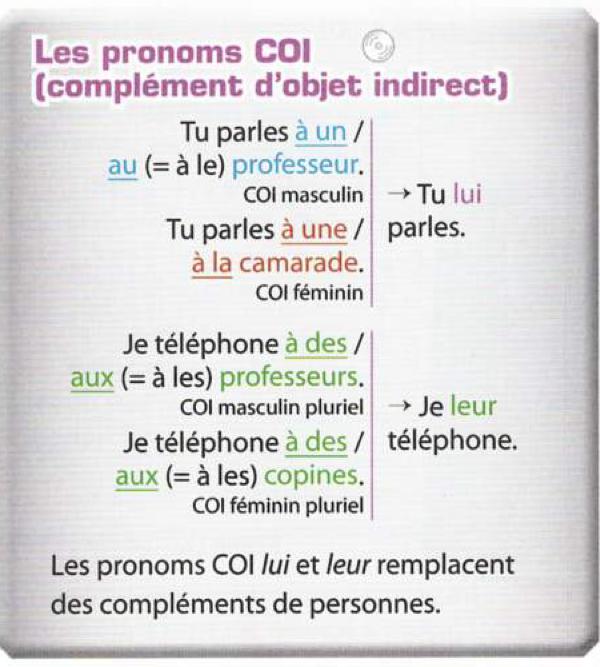
A COI (complément d'objet indirect) is the person you do something to: a person after the little word à. Verbs like téléphoner à, parler à, donner à, demander à, expliquer à, envoyer à, offrir à, écrire à take it. Instead of repeating the person, use one word.
Adosphère 2, p. 75
| Person(s) | Pronoun | Example |
|---|---|---|
| one person, boy or girl (à un / à une / à la / au) | lui | Tu parles au professeur. → Tu lui parles. |
| several people (à des / aux) | leur | Je téléphone aux copines. → Je leur téléphone. |
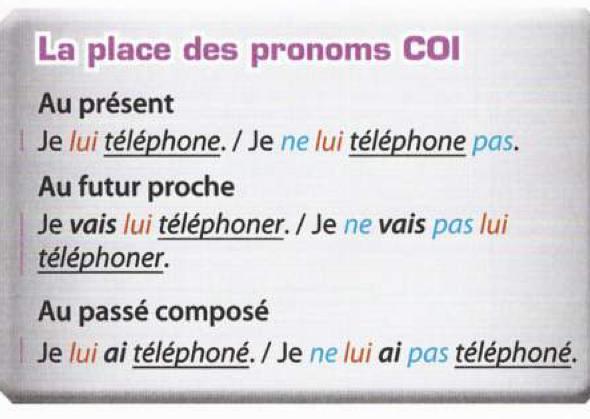
Lui and leur only replace people, and they do not change for masculine or feminine. They stand before the verb:
Adosphère 2, p. 82
| Tense | Affirmative | Negative |
|---|---|---|
| present | Je lui téléphone. | Je ne lui téléphone pas. |
| near future | Je vais lui téléphoner. | Je ne vais pas lui téléphoner. |
| passé composé | Je lui ai téléphoné. | Je ne lui ai pas téléphoné. |
Writing
Using leur for one person, or lui for several: Wassim → lui, les Restos du Cœur (a group of people) → leur.
Using lui for a thing. Lui and leur are for people, as the book box says.
(a) Émilie explique le projet au professeur.
(b) Nous envoyons les paquets aux Restos du Cœur. (the people there, plural)
(c) Je vais téléphoner à Wassim.
(d) Elle n'a pas parlé à ses parents.
Show answerHide answer
(b) Nous leur envoyons les paquets.
(c) Je vais lui téléphoner.
(d) Elle ne leur a pas parlé.
2.2The race against illness (la course contre la maladie)
Lesson 2 is an article from the school newspaper Collège infos, signed by Émilie. The school ran a race for the Téléthon. The rule: each student finds a sponsor (un parrain) and runs as many laps as possible round the school yard (one lap = 500 metres). The sponsor gives 2 euros for every lap. Everyone was tired but happy.
Money: 1 390 laps × 2 euros = 2 780 euros. A student who runs 3 laps earns 3 × 2 = 6 euros from the sponsor (the book says "3 tours, 6 euros").
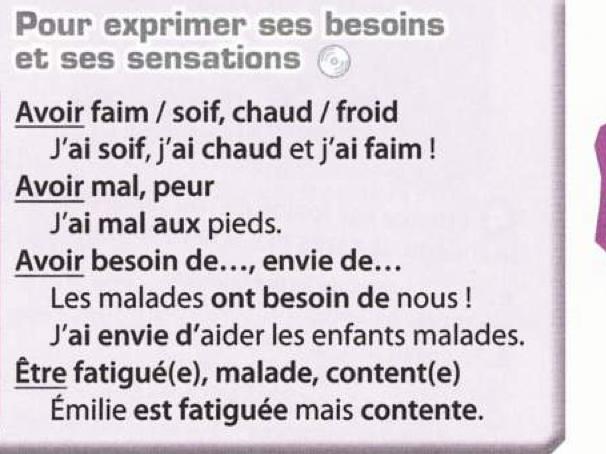
Needs and sensations (les besoins et les sensations)
Adosphère 2, p. 77
| Use | French | English |
|---|---|---|
| avoir + noun | J'ai faim / soif / chaud / froid. | I'm hungry / thirsty / hot / cold. |
| avoir mal à | J'ai mal aux pieds. Il a très mal à la jambe. | My feet hurt. His leg really hurts. |
| avoir peur | Elle a peur. | She is afraid. |
| avoir besoin de | Les malades ont besoin de nous ! | The sick need us! |
| avoir envie de + verb | J'ai envie d'aider les enfants malades. | I want to help sick children. |
| être + adjective | Émilie est fatiguée mais contente. | Émilie is tired but happy. |
The condition: si + present
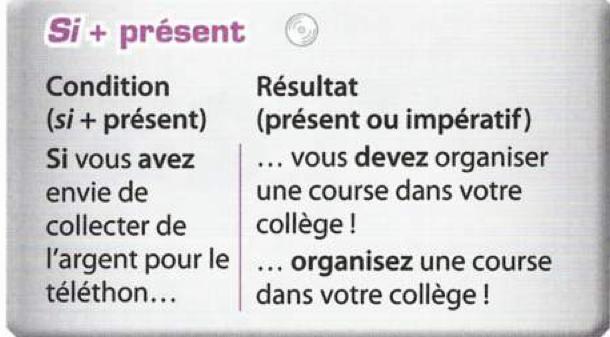
Adosphère 2, p. 77
To say what will happen if something is true, put si + present for the condition. The result is in the present or the imperative (an order or advice); the book also has the near future in its examples (je vais faire du sport). The si part can come first or second.
| Condition (si + present) | Result | English |
|---|---|---|
| Si vous avez envie de collecter de l'argent, | organisez une course ! (imperative) | If you want to collect money, organise a race! |
| Si je suis stressé(e), | je vais faire du sport. (near future) | If I'm stressed, I'll do some sport. |
| Si on collecte beaucoup d'argent, | on peut aider beaucoup d'enfants. (present) | If we collect a lot of money, we can help many children. |
Show answerHide answer
2.3First aid (les secours)
Lesson 3 is a quiz: Es-tu un bon secouriste ? Four people have a problem and you choose the best action (A, B or C). The lesson also gives the vocabulary of accidents and first aid.
| Problem | Good action (from the test) |
|---|---|
| Émilie a eu un accident. Elle est sur la route, elle ne bouge pas. | Ask someone for help, stop the cars and phone the emergency services (les secours). Do not move her. |
| Akiko s'est coupé le doigt. La coupure saigne beaucoup. | Put a clean handkerchief round the finger; if it keeps bleeding, call the school nurse. |
| Jeanne s'est brûlé la main avec de l'eau très chaude. | Put the hand under cold water and call the nurse. Do not put cream on it. |
| Étienne est tombé de son skate. Il a très mal à la jambe. | Do not touch the leg, do nothing risky, call the firefighters (les pompiers). |
| Verb | Noun | English |
|---|---|---|
| se brûler | une brûlure | to burn oneself / a burn |
| se couper | une coupure | to cut oneself / a cut |
| saigner | le sang | to bleed / blood |
| tomber | une chute | to fall / a fall |
| les secours (first-aid services), les pompiers, l'infirmerie (school sick room), le médecin, le médicament, la crème, l'hôpital | ||
Quelqu'un, quelque chose, personne, rien
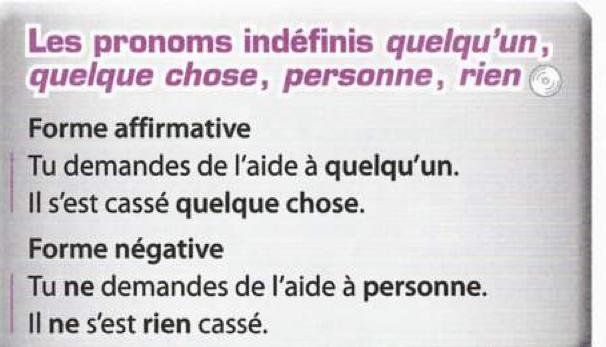
Adosphère 2, p. 79
| person | thing | |
|---|---|---|
| affirmative | quelqu'un (someone) Tu demandes de l'aide à quelqu'un. | quelque chose (something) Il s'est cassé quelque chose. |
| negative | ne… personne (nobody) Tu ne demandes de l'aide à personne. | ne… rien (nothing) Il ne s'est rien cassé. |
Leaving out ne:
In the passé composé, rien stands before the participle and personne after it: Il n'a rien compris, Je n'ai téléphoné à personne.
Ne… personne is for people, ne… rien for things: Il n'y a personne (nobody is there), Il n'y a rien (nothing is there).
(a) Tu as besoin de quelque chose ? (b) Il y a quelqu'un à l'infirmerie ? (c) Elle a appelé quelqu'un ?
Show answerHide answer
(b) Non, il n'y a personne.
(c) Non, elle n'a appelé personne.
2.4The French and humanitarian help (l'humanitaire)
In France there are many humanitarian associations, and French people give about 3 billion euros to them each year (book p. 80). Lesson 4 shows three of them.
| Association | What it does |
|---|---|
| Emmaüs | created in 1954 by l'abbé Pierre; collects objects and clothes and sells them to help people |
| Samusocial de Paris | the number 115 is "the number of solidarity": trucks drive through the night to help and talk to people sleeping in the street |
| Les Clowns de l'Espoir | clowns visit sick children in hospitals |
Other names in the module: Les Restos du Cœur (meals) and the Téléthon (a fund-raising event to help sick people). Compare with Malaysia: you can name a charity of your own country (for example the Red Crescent or a school welfare fund) when the book asks you to present one.
2.5Science in French: microbes and hygiene (Mon cours de sciences)
Page 81 is a science lesson. The word microbe comes from two Greek words, micro (small) and bios (life). Microbes are everywhere (houses, the human body, animals, objects) but we cannot see them because they are very small. Some give illnesses, so we must follow rules.
| To do (à faire) | Not to do (à ne pas faire) |
|---|---|
| Je me lave les mains avant d'aller à la cantine. Je mets mon mouchoir devant ma bouche quand je tousse. Je jette les papiers sales à la poubelle. Je me lave les mains avec de l'eau et du savon (30 secondes). Je prends une douche tous les jours. | Je mets mon stylo dans ma bouche. Je donne à manger à mon chien à table. Mon chien dort dans ma chambre. Je me lave les dents seulement le matin. |
Show answerHide answer
2.6Pronunciation and project work
The sound [ɥ] is spelled ui. Say [y] (as in tu) very quickly followed by [i]: huit, lui, aujourd'hui, cuisine, juillet, fruits, nuit. Do not say [wi] as in oui: in ui the lips stay rounded, as for [y]. Practise: Aujourd'hui, nous collectons des produits. Émilie est née le dix-huit juillet.
How to take part in a group project (apprendre à apprendre)
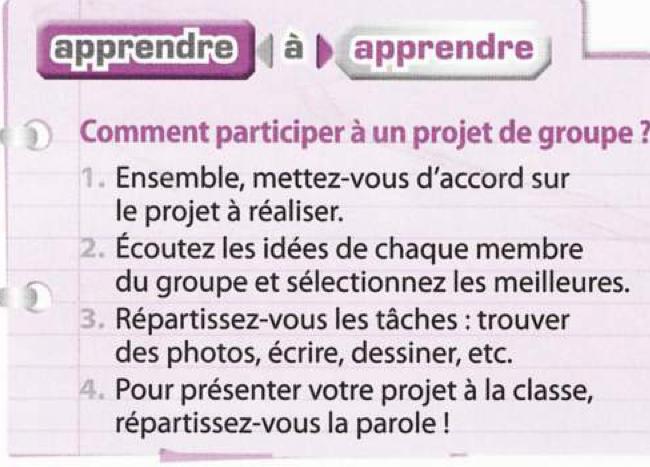
Adosphère 2, p. 83
- Agree together on the project.
- Listen to every member's ideas and choose the best.
- Share the jobs (photos, writing, drawing…).
- Share the speaking when you present to the class.
2.7Words to know (Ton dico, p. 84)

Adosphère 2, p. 84
Show answerHide answer
Summary
| Topic | Remember |
|---|---|
| COI lui / leur | one person → lui, several → leur; before the verb (Je lui téléphone, Je vais lui téléphoner, Je lui ai téléphoné); ne goes before the pronoun and pas after the conjugated verb |
| si + present | Si tu as faim, mange ! Result in the present, the near future or the imperative; s'il, s'ils |
| Needs | avoir faim, soif, chaud, froid, mal (à), peur, besoin de + noun, envie de + verb; être fatigué(e), malade, content(e) |
| Indefinite | quelqu'un / ne… personne; quelque chose / ne… rien; il n'a rien compris, je n'ai vu personne |
| First aid | une brûlure, une coupure, une chute, saigner, les pompiers, les secours, l'infirmerie |
| Sound | [ɥ] in huit, lui, aujourd'hui |
| Culture | Restos du Cœur, Emmaüs, Samusocial (115), Clowns de l'Espoir, Téléthon |
1.
2.
3.
4.
5.