Bahasa Perancis questions, module 3
Nama / NameKelas / ClassTarikh / Date
Wassim : les métiers, les qualités et la nécessité
44 marks. Use Practice to check each answer as you go, or Exam to answer everything first. The item types follow the school UASA paper: multiple choice, Partie 1 (verbs, formal questions, a word bank, job families), Partie 2 (an interview and job cards with vrai ou faux and questions) and Partie 3 (a short job card).
Section A: choix multiple
10 marksChoisissez la bonne réponse A, B, C ou D. Choose the correct answer A, B, C or D.
1
Question 1
Choisissez la bonne forme de pouvoir. Choose the correct form of pouvoir.
Tu ______ venir avec nous pour l'interview ?
Tu ______ venir avec nous pour l'interview ?
Show answerHide answer
B
Tu goes with peux (je peux, tu peux, il peut). Peut is for il / elle.
2
Question 2
Quel métier appartient à la famille « métiers de la santé » ? Which job belongs to the family "health jobs"?
Show answerHide answer
D
Un infirmier (a nurse) works in health. A baker is in trade, a gardener in nature and a footballer in sport.
3
Question 3
Que veut dire cette phrase ? What does this sentence mean?
« Pour être journaliste, il faut être curieux. »
« Pour être journaliste, il faut être curieux. »
Show answerHide answer
A
Il faut + infinitive expresses a necessity (must, have to). Il is impersonal and does not mean "he".
4
Question 4
Quelle phrase est une question formelle (avec inversion) ? Which sentence is a formal question (with inversion)?
Show answerHide answer
C
A formal question puts the verb before the subject with a hyphen: Travaillez-vous ici ? The others use est-ce que or keep the normal word order.
5
Question 5
Choisissez le féminin. Choose the feminine.
Ma mère est ______ : elle chante à l'opéra.
Ma mère est ______ : elle chante à l'opéra.
Show answerHide answer
B
The feminine of chanteur is chanteuse (book p. 91). -trice belongs to other jobs such as actrice and animatrice; there is no chantrice or chanteure.
6
Question 6
Quelle est la bonne question au passé composé ? Which is the correct question in the passé composé?
Show answerHide answer
D
Only the auxiliary moves: êtes-vous devenu. A and C keep the normal word order and B uses two question forms at the same time.
7
Question 7
Dans quel mot entend-on le son [ø] comme dans « deux » ? In which word do you hear the sound [ø] as in "deux"?
Show answerHide answer
C
Veux ends the syllable and has the closed sound [ø]. heure, vendeur, acteur have [œ] before a pronounced r.
8
Question 8
Trouvez l'intrus. Find the odd one out.
Show answerHide answer
A
Un bureau is a place (an office). The other three are jobs.
9
Question 9
Quelle phrase est correcte ? Which sentence is correct?
Show answerHide answer
C
Il ne faut pas être stressé is correct (it is in the book, p. 88). A needs the infinitive être; B must be il; D has two verbs: il faut savoir écouter.
10
Question 10
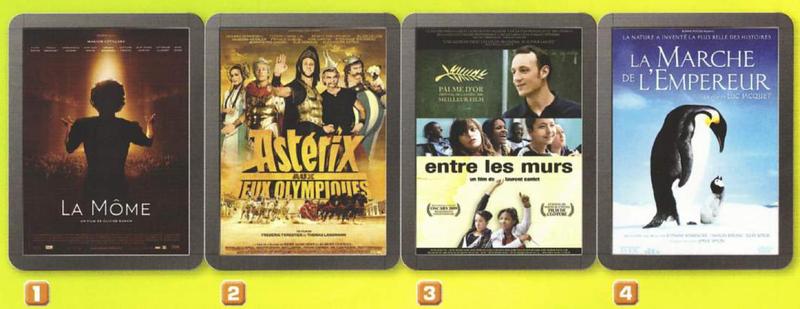
Regardez l'affiche 3. Le film « Entre les murs » a gagné la Palme d'or. Quel festival donne ce prix ? Look at poster 3. The film "Entre les murs" won the Palme d'or. Which festival gives this prize?
Show answerHide answer
B
The Palme d'or is the prize of the Festival de Cannes (book p. 89 and the poster on p. 92).
Section B: grammaire et vocabulaire (Partie 1)
16 marksRépondez à toutes les questions. Answer all the questions.
11
Question 11
Complétez le dialogue à l'aide des mots suivants. Attention : il y a deux mots en plus. Complete the dialogue with the words below. Careful: there are two extra words.
Mme Aziz – Oui, je (2) ______ vous répondre dix minutes.
Hugo – Quels métiers (3) ______-vous faits avant ?
Mme Aziz – J'ai été vendeuse. Pour faire ce métier, il (4) ______ être sociable.
pouvezpeuxavezfautontsommes
Interview
Hugo – Bonjour madame. (1) ______-vous répondre à nos questions ?Mme Aziz – Oui, je (2) ______ vous répondre dix minutes.
Hugo – Quels métiers (3) ______-vous faits avant ?
Mme Aziz – J'ai été vendeuse. Pour faire ce métier, il (4) ______ être sociable.
[1 mark]
(1)Gap (1)
Show answerHide answer
Pouvez-vous is the formal question.
Tick each point you got.
[1 mark]
(2)Gap (2)
Show answerHide answer
Je peux = I can (je takes -x).
Tick each point you got.
[1 mark]
(3)Gap (3)
Show answerHide answer
Quels métiers avez-vous faits ? (passé composé, p. 87).
Tick each point you got.
[1 mark]
(4)Gap (4)
Show answerHide answer
Il faut être sociable. ont and sommes are the extra words.
Tick each point you got.
12
Question 12
Complétez avec le verbe entre parenthèses au présent. Complete with the verb in brackets in the present tense.
Example: Je peux répondre. (pouvoir)
Example: Je peux répondre. (pouvoir)
[1 mark]
(a)Nous ______ partir à huit heures. (devoir)
Show answerHide answer
Tick each point you got.
[1 mark]
(b)Ils ______ devenir pompiers. (vouloir)
Show answerHide answer
Ils takes the plural ending -ent: veulent.
Tick each point you got.
[1 mark]
(c)Est-ce que vous ______ venir avec nous ? (pouvoir)
Show answerHide answer
Tick each point you got.
[1 mark]
(d)Elle ______ être actrice. (vouloir)
Show answerHide answer
Elle veut (third person singular).
Tick each point you got.
13
Question 13
Transformez les questions suivantes en questions formelles. Change these questions into formal questions.
Example: Est-ce que vous aimez le cinéma ? → Aimez-vous le cinéma ?
Example: Est-ce que vous aimez le cinéma ? → Aimez-vous le cinéma ?
[1 mark]
(a)Est-ce que vous aimez votre métier ?
Show answerHide answer
Tick each point you got.
[1 mark]
(b)Où est-ce que vous travaillez ?
Show answerHide answer
Tick each point you got.
[1 mark]
(c)Est-ce que vous avez rencontré des gens passionnants ?
Show answerHide answer
In the passé composé only the auxiliary avez is inverted.
Tick each point you got.
[1 mark]
(d)Qu'est-ce que vous préférez aujourd'hui ?
Show answerHide answer
Qu'est-ce que vous préférez becomes Que préférez-vous.
Tick each point you got.
14
Question 14
Dans quelle famille de métiers travaille chaque personne ? Regardez les cartes. In which job family does each person work? Look at the cards.

[1 mark]
(a)un jardinier
Show answerHide answer
les métiers de la nature
Un jardinier works with plants: the family of nature.
[1 mark]
(b)une infirmière
Show answerHide answer
les métiers de la santé
Une infirmière works in a hospital: health.
[1 mark]
(c)un journaliste
Show answerHide answer
les métiers de la communication
A journalist works in the media: communication (microphone and pencil).
[1 mark]
(d)une footballeuse
Show answerHide answer
les métiers du sport
A footballer works in sport (racket and balls).
Section C: compréhension écrite (Partie 2)
12 marksLisez les documents et répondez. Read the documents and answer.
15
Question 15
Lisez l'interview et répondez « Vrai » ou « Faux ». Read the interview and answer "Vrai" (true) or "Faux" (false).
Mme Garnier – Non. D'abord, j'ai été vendeuse dans un magasin de vêtements. Ensuite, j'ai étudié la cuisine et je suis devenue boulangère.
Le journaliste – Que devez-vous faire tous les jours ?
Mme Garnier – Je dois me lever à quatre heures, et je peux vendre mon pain à sept heures.
Le journaliste – Quelles qualités faut-il avoir ?
Mme Garnier – Il faut être organisée et résistante, et il faut aimer les gens.
Le journaliste – Que voudriez-vous faire plus tard ?
Mme Garnier – Je voudrais ouvrir un deuxième magasin.
Interview de madame Garnier, boulangère
Le journaliste – Madame Garnier, avez-vous toujours été boulangère ?Mme Garnier – Non. D'abord, j'ai été vendeuse dans un magasin de vêtements. Ensuite, j'ai étudié la cuisine et je suis devenue boulangère.
Le journaliste – Que devez-vous faire tous les jours ?
Mme Garnier – Je dois me lever à quatre heures, et je peux vendre mon pain à sept heures.
Le journaliste – Quelles qualités faut-il avoir ?
Mme Garnier – Il faut être organisée et résistante, et il faut aimer les gens.
Le journaliste – Que voudriez-vous faire plus tard ?
Mme Garnier – Je voudrais ouvrir un deuxième magasin.
[1 mark]
(a)Madame Garnier a toujours été boulangère.
Show answerHide answer
Faux
She was first a shop assistant (vendeuse).
[1 mark]
(b)Elle a étudié la cuisine.
Show answerHide answer
Vrai
J'ai étudié la cuisine.
[1 mark]
(c)Elle se lève à sept heures.
Show answerHide answer
Faux
She gets up at four o'clock (quatre heures); seven o'clock is when she can sell bread.
[1 mark]
(d)Elle voudrait ouvrir un deuxième magasin.
Show answerHide answer
Vrai
Je voudrais ouvrir un deuxième magasin.
16
Question 16
Relisez l'interview de madame Garnier et répondez en français. Read the interview again and answer in French.
Mme Garnier – Non. D'abord, j'ai été vendeuse dans un magasin de vêtements. Ensuite, j'ai étudié la cuisine et je suis devenue boulangère.
Le journaliste – Que devez-vous faire tous les jours ?
Mme Garnier – Je dois me lever à quatre heures, et je peux vendre mon pain à sept heures.
Le journaliste – Quelles qualités faut-il avoir ?
Mme Garnier – Il faut être organisée et résistante, et il faut aimer les gens.
Le journaliste – Que voudriez-vous faire plus tard ?
Mme Garnier – Je voudrais ouvrir un deuxième magasin.
Interview de madame Garnier, boulangère
Le journaliste – Madame Garnier, avez-vous toujours été boulangère ?Mme Garnier – Non. D'abord, j'ai été vendeuse dans un magasin de vêtements. Ensuite, j'ai étudié la cuisine et je suis devenue boulangère.
Le journaliste – Que devez-vous faire tous les jours ?
Mme Garnier – Je dois me lever à quatre heures, et je peux vendre mon pain à sept heures.
Le journaliste – Quelles qualités faut-il avoir ?
Mme Garnier – Il faut être organisée et résistante, et il faut aimer les gens.
Le journaliste – Que voudriez-vous faire plus tard ?
Mme Garnier – Je voudrais ouvrir un deuxième magasin.
[1 mark]
(a)Quel métier a-t-elle fait avant ? What job did she do before?
Show answerHide answer
She says J'ai été vendeuse.
Tick each point you got.
[1 mark]
(b)Qu'est-ce qu'elle a étudié ? What did she study?
Show answerHide answer
J'ai étudié la cuisine.
Tick each point you got.
[2 marks]
(c)Donnez deux qualités nécessaires pour être boulangère. Give two qualities needed to be a baker.
Show answerHide answer
Il faut être organisée et résistante, et il faut aimer les gens.
Tick each point you got.
17
Question 17
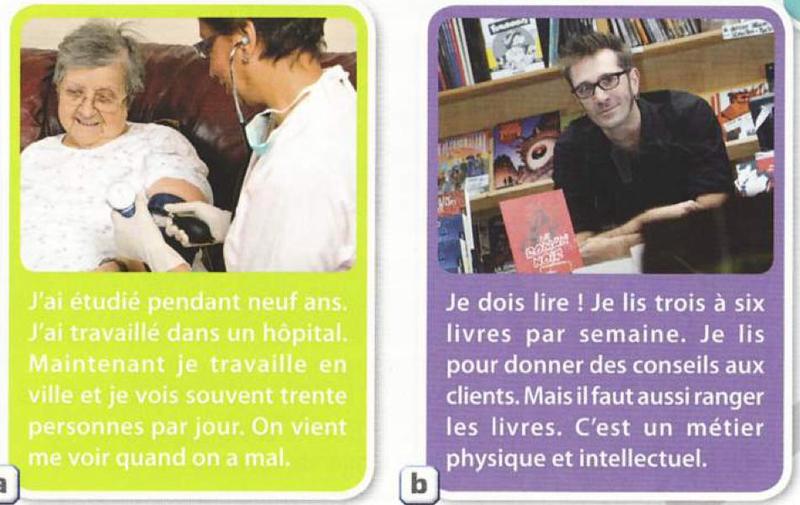
Regardez les cartes a et b et répondez. Look at cards a and b and answer.
[1 mark]
(a)Carte a : pendant combien d'années la personne a-t-elle étudié ? Card a: for how many years did the person study?
Show answerHide answer
J'ai étudié pendant neuf ans.
Tick each point you got.
[1 mark]
(b)Carte a : où travaille la personne maintenant ? Card a: where does the person work now?
Show answerHide answer
Maintenant je travaille en ville.
Tick each point you got.
[1 mark]
(c)Carte b : combien de livres la personne lit-elle par semaine ? Card b: how many books does the person read each week?
Show answerHide answer
Je lis trois à six livres par semaine.
Tick each point you got.
[1 mark]
(d)Carte b : c'est un métier seulement physique.
Show answerHide answer
Faux
The card says the job is physical and intellectual (physique et intellectuel), so the statement is false.
Section D: production écrite (Partie 3)
6 marksÉcrivez en français. Write in French.
18
Question 18
Réalisez une fiche métier : présentez le métier de vos rêves (30 à 40 mots). Write a job card: present the job of your dreams (30 to 40 words).
- Dites quel métier vous voudriez faire plus tard. Say what job you would like to do later.
- Dites où vous pouvez travailler. Say where you can work.
- Donnez deux qualités avec « il faut ». Give two qualities with "il faut".
- Dites une chose que vous devez faire pour ce métier. Say one thing you must do for this job.
[6 marks]
(a)Your job card
Show answerHide answer
Model answer: Plus tard, je voudrais être infirmière. J'aime aider les personnes malades. Je peux travailler dans un hôpital. Il faut être patiente et savoir écouter les gens. Je dois étudier pendant trois ans. (32 words)
Tick each point you got.