Scale Drawings
What this chapter covers
- Investigate and explain the relationship between the actual measurements and the measurements of various sizes of drawings of an object, and explain the meaning of scale drawing (4.1.1)
- Interpret the scale of a scale drawing, in the form 1 : n (4.1.2)
- Determine the scale, the measurement of an object or the measurement of a scale drawing (4.1.3)
- Draw the scale drawing of an object, and the object from its scale drawing (4.1.4)
- Solve problems involving scale drawings, including maps, areas and speed (4.1.5)
Navigation apps, house plans and model aircraft all rely on scale drawings. A map on your phone shows Johor Bahru and Kuala Lumpur only a few centimetres apart, yet the real distance is hundreds of kilometres. The drawing is smaller, but every length has been changed by the same proportion. This chapter shows how to read, find and use a scale, and how to draw an object to a given scale.
| English | Bahasa Melayu |
|---|---|
| scale | skala |
| scale drawing | lukisan berskala |
| object | objek |
| actual distance | jarak sebenar |
| grid | grid |
4.1Scale drawings
What is a scale drawing?
Example 1 (textbook p. 88): is it a scale drawing?
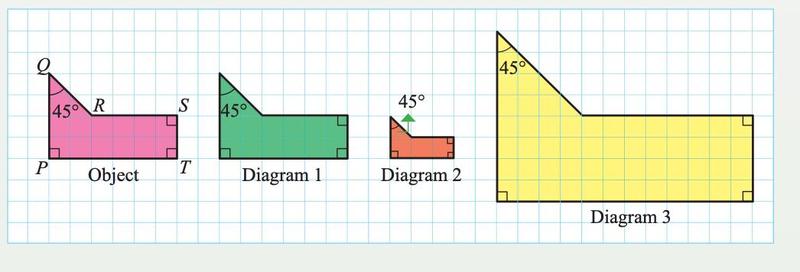
Figure: Mathematics Form 3 (DLP) textbook, p. 88.
- Diagram 1: all sides and angles are the same as the object (same size).
- Diagram 2: all sides are reduced in the same proportion, angles unchanged.
- Diagram 3: all sides are increased in the same proportion, angles unchanged.
So Diagrams 1, 2 and 3 are all scale drawings of object PQRST.
Interpreting the scale
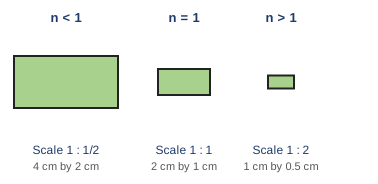
| Value of n | Example scale | The scale drawing is |
|---|---|---|
| n < 1 | 1 : 12 | bigger than the object |
| n = 1 | 1 : 1 | the same size as the object |
| n > 1 | 1 : 2 | smaller than the object |
Show answerHide answer
b) n = 14 < 1, so the drawing is bigger: every length is 4 times as long.
Determining the scale
Measure a length on the drawing and the same length on the object, then divide: scale = drawing ÷ object. On a grid you can simply count squares.
Same size of grid squares
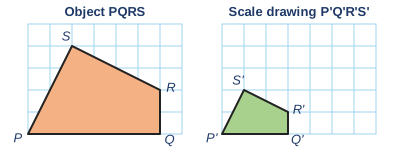
Example 2 (like textbook p. 91)
Scale = P'Q'PQ = 36 = 12, so the scale is 1 : 2. Check with PS and P'S' (the same ratio, since all lengths change by the same factor).
Different size of grid squares
If the object and the drawing use the same number of squares for each side, compare the sizes of the squares instead.
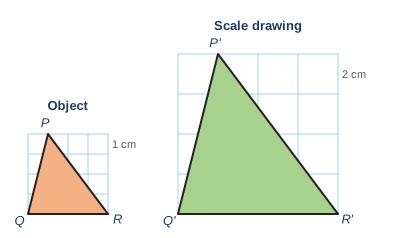
Example 4 (textbook p. 92): scale from grid sizes
Scale = grid size of drawinggrid size of object = 2 cm1 cm = 2 : 1.
Write it as 1 : n by dividing both parts by 2: 2 : 1 = 1 : 12. The drawing is bigger, so n < 1.
Show answerHide answer
Finding the actual length or the length on the drawing
| Unit conversions to remember | |
|---|---|
| 1 m | 100 cm |
| 1 km | 1 000 m = 100 000 cm |
Example 6 (textbook p. 93): map length to actual length
A map has scale 1 : 300 000. A river is 3 cm long on the map. Actual length of river:
- 3 cm × 300 000 = 900 000 cm
- 900 000 cm ÷ 100 000 = 9 km
Example 7 (textbook p. 93): scale given in units
Scale 1 cm to 10 km. A distance of 2 cm on the map is 2 × 10 km = 20 km. There is no need to change the units to cm if the question asks for km.
Example 8 (textbook p. 94): object to drawing
A square with sides of 6 cm is drawn to the scale 1 : 13. Side of the drawing = 6 cm × 3 = 18 cm (n < 1, so the drawing is bigger).
Show answerHide answer
b) 12.5 km = 1 250 000 cm; 1 250 000 ÷ 250 000 = 5 cm.
Drawing a scale drawing
There are three ways to draw the scale drawing of an object:
- use grid paper of the same size squares and change the number of squares;
- use grid paper of different size squares and keep the same number of squares;
- draw on blank paper with a ruler and protractor, using the scale.
Example 11 (like textbook p. 96): draw to the scale 1 : 2
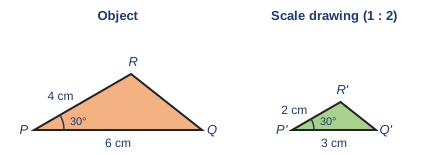
- P'Q' = 6 ÷ 2 = 3 cm and P'R' = 4 ÷ 2 = 2 cm.
- Draw P'Q' = 3 cm, use a protractor to draw a 30° angle at P', and mark R' on that line 2 cm from P'. Join Q'R'.
Example 12 (textbook p. 96-97): from the drawing back to the object
Scale 1 : 2 means every side of the object is 2 times the side of the drawing. Redraw the drawing P'Q'R'S'T' with every length doubled (for example 3 squares becomes 6 squares on equal squares), or keep the same number of squares and draw them on bigger squares (the grid size doubles).
Lengths and areas (going further)
If the scale is 1 : n, lengths change by the factor 1n. Areas change by the square of that factor, 1n × 1n.
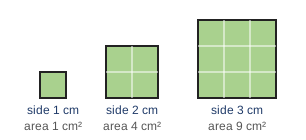
Example: the area on the drawing
A rectangle with area 60 cm² is drawn to the scale 1 : 2. Lengths are halved, so area = 60 × 12 × 12 = 60 × 14 = 15 cm², not 30 cm².
In the other direction (textbook Test Yourself, p. 101): area of drawing 112.5 cm², area of object 4.5 cm². Area ratio = 112.5 ÷ 4.5 = 25, so the length ratio is √25 = 5 and the scale is 1 : 15.
Solving problems
Example 14 (textbook p. 99): Bintulu to Miri
A map is drawn to the scale 1 cm : 50 km. Bintulu to Miri is 4 cm on the map.
- Actual distance = 4 × 50 = 200 km.
- On a map of scale 1 : 2 000 000, 200 km = 20 000 000 cm, and 20 000 000 ÷ 2 000 000 = 10 cm.
- Time at 80 km/h = distance ÷ speed = 200 ÷ 80 = 2.5 h = 2 hours 30 minutes.
Show answerHide answer
b) 32 × 20 = 640 m².
Summary
| Idea | Key fact |
|---|---|
| Scale drawing | All lengths in the same proportion, angles unchanged |
| Scale | Drawing : object = 1 : n |
| n < 1, n = 1, n > 1 | Bigger, same size, smaller |
| Grid squares of different sizes | Scale = grid size of drawing : grid size of object |
| Actual length | Length on drawing × n (change units if needed) |
| Area | Multiply by the length factor squared (for scale 1 : 2, multiply by 1/4) |