Mathematics questions, chapter 5
Nama / NameKelas / ClassTarikh / Date
Trigonometric Ratios
41 marks. Use Practice to check each answer as you go, or Exam to answer everything first. Show your working for Section B. A scientific calculator is allowed for questions that do not say 'without a calculator'.
Section A: objective questions
12 marksChoose the correct answer. Each question carries 1 mark.
1
Question 1
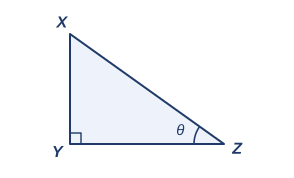
Diagram 1 shows a right-angled triangle XYZ. Which side is the opposite side of angle θ?
Show answerHide answer
C
θ is at Z. The opposite side faces θ, so it is XY. YZ touches Z (the adjacent side) and XZ is the hypotenuse, which is opposite the right angle at Y.
2
Question 2
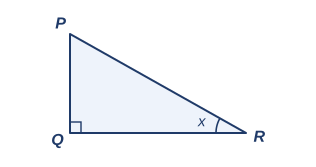
Diagram 2 shows a right-angled triangle PQR. Which expression is equal to tan x?
Show answerHide answer
A
tan x = opposite ÷ adjacent. Angle x is at R, so the opposite side is PQ and the adjacent side is QR: tan x = PQQR. PQPR is sin x and QRPR is cos x.
3
Question 3
Two right-angled triangles have the same acute angle θ, but one triangle is twice as large as the other. Which statement is correct?
Show answerHide answer
D
For a fixed acute angle, each ratio of sides is a constant. The sides double, but the ratios stay the same, so the three trigonometric ratios do not change.
4
Question 4
An acute angle θ increases from 20° to 70°. What happens to the values of sin θ and cos θ?
Show answerHide answer
B
As an acute angle gets larger, sin θ gets larger (sin 20° = 0.3420, sin 70° = 0.9397) and cos θ gets smaller (cos 20° = 0.9397, cos 70° = 0.3420).
5
Question 5
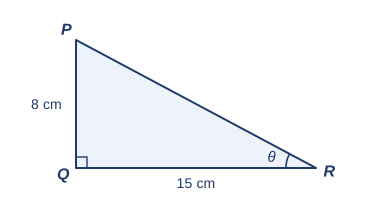
Diagram 3 shows a right-angled triangle PQR. Find the value of cos θ.
Show answerHide answer
B
PR = √(8² + 15²) = √289 = 17 cm. cos θ = adjacent ÷ hypotenuse = QRPR = 1517. 817 is sin θ and 815 is tan θ.
6
Question 6
Given that sin θ = 25 and tan θ = 2√21, find the value of cos θ.
Show answerHide answer
A
tan θ = sin θcos θ, so cos θ = sin θtan θ = 25 × √212 = √215. Check with a triangle: opposite 2, adjacent √21, hypotenuse √(4 + 21) = 5.
7
Question 7
In a right-angled triangle, the hypotenuse is 39 cm and the sine of an acute angle is 513. Find the length of the side adjacent to this angle.
Show answerHide answer
D
Opposite = 513 × 39 = 15 cm. Adjacent = √(39² − 15²) = √1296 = 36 cm. 15 cm is the opposite side.
8
Question 8
What is the value of cos 60° without using a calculator?
Show answerHide answer
C
In the half equilateral triangle with sides 1, √3 and 2, the angle 60° has adjacent side 1 and hypotenuse 2, so cos 60° = 12. √32 is cos 30° (or sin 60°).
9
Question 9
Without using a calculator, find the value of (6 sin 30°)(4 cos 60°) − 2 tan 45°.
Show answerHide answer
B
6 sin 30° = 6 × 12 = 3 and 4 cos 60° = 4 × 12 = 2, so the product is 6. 2 tan 45° = 2 × 1 = 2. 6 − 2 = 4.
10
Question 10
Express 35.4° in degrees and minutes.
Show answerHide answer
C
0.4° = 0.4 × 60′ = 24′, so 35.4° = 35° 24′. 35° 40′ wrongly writes 0.4 as 40 minutes.
11
Question 11
Given that cos x = 0.4, find the value of x in degrees and minutes.
Show answerHide answer
D
x = cos⁻¹ 0.4 = 66.42…°. 0.42…° × 60 = 25.3′, so x = 66° 25′. 23° 35′ is sin⁻¹ 0.4 (wrong key). 66° 42′ keeps the decimal digits as minutes.
12
Question 12
A point on level ground is 20 m from the foot of a tower. The angle of elevation of the top of the tower from the point is 40°. What is the height of the tower, correct to two decimal places?
Show answerHide answer
A
The height is opposite the 40° angle and the 20 m is adjacent, so use tan: height = 20 × tan 40° = 16.78 m. 12.86 is 20 sin 40°, 15.32 is 20 cos 40° and 23.84 is 20 ÷ tan 40°.
Section B: structured questions
29 marksAnswer all questions. Show your working.
13
Question 13
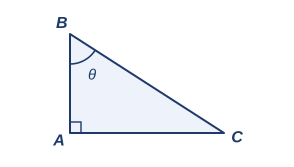
Diagram 4 shows a right-angled triangle ABC. For angle θ (∠ABC), name
[1 mark]
(a)the hypotenuse
Show answerHide answer
Tick each point you got.
[1 mark]
(b)the opposite side
Show answerHide answer
Tick each point you got.
[1 mark]
(c)the adjacent side
Show answerHide answer
The hypotenuse faces the right angle at A. The opposite side faces B and the adjacent side touches B.
Tick each point you got.
14
Question 14
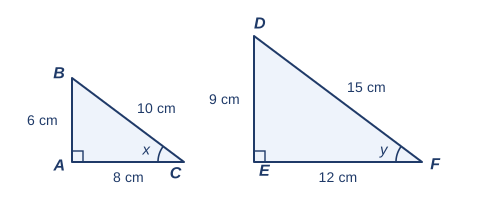
Diagram 5 shows two right-angled triangles, ABC and DEF.
[2 marks]
(a)State sin x and cos x in their simplest form.
Show answerHide answer
Tick each point you got.
[2 marks]
(b)Show that tan y = tan x. What does this tell you about angle x and angle y?
Show answerHide answer
The two triangles have sides in the same proportion (each side of DEF is 1.5 times the matching side of ABC), so the angles x and y are equal.
Tick each point you got.
15
Question 15
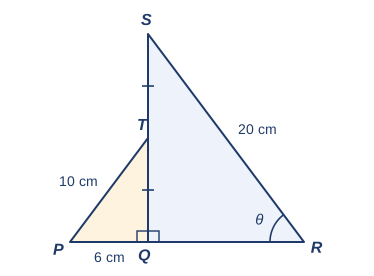
In Diagram 6, P, Q and R lie on a straight line and QS is perpendicular to PR. T is the midpoint of QS. PQ = 6 cm, PT = 10 cm and RS = 20 cm. Calculate
[1 mark]
(a)the length of TQ, in cm.
Show answerHide answer
Tick each point you got.
[1 mark]
(b)the length of SQ, in cm.
Show answerHide answer
Tick each point you got.
[1 mark]
(c)the length of QR, in cm.
Show answerHide answer
Tick each point you got.
[1 mark]
(d)cos θ, where θ = ∠QRS.
Show answerHide answer
Check: QR = 12, SQ = 16 and RS = 20 is a 3-4-5 triangle enlarged 4 times, so cos θ = 35.
Tick each point you got.
16
Question 16
Without using a calculator, find the value of each of the following. Give (b) in surd form.
[2 marks]
(a)2 cos 60° + 3 tan 45°
Show answerHide answer
Tick each point you got.
[2 marks]
(b)4 sin 60° − 3 tan 30°
Show answerHide answer
3 × 1√3 = 3√3 = √3 after rationalising.
Tick each point you got.
17
Question 17
Use a scientific calculator for this question.
[1 mark]
(a)Convert 47.6° to degrees and minutes.
Show answerHide answer
Tick each point you got.
[1 mark]
(b)Find the value of sin 52° 18′, correct to four decimal places.
Show answerHide answer
Tick each point you got.
[1 mark]
(c)Given that tan x = 0.75, find x in degrees and minutes.
Show answerHide answer
Tick each point you got.
18
Question 18
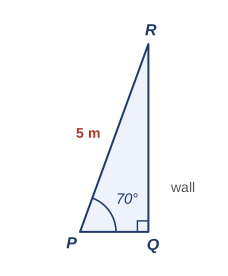
Diagram 7 shows a ladder PR of length 5 m leaning against a vertical wall. The ladder makes an angle of 70° with the horizontal ground. Calculate, correct to two decimal places,
[2 marks]
(a)the height of the top of the ladder above the ground, QR.
Show answerHide answer
Tick each point you got.
[1 mark]
(b)the distance from the foot of the ladder to the wall, PQ.
Show answerHide answer
Check with Pythagoras: √(4.70² + 1.71²) = 5.00 m.
Tick each point you got.
19
Question 19
Farid says, “60° is twice 30°, so sin 60° is twice sin 30°.” Is Farid correct? Show your working.
[2 marks]
(a)Determine whether Farid is correct.
Show answerHide answer
The values of sin, cos and tan are not proportional to the size of the angle.
Tick each point you got.
20
Question 20
Create a right-angled triangle whose three sides are whole numbers of centimetres and whose hypotenuse is longer than 20 cm.
[1 mark]
(a)Write down the three side lengths and show that they satisfy the Pythagoras theorem.
Show answerHide answer
Tick each point you got.
[1 mark]
(b)For your triangle, state tan θ, where θ is the angle opposite the shortest side.
Show answerHide answer
For 20, 21, 29: tan θ = 2021
Tick each point you got.
21
Question 21
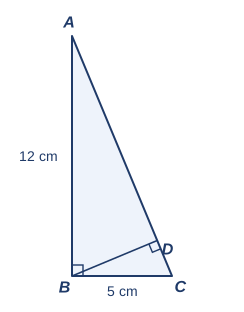
In Diagram 8, ABC is a right-angled triangle with the right angle at B, AB = 12 cm and BC = 5 cm. D is a point on AC such that BD is perpendicular to AC.
[1 mark]
(a)Calculate the length of AC.
Show answerHide answer
Tick each point you got.
[1 mark]
(b)Write down the value of sin ∠BAC.
Show answerHide answer
Tick each point you got.
[2 marks]
(c)Hence, calculate the length of BD, correct to two decimal places.
Show answerHide answer
∠BAD is the same angle as ∠BAC, so it has the same sine. Check using areas: BD = 12 × 513 = 4.62 cm.
Tick each point you got.