myUASARevision for UASA
Mathematics notes, chapter 5

Trigonometric Ratios

Textbook Mathematics Form 3 (DLP), pages 106–127

What this chapter covers

  • Identify the opposite side, the adjacent side and the hypotenuse for an acute angle in a right-angled triangle (5.1.1)
  • Make and verify the conjecture about the ratios of the sides of right-angled triangles and define sine, cosine and tangent (5.1.2)
  • Describe how changing the size of an acute angle changes the values of sine, cosine and tangent (5.1.3)
  • Determine the values of sine, cosine and tangent of acute angles from right-angled triangles (5.1.4)
  • Determine the values of sine, cosine and tangent of 30°, 45° and 60° without a calculator (5.1.5)
  • Convert between degrees and minutes and use a scientific calculator for sine, cosine, tangent and the angle for a given ratio (5.1.6)
  • Solve problems involving sine, cosine and tangent, including angles of elevation (5.1.7)

5.1Sine, cosine and tangent of acute angles in right-angled triangles

Trigonometry lets you find a length or an angle you cannot measure directly, such as the height of a building or the width of a river. Everything starts with a right-angled triangle and one acute angle.

Naming the sides: hypotenuse, opposite and adjacent
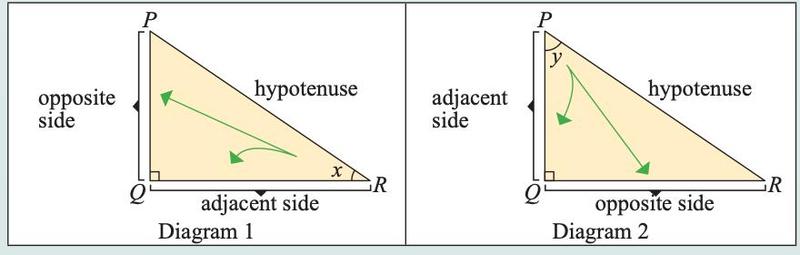
The hypotenuse is the longest side of a right-angled triangle. It is always opposite the 90° angle. The opposite side faces the angle you are looking at. The adjacent side is the other side that touches that angle.
Two copies of right-angled triangle PQR. With angle x at R, PQ is the opposite side and QR is the adjacent side. With angle y at P, QR is the opposite side and PQ is the adjacent side. PR is the hypotenuse in both.
The hypotenuse PR stays the same; the opposite and adjacent sides swap when you change the angle.

Figure: Mathematics Form 3 (DLP) textbook, p. 108.
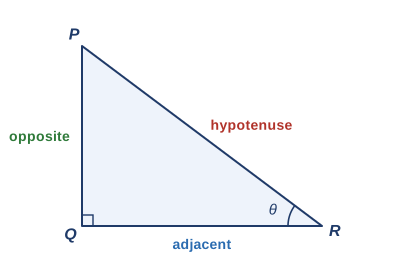
Right-angled triangle PQR with the right angle at Q. For angle theta at R, PR is the hypotenuse, PQ is the opposite side and QR is the adjacent side.
For angle θ at R: PQ is opposite (faces θ), QR is adjacent (touches θ), PR is the hypotenuse.
An acute angle is between 0° and 90°. The two acute angles of a right-angled triangle add up to 90°, so if one is x, the other is 90° − x.
Example 1 (textbook p. 109)
Triangle ABC has its right angle at B.
For ∠BAC: hypotenuse AC, opposite side BC, adjacent side AB.
For ∠BCA: hypotenuse AC, opposite side AB, adjacent side BC.
Mixing up opposite and adjacent. They depend on which angle you are using. Always mark the angle first, then name the side that faces it (opposite) and the side that touches it (adjacent).
Triangle DEF has its right angle at E. For ∠EDF, name the hypotenuse, the opposite side and the adjacent side.
Show answerHide answer
Hypotenuse DF (opposite the right angle at E).
Opposite side EF (faces D).
Adjacent side DE (touches D).

Defining sine, cosine and tangent

Draw a right-angled triangle, then draw lines parallel to one side to make smaller and larger triangles with the same acute angle (textbook Brainstorming 1, p. 110). The sides all change, but the ratios of the sides do not.

For a fixed acute angle, the ratio opposite ÷ hypotenuse, the ratio adjacent ÷ hypotenuse and the ratio opposite ÷ adjacent are each a constant. They are called:
sin θ = opposite sidehypotenuse    cos θ = adjacent sidehypotenuse    tan θ = opposite sideadjacent side
Say "sine", "cosine" and "tangent". The word trigonometry comes from the Greek trigonon (triangle) and metron (to measure). Many students remember the three ratios as SOH, CAH, TOA.
Example 2 (textbook p. 111)
Triangle PQR has its right angle at Q. Angle x is at P and angle y is at R.
sin x = QRPR   cos x = PQPR   tan x = QRPQ
sin y = PQPR   cos y = QRPR   tan y = PQQR
Notice that sin x = cos y. The side that is opposite one angle is adjacent to the other.
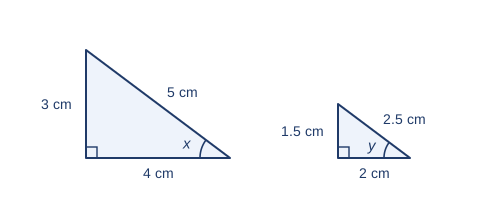
Example 3 (textbook p. 113): same angle, different size
Two right-angled triangles. The first has sides 3 cm, 4 cm and 5 cm. The second has sides 1.5 cm, 2 cm and 2.5 cm. Angle x is in the first triangle and angle y is in the second.
First triangle: sin x = 35, cos x = 45, tan x = 34.
Second triangle: sin y = 1.52.5 = 35, cos y = 22.5 = 45, tan y = 1.52 = 34.
All three ratios are equal because the corresponding sides of the two triangles are in proportion. So angle x = angle y.
A right-angled triangle has sides 5 cm, 12 cm and 13 cm. Write sin θ, cos θ and tan θ for the angle θ that is opposite the 5 cm side.
Show answerHide answer
The hypotenuse is 13 cm. Opposite = 5 cm, adjacent = 12 cm.
sin θ = 513, cos θ = 1213, tan θ = 512

How the size of the angle changes sin, cos and tan

The values below were found with a calculator (to 4 decimal places). In textbook Brainstorming 2 (p. 112) you draw triangles with a 10 cm base and measure; your drawn values will be close to these.

θ10°20°30°40°50°60°70°80°
sin θ0.17360.34200.50000.64280.76600.86600.93970.9848
cos θ0.98480.93970.86600.76600.64280.50000.34200.1736
tan θ0.17630.36400.57740.83911.19181.73212.74755.6713
As an acute angle gets larger: sin θ gets larger (towards 1), cos θ gets smaller (towards 0), and tan θ gets larger.
Limits: sin 0° = 0, cos 0° = 1, tan 0° = 0; sin 90° = 1, cos 90° = 0, and tan 90° is undefined (it grows without limit).
Thinking cos θ also gets bigger when the angle gets bigger. It does the opposite: cos 80° is much smaller than cos 10°. Also, sin and cos of an acute angle are never greater than 1, but tan can be.
Without a calculator, which is larger: sin 35° or sin 65°? cos 35° or cos 65°?
Show answerHide answer
sin 65° is larger (sine increases with the angle).
cos 35° is larger (cosine decreases as the angle increases).

Finding the values of sin, cos and tan from a triangle
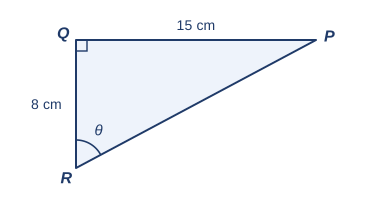
Use the Pythagoras theorem, c² = a² + b², to find the missing side first. Give each ratio in its simplest form.
Example 4 (textbook p. 114)
Right-angled triangle PQR with the right angle at Q, PQ = 15 cm and QR = 8 cm
PQ = 15 cm, QR = 8 cm.
(a) PR = √(15² + 8²) = √289 = 17 cm
(b) sin ∠PRQ = oppositehypotenuse = PQPR = 1517
(c) cos ∠PRQ = QRPR = 817
(d) tan ∠QPR = QRPQ = 815
In triangle PQR, the right angle is at Q, PQ = 24 cm and QR = 7 cm. Find PR, sin ∠PRQ and tan ∠QPR.
Show answerHide answer
PR = √(24² + 7²) = √625 = 25 cm
sin ∠PRQ = PQPR = 2425
tan ∠QPR = QRPQ = 724
Example 5 (textbook p. 114): two triangles sharing a side
P, Q and R lie on a straight line, and T is the midpoint of the line SQ, which is perpendicular to PR. PQ = 4 cm, SQ = 6 cm and RS = 10 cm. Find (a) QR, (b) PT, (c) sin ∠QRS, (d) cos ∠TPQ, (e) tan ∠PTQ.
TQ = 6 ÷ 2 = 3 cm.
(a) QR = √(10² − 6²) = √64 = 8 cm
(b) PT = √(4² + 3²) = √25 = 5 cm
(c) sin ∠QRS = SQRS = 610 = 35
(d) cos ∠TPQ = PQPT = 45
(e) tan ∠PTQ = PQTQ = 43

The relationship between sin, cos and tan

Draw a right-angled triangle with hypotenuse 1. Then the opposite side is x = sin θ and the adjacent side is y = cos θ. Since tan θ = oppositeadjacent:

tan θ = sin θcos θ
Example 6 (textbook p. 115)
sin θ = 0.6 and cos θ = 0.8, so tan θ = 0.60.8 = 34 = 0.75.
Example 7 (textbook p. 115): find cos θ
sin θ = 38 and tan θ = 3√55. Since tan θ = sin θcos θ, cos θ = sin θtan θ.
cos θ = 38 ÷ 3√55 = 38 × √553 = √558
Given sin θ = 25 and cos θ = √215, find tan θ.
Show answerHide answer
tan θ = sin θcos θ = 25 ÷ √215 = 2√21

Using a given ratio to find a side

Example 8 (textbook p. 116)
Triangle PQR has its right angle at Q, PR = 20 cm and sin ∠QPR = 35.
(a) QRPR = 35, so QR = 35 × 20 = 12 cm
(b) PQ = √(20² − 12²) = √256 = 16 cm, so cos ∠QPR = PQPR = 1620 = 45
Example 9 (textbook p. 116): two triangles joined
P, Q and R lie on a straight line and S, T and Q lie on a straight line. T is the midpoint of SQ. PQ = 12 cm, PT = 13 cm and RS = 26 cm. Find cos x, where x = ∠SRQ.
TQ = √(13² − 12²) = 5 cm, so SQ = 2 × 5 = 10 cm.
RQ = √(26² − 10²) = √576 = 24 cm.
cos x = RQRS = 2426 = 1213
Leaving a ratio as 2426. The textbook asks for ratio values in the simplest form: write 1213.
Triangle ABC has its right angle at B, AC = 30 cm and sin ∠BAC = 45. Find BC, AB and cos ∠BAC.
Show answerHide answer
BC = 45 × 30 = 24 cm
AB = √(30² − 24²) = √324 = 18 cm
cos ∠BAC = 1830 = 35

Special angles: 30°, 45° and 60° without a calculator

Half of an equilateral triangle with side 2 gives a right-angled triangle with angles 30° and 60° and sides 1, √3 and 2. An isosceles right-angled triangle with two sides of 1 has hypotenuse √2 and angles 45°.
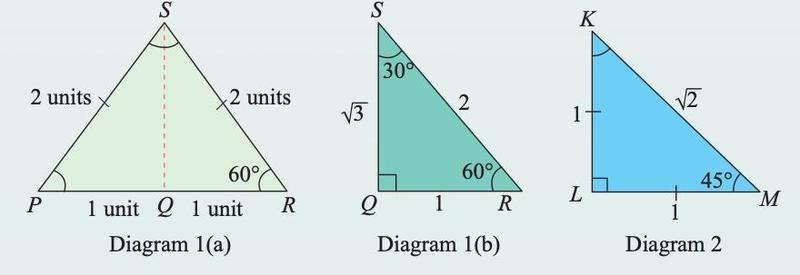
An equilateral triangle PRS with side 2 units cut in half by SQ; the half triangle has sides 1, root 3 and 2 with angles 30 and 60 degrees; and an isosceles right-angled triangle KLM with legs 1 and hypotenuse root 2 with a 45 degree angle

Figure: Mathematics Form 3 (DLP) textbook, p. 119.

θ30°45°60°
sin θ121√2√32
cos θ√321√212
tan θ1√31√3
You can rebuild the table from the two triangles: sin 30° = cos 60° and sin 60° = cos 30°. Rationalise with 1√2 = √22 and √2 × √2 = 2.
Example 11 (textbook p. 119)
(a) sin 45° + cos 45° = 1√2 + 1√2 = 2√2 = √2
(b) 3 cos 30° − 2 sin 60° = 3(√32) − 2(√32) = 3√32 − 2√32 = √32
(c) 2 tan 45° − 2 cos 60° = 2(1) − 2(12) = 2 − 1 = 1
Without a calculator, find (a) 4 sin 30° + tan 60° × tan 30° (b) (2 cos 45°)(3 sin 45°).
Show answerHide answer
(a) 4(12) + (√3)(1√3) = 2 + 1 = 3
(b) (2 × 1√2)(3 × 1√2) = 62 = 3

Degrees, minutes and seconds

1° = 60′ (60 minutes) and 1′ = 60″ (60 seconds). To convert 0.1° to minutes, multiply by 60.
Example 12 (textbook p. 120)
(a) 30.2° = 30° + 0.2° = 30° + (0.2 × 60)′ = 30° 12′
(b) 43° 30′ = 43° + 3060° = 43° + 0.5° = 43.5°
(a) Convert 52.4° to degrees and minutes. (b) Convert 36° 45′ to degrees.
Show answerHide answer
(a) 0.4 × 60 = 24, so 52° 24′
(b) 45 ÷ 60 = 0.75, so 36.75°

Using a scientific calculator

Make sure the calculator is in degree mode (the display shows D or DEG).

Example 13 (textbook p. 121): angle to ratio (4 d.p.)
(a) sin 45° 6′ = 0.7083 (use the ° ′ ″ key for the minutes)
(b) cos 20.7° = 0.9354
(c) tan 64° 12′ = 2.0686
Example 14 (textbook pp. 121–122): ratio to angle
(a) sin x = 0.8377, so x = sin⁻¹ 0.8377 = 56.898…° = 56° 54′
(b) cos x = 0.7021, so x = cos⁻¹ 0.7021 = 45.404…° = 45° 24′
(c) tan x = 2.4876, so x = tan⁻¹ 2.4876 = 68.100…° = 68° 6′
When you convert to minutes, a remainder of 30″ or more adds 1′. In (a) the calculator shows 56° 53′ 52.93″, which becomes 56° 54′.
Using sin⁻¹ when the question gives a cosine ratio (or the other way round). Match the inverse key to the ratio in the question. Also, sin⁻¹ 0.5 is not 1sin 0.5; it is the angle whose sine is 0.5.
Use a calculator. (a) tan 38.5° to 4 d.p. (b) Find x if cos x = 0.8, in degrees and minutes.
Show answerHide answer
(a) tan 38.5° = 0.7954
(b) x = cos⁻¹ 0.8 = 36.87…° = 36° 52′

Solving problems
Follow four steps: understand the problem (draw the right-angled triangle and mark the angle), plan (which ratio uses the sides you have and the side you want), implement (calculate) and conclude (answer with units and the required accuracy).
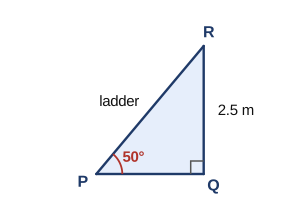
Example 15 (textbook p. 122): the ladder
A ladder PR leans against a wall. Right-angled triangle PQR with angle P = 50 degrees and QR = 2.5 m.
The height QR is opposite the 50° angle and the ladder PR is the hypotenuse, so use sine.
sin 50° = QRPR = 2.5PR
PR = 2.5sin 50° = 3.26 m (2 d.p.)
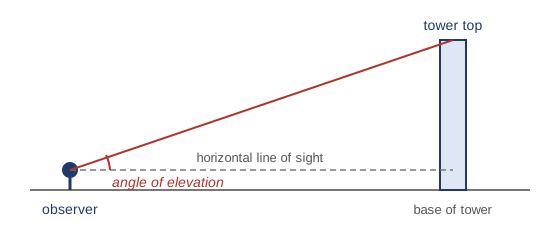
The angle of elevation is measured upwards from the horizontal. The angle of depression is measured downwards from the horizontal. Alternate angles make the two equal.
An observer on the ground looks up at the top of a tower. The angle between the horizontal line of sight and the line to the top is the angle of elevation.
Angle of elevation.
Example 16 (textbook pp. 122–123): angle in a cuboid
In cuboid ABCDEFGH, BC = 8 cm, CH = 5 cm and HE = 4 cm. Find ∠FCG.
FG = HE = 4 cm. In the base, CG = √(8² + 5²) = √89 cm.
tan ∠FCG = FGCG = 4√89, so ∠FCG = tan⁻¹ 4√89 = 22.98° = 22° 59′.
A 6 m ladder leans against a wall and makes 65° with the ground. How high up the wall does it reach? (2 d.p.)
Show answerHide answer
Height is opposite 65°, ladder is the hypotenuse: sin 65° = h6
h = 6 × sin 65° = 5.44 m

Content and examples follow Mathematics Form 3 (DLP) textbook, Chapter 5, pp. 108–123.