Mathematics notes, chapter 6
Angles and Tangents of Circles
Textbook Mathematics Form 3 (DLP), pages 128–167
What this chapter covers
- Recognise the angle at the circumference and the central angle subtended by an arc, verify the relationships between them (same arc, arc length, twice the central angle, angle in a semicircle) and solve problems (6.1)
- Recognise cyclic quadrilaterals, use the relationships between their angles (opposite angles add up to 180°, exterior angle equals the opposite interior angle) and solve problems (6.2)
- Recognise tangents to circles and points of tangency, and verify that the radius is perpendicular to the tangent at the point of tangency (6.3)
- Use the properties of two tangents from a point and the angle in the alternate segment, and solve problems involving tangents and common tangents (6.3)
- Solve problems that combine angles in circles, cyclic quadrilaterals and tangents (6.4)
6.1Angle at the circumference and central angle subtended by an arc
Chord: a straight line joining two points on the circle. Arc: part of the circumference. The shorter arc is the minor arc, the longer one is the major arc. A chord subtends (cuts off) an arc, and an angle is "subtended by an arc" when its two arms end at the two ends of that arc.
| Angle | Where its vertex is | Example in a circle with centre O |
|---|---|---|
| Angle at the circumference | On the circumference | ∠PRQ, subtended by arc PQ |
| Central angle | At the centre O | ∠POQ, subtended by the same arc PQ |
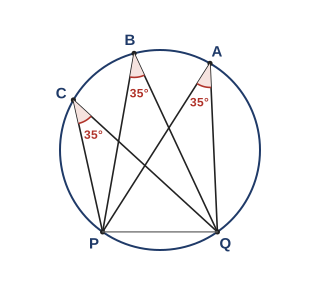
The four rules
| Rule | In words |
|---|---|
| 1. Same arc | Angles at the circumference subtended by the same arc are equal. |
| 2. Arc length | Angles at the circumference subtended by arcs of equal length are equal. The angle is proportional to the arc length: twice the arc, twice the angle. |
| 3. Centre and circumference | The central angle is twice the angle at the circumference subtended by the same arc. |
| 4. Diameter | The angle at the circumference subtended by a diameter is 90° (an angle in a semicircle). |
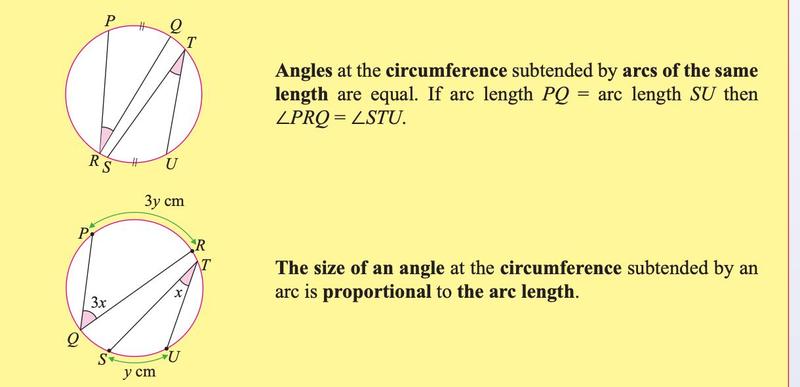
Textbook figure: Mathematics Form 3 (DLP), p. 136.
Example 1 (textbook p. 139): central angle and angle at the circumference
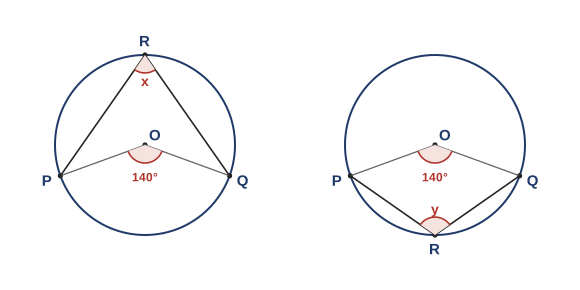
Left, R is on the major arc: x = ½ × 140° = 70°.
Right, R is on the minor arc, so it sees the major arc, whose central angle is 360° − 140° = 220°: y = ½ × 220° = 110°.
Check: x + y = 180°.
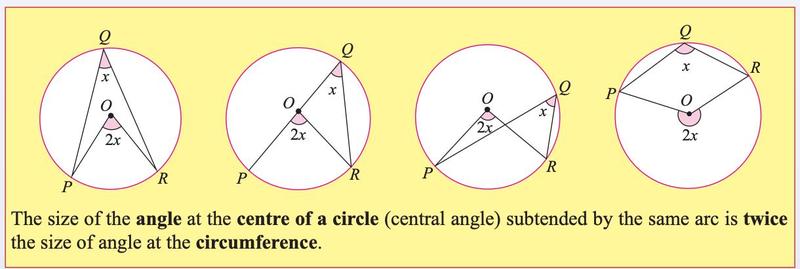
Textbook figure: Mathematics Form 3 (DLP), p. 139.
Halving the central angle only works when the point on the circumference is on the major arc side. If the point is on the minor arc, it sees the other (reflex) central angle, 360° − ∠POQ, and the angle at the circumference is half of that, so it is more than 90°.
Example 2 (textbook p. 136): arc length and angle
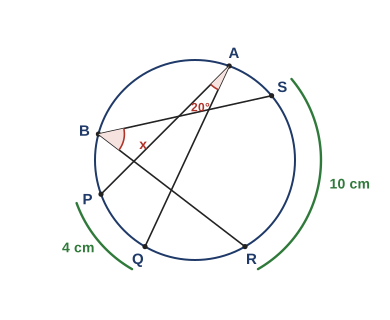
x ÷ 20° = 10 cm ÷ 4 cm
x = 20° × 10 ÷ 4 = 50°
Central angles follow the same two rules: equal arcs give equal central angles, and the central angle is proportional to the arc length. So 4 cm of arc is 40° at the centre and 20° at the circumference, and a whole circle of 360° is 36 cm.
Example 3 (textbook p. 142): angle in a semicircle
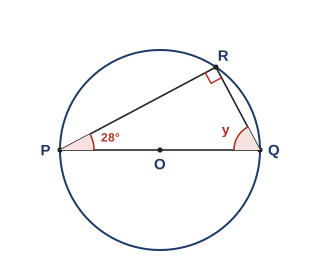
Angles in triangle PQR add up to 180°: y = 180° − 90° − 28° = 62°.
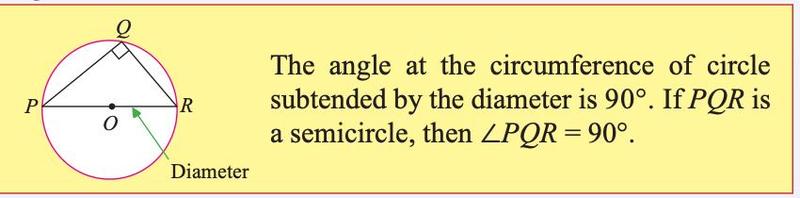
Textbook figure: Mathematics Form 3 (DLP), p. 142.
(a) Arc AB subtends 22° at the circumference. Arc CD is three times as long as arc AB. What angle does arc CD subtend at the circumference?
(b) In a circle with centre O, ∠POQ = 130°. Find ∠PRQ when R is on the major arc, and when R is on the minor arc.
(c) AB is a diameter and C is on the circle. ∠CAB = 40°. Find ∠ABC.
(b) In a circle with centre O, ∠POQ = 130°. Find ∠PRQ when R is on the major arc, and when R is on the minor arc.
(c) AB is a diameter and C is on the circle. ∠CAB = 40°. Find ∠ABC.
Show answerHide answer
(a) 3 × 22° = 66°
(b) Major arc: ½ × 130° = 65°. Minor arc: ½ × (360° − 130°) = 115°
(c) ∠ACB = 90°, so ∠ABC = 180° − 90° − 40° = 50°
(b) Major arc: ½ × 130° = 65°. Minor arc: ½ × (360° − 130°) = 115°
(c) ∠ACB = 90°, so ∠ABC = 180° − 90° − 40° = 50°
6.2Cyclic quadrilaterals
A cyclic quadrilateral is a four-sided figure whose four vertices all lie on the circumference of a circle. If even one vertex is inside or outside the circle, it is not cyclic. Opposite angles are the two angles that face each other, such as ∠A and ∠C.

Textbook figure: Mathematics Form 3 (DLP), p. 145.
Example 4 (textbook p. 146): opposite angles
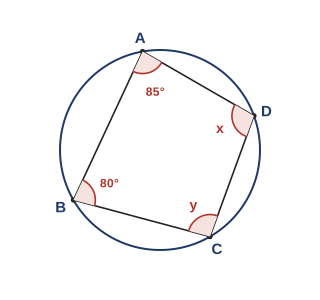
y is opposite ∠DAB: y = 180° − 85° = 95°.
Check: the four angles add up to 80° + 100° + 85° + 95° = 360°.
Exterior angle of a cyclic quadrilateral
Extend one side of a cyclic quadrilateral. The angle formed outside is the exterior angle. It is equal to the opposite interior angle (the interior angle at the vertex facing it).
Example 5 (textbook p. 147): exterior angle
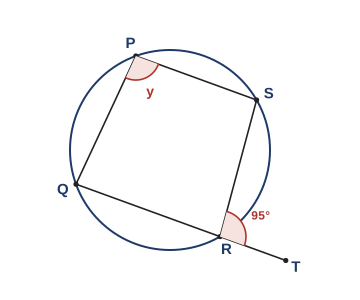
∠SPQ is opposite ∠QRS, so y = 180° − 85° = 95°.
So the exterior angle equals the opposite interior angle: y = 95°. Use this shortcut to skip a step.
Name opposite angles by going across the quadrilateral: in PQRS, ∠P and ∠R are opposite, and so are ∠Q and ∠S.
Adding the two adjacent angles (next to each other) to get 180°. Only opposite angles add to 180°. Adjacent angles in a cyclic quadrilateral have no fixed sum.
(a) In cyclic quadrilateral PQRS, ∠PQR = 72°. Find ∠PSR.
(b) A side of a cyclic quadrilateral is extended and the exterior angle is 64°. What is the opposite interior angle?
(b) A side of a cyclic quadrilateral is extended and the exterior angle is 64°. What is the opposite interior angle?
Show answerHide answer
(a) ∠PSR = 180° − 72° = 108°
(b) 64° (exterior angle = opposite interior angle)
(b) 64° (exterior angle = opposite interior angle)
6.3Tangents to circles
A tangent to a circle is a straight line that touches the circle at only one point. That point is the point of tangency. A line that cuts the circle at two points is not a tangent.
Tangent and radius
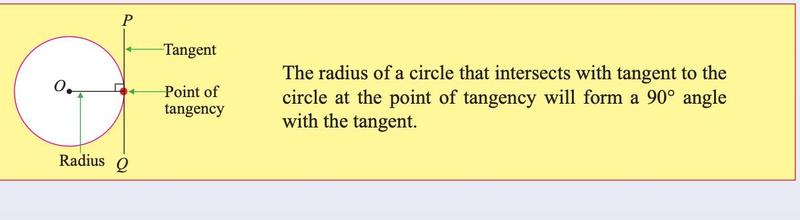
Textbook figure: Mathematics Form 3 (DLP), p. 152.
The radius drawn to the point of tangency is perpendicular to the tangent: the angle between them is 90°.
Example 6 (textbook p. 152): tangent and radius
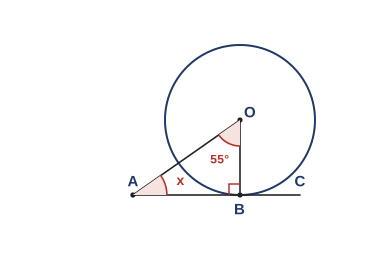
In triangle OAB: x = 180° − 90° − 55° = 35°.
Two tangents from one point

Textbook figure: Mathematics Form 3 (DLP), p. 154.
If tangents from a point P touch a circle with centre O at A and B, then:
- the two tangent lengths are equal: PA = PB
- ∠AOP = ∠BOP and ∠OPA = ∠OPB (OP bisects the angles)
- ∠OAP = ∠OBP = 90°, so OAPB is a kite
Example 7 (textbook p. 154): two tangents
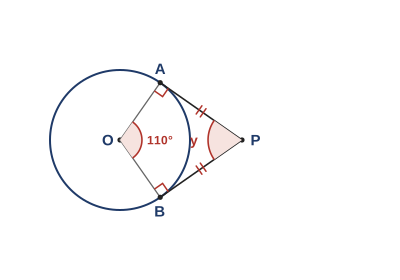
y = 360° − 90° − 90° − 110° = 70°
OP bisects ∠APB, so ∠OPA = 35°.
In the right-angled triangle OAP, use Pythagoras or trigonometry: OP² = OA² + AP². For example OA = 5 cm and OP = 13 cm give AP = √(13² − 5²) = 12 cm.
Angle in the alternate segment
The angle between a tangent and a chord at the point of tangency is equal to the angle in the alternate segment, that is the angle at the circumference on the opposite side of the chord, subtended by the same chord.

Textbook figure: Mathematics Form 3 (DLP), p. 155.
Example 8 (textbook p. 156): alternate segment
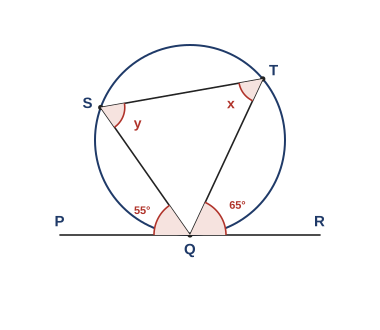
y = ∠QST is in the alternate segment of chord QT, so y = ∠RQT = 65°.
Check with the triangle: ∠SQT = 180° − 55° − 65° = 60°, and 55° + 60° + 65° = 180° on the straight line PQR.
Using the angle on the same side of the chord. The matching angle is always across the chord, in the alternate segment. A common slip is to match ∠PQS with ∠QST, which belongs to the other chord, QT.
Common tangents to two circles
A common tangent touches both circles. How many there are depends on how the circles sit.
| Position of the two circles | Common tangents |
|---|---|
| Not touching each other | 4 |
| Touching at one point | 3 |
| Intersecting (cutting each other at two points) | 2 |
| Overlapping (one circle inside the other, touching at one point) | 1 |
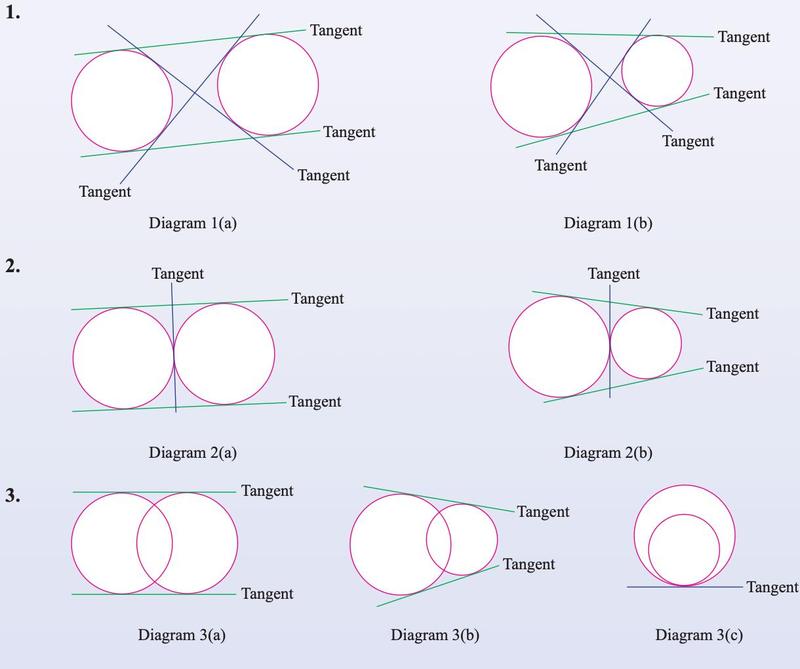
Textbook figure: Mathematics Form 3 (DLP), p. 157.
Example 9 (textbook p. 158): length of a common tangent
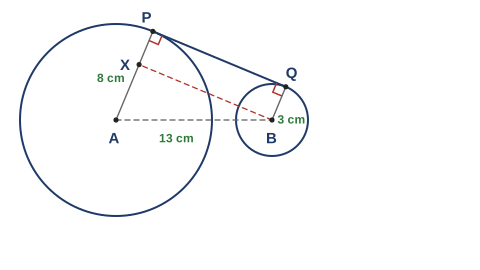
AX = AP − PX = 8 − 3 = 5 cm.
In right-angled triangle AXB: BX² = AB² − AX² = 13² − 5² = 144, so PQ = BX = 12 cm.
(a) PA and PB are tangents to a circle with centre O. ∠APB = 50°. Find ∠AOB.
(b) The radius of a circle is 7 cm and a point P is 25 cm from the centre. Find the length of the tangent from P.
(c) A tangent and a chord make an angle of 38° at the point of tangency. What is the angle in the alternate segment?
(b) The radius of a circle is 7 cm and a point P is 25 cm from the centre. Find the length of the tangent from P.
(c) A tangent and a chord make an angle of 38° at the point of tangency. What is the angle in the alternate segment?
Show answerHide answer
(a) ∠AOB = 360° − 90° − 90° − 50° = 130°
(b) √(25² − 7²) = √576 = 24 cm
(c) 38°
(b) √(25² − 7²) = √576 = 24 cm
(c) 38°
6.4Angles and tangents of circles
Many problems use two or three of the rules. Draw the diagram, mark what you know, and give a reason for each step.
| What you see | Rule to use |
|---|---|
| Two angles at the circumference on the same arc | Equal |
| An angle at the centre and one at the circumference on the same arc | Central angle = 2 × angle at the circumference |
| A diameter | Angle at the circumference = 90° |
| Four vertices on a circle | Opposite angles add to 180°; exterior = opposite interior |
| A tangent and a radius | Angle = 90° |
| Two tangents from one point | Equal lengths; kite OAPB |
| A tangent and a chord | Angle = angle in the alternate segment |
| Radii OA and OB | Isosceles triangle OAB: equal base angles |
Example 10 (textbook p. 160): combined problem
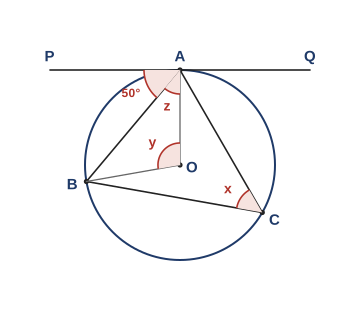
(b) y = ∠AOB is the central angle on the same arc AB, so y = 2 × 50° = 100°.
(c) OA = OB (radii), so triangle OAB is isosceles: z = (180° − 100°) ÷ 2 = 40°.
Check: OA is a radius to the point of tangency, so ∠OAP = 90° and z = 90° − 50° = 40°. Both routes agree.
When two different routes give the same answer you can be confident. In the example above, the isosceles triangle and the tangent-radius right angle both give 40°.
PA is a tangent at A to a circle with centre O. B is on the circle and ∠PAB = 64°. Find ∠AOB and ∠OAB.
Show answerHide answer
Angle in the alternate segment = 64°, so ∠AOB = 2 × 64° = 128°.
∠OAB = 90° − 64° = 26° (check: (180° − 128°) ÷ 2 = 26°)
∠OAB = 90° − 64° = 26° (check: (180° − 128°) ÷ 2 = 26°)