Mathematics questions, chapter 8
Nama / NameKelas / ClassTarikh / Date
Loci in Two Dimensions
41 marks. Use Practice to check each answer as you go, or Exam to answer everything first. In Section B, show your working; a ruler and a pair of compasses help you check the diagrams.
Section A: objective questions
12 marksChoose the correct answer. Each question carries 1 mark.
1
Question 1
Which statement best describes a locus?
Show answerHide answer
C
A locus is the trace or path formed by all the points that satisfy certain conditions. It can be a straight line, an arc or a curve.
2
Question 2
A durian falls straight down from a tree. What is the locus of a point on the durian?
Show answerHide answer
A
The durian moves straight downwards, so any point on it traces a vertical straight line. A circle or an arc needs a turning motion about a fixed point.
3
Question 3
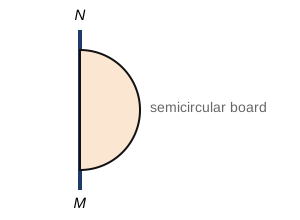
Diagram 1 shows a semicircular board fixed to the pole MN along its diameter. The board is rotated 360° about MN. What three-dimensional shape is formed?
Show answerHide answer
D
Rotating a semicircle 360° about its diameter sweeps out a whole sphere. A hemisphere is only half of this solid: it is formed by a quarter circle turned about one of its straight edges.
4
Question 4
A point P always moves 4 cm from a fixed point O. What is the locus of P?
Show answerHide answer
B
The constant distance from O is the radius, so the locus is a circle with centre O and radius 4 cm. A circle that passes through O would have O on its edge, not at its centre.
5
Question 5
What is the locus of a point that is equidistant from two fixed points M and N?
Show answerHide answer
A
Points that are the same distance from M and from N lie on the perpendicular bisector of MN: a straight line through the midpoint of MN at 90° to it.
6
Question 6
A straight road AB is very long. A point X always moves 2.5 cm from AB. What is the distance between the two lines that make the locus of X?
Show answerHide answer
D
The locus is a pair of lines parallel to AB, one on each side, each 2.5 cm from AB. The distance between them is 2.5 + 2.5 = 5 cm. 2.5 cm is the distance from AB to one line only.
7
Question 7
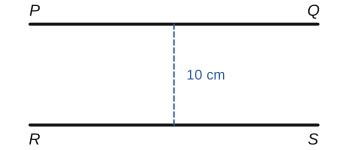
In Diagram 2, PQ and RS are parallel lines 10 cm apart. What is the locus of a point that is equidistant from PQ and RS?
Show answerHide answer
C
The locus is one straight line parallel to both lines and halfway between them: 10 ÷ 2 = 5 cm from each. A pair of lines would be the locus of a point 5 cm from one line.
8
Question 8
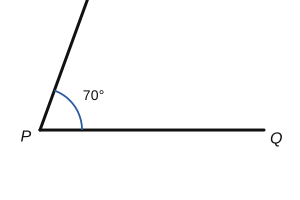
In Diagram 3, ∠QPR = 70°. Z is a point that is always the same distance from PQ and from PR. What angle does the locus of Z make with PQ?
Show answerHide answer
B
The locus is the angle bisector of ∠QPR. It cuts 70° into two equal parts, so it makes 70° ÷ 2 = 35° with PQ.
9
Question 9
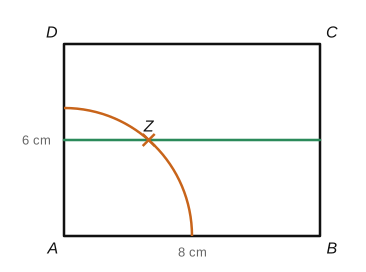
In Diagram 4, ABCD is a rectangle with AB = 8 cm and AD = 6 cm. X is a point that is always 4 cm from A. Y is a point that is equidistant from AB and DC. The loci of X and Y meet at Z inside the rectangle. What is the distance of Z from AD?
Show answerHide answer
A
The locus of Y is 3 cm above AB (half of 6 cm). Z is 4 cm from A, so its distance from AD is √(4² − 3²) = √7 ≈ 2.6 cm. 3 cm is the height of Z, 4 cm is the radius and 5 cm comes from adding the squares instead of subtracting.
10
Question 10
A point is the same distance from the x-axis and the y-axis, and is less than 5 units from the origin O. Which point could it be?
Show answerHide answer
C
The point must have equal coordinates (or opposite ones), so (4, 2) is out. Distance from O: (4, 4) is √32 ≈ 5.7 and (−6, 6) is √72 ≈ 8.5, both more than 5. (3, 3) is √18 ≈ 4.2, which is less than 5.
11
Question 11
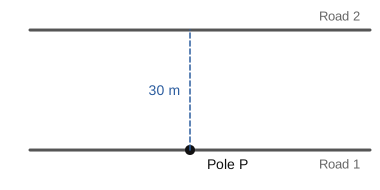
In Diagram 5, Road 1 and Road 2 are parallel and 30 m apart. P is a pole on Road 1. A tree is to be planted equidistant from the two roads and 15 m from P. How many positions are possible?
Show answerHide answer
D
Equidistant from the roads means on the middle line, 15 m from each road and so 15 m from P at the closest. The circle of radius 15 m about P only touches this line, at one point directly above P. One position.
12
Question 12
Aiman wants to construct the locus of points equidistant from P and Q, where PQ = 8 cm. He sets his compasses to 3 cm and draws arcs from P and from Q. What happens?
Show answerHide answer
B
The compasses must be set to more than half of PQ, which is more than 4 cm. With 3 cm, an arc from P reaches only 3 cm and an arc from Q reaches only 3 cm, so they stop 2 cm short of meeting.
Section B: structured questions
29 marksAnswer all questions. Give your reasons and show your working.
13
Question 13
Diagram 6 shows a line segment PQ of length 6 cm. X is a point that is always 2.5 cm from P. Y is a point that is always the same distance from P and from Q.
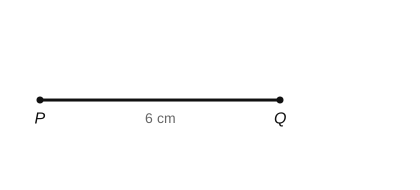
[2 marks]
(a)Describe the locus of X completely.
Show answerHide answer
Tick each point you got.
[2 marks]
(b)Describe the locus of Y completely.
Show answerHide answer
Tick each point you got.
14
Question 14
Diagram 7 shows a line segment CD of length 8 cm. T is a point that is always 1.5 cm from the line segment CD.
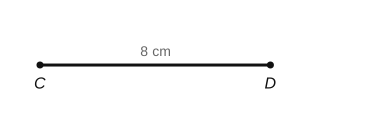
[2 marks]
(a)Describe the locus of T completely.
Show answerHide answer
Tick each point you got.
[2 marks]
(b)Calculate the total length of the locus of T. Use π = 3.14.
Show answerHide answer
Tick each point you got.
15
Question 15
Diagram 8 shows a square ABCD with sides of 6 units on a square grid. X and Y are points that move inside the square. X is always the same distance from AB and from AD. Y is always 4 units from C.
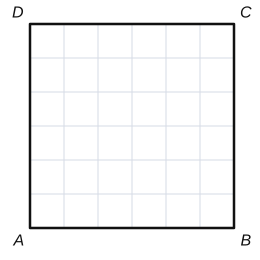
[1 mark]
(a)Describe the locus of X.
Show answerHide answer
Tick each point you got.
[1 mark]
(b)Describe the locus of Y.
Show answerHide answer
Tick each point you got.
[2 marks]
(c)The two loci meet at one point inside the square. Calculate the distance of this point from A, correct to 2 decimal places.
Show answerHide answer
Tick each point you got.
16
Question 16
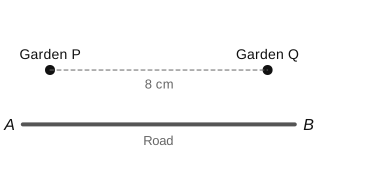
Diagram 9 is a map drawn to a scale of 1 cm to 200 m. Garden P and garden Q are 8 cm apart. The straight road AB is parallel to PQ and 2 cm from it. A clinic is to be built so that it is equidistant from P and Q and is 600 m from the road AB.
[1 mark]
(a)How many centimetres on the map is 600 m?
Show answerHide answer
Tick each point you got.
[2 marks]
(b)Describe the two loci that the clinic must be on.
Show answerHide answer
Tick each point you got.
[2 marks]
(c)The council chooses the position that is closer to P. How far from garden P, in metres, is it?
Show answerHide answer
Tick each point you got.
17
Question 17
Hana makes two statements about loci. Statement 1: "The locus of a point that is always 4 cm from a fixed point O is a circle with a diameter of 4 cm." Statement 2: "The locus of a point that is equidistant from two fixed points A and B is the straight line AB."
[2 marks]
(a)Statement 1 is wrong. Explain her mistake and write the correct statement.
Show answerHide answer
Tick each point you got.
[2 marks]
(b)Statement 2 is wrong. Explain her mistake and write the correct statement.
Show answerHide answer
Tick each point you got.
18
Question 18
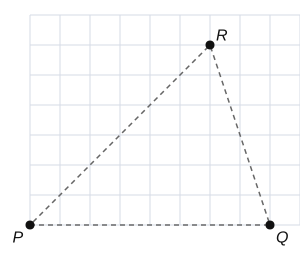
Diagram 10 shows three shops P, Q and R on a square grid with sides of 1 unit, where 1 unit represents 50 m. P is at (0, 0), Q is at (8, 0) and R is at (6, 6). The council wants to build a bus stop that is the same distance from all three shops.
[2 marks]
(a)Using loci, explain how to find the position of the bus stop.
Show answerHide answer
Tick each point you got.
[1 mark]
(b)Explain why this point is the same distance from all three shops.
Show answerHide answer
Tick each point you got.
[2 marks]
(c)The bus stop is at (4, 2). Calculate its distance from P in metres, correct to the nearest metre.
Show answerHide answer
Tick each point you got.
19
Question 19
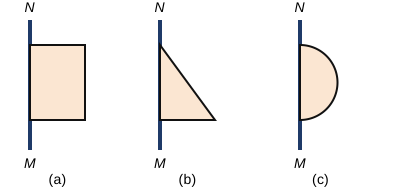
In Diagram 11, each shaded shape is rotated 360° about the pole MN. Name the three-dimensional shape formed in each case.
[1 mark]
(a)Shape (a), a rectangle
Show answerHide answer
Tick each point you got.
[1 mark]
(b)Shape (b), a right-angled triangle
Show answerHide answer
Tick each point you got.
[1 mark]
(c)Shape (c), a semicircle
Show answerHide answer
Tick each point you got.