myUASARevision for UASA
Mathematics notes, chapter 8

Loci in Two Dimensions

Textbook Mathematics Form 3 (DLP), pages 198–223

What this chapter covers

  • Recognise loci in real-life situations and explain the meaning of locus (8.1.1)
  • Describe the locus of points that are of constant distance from a fixed point (8.2.1)
  • Describe the locus of points that are equidistant from two fixed points (8.2.2)
  • Describe the locus of points that are of constant distance from a straight line (8.2.3)
  • Describe the locus of points that are equidistant from two parallel lines (8.2.4)
  • Describe the locus of points that are equidistant from two intersecting lines (8.2.5)
  • Determine the locus that satisfies two or more conditions (8.2.6)
  • Solve problems involving loci (8.2.7)

When a shuttlecock is smashed, a bicycle wheel turns or a rocket lifts off, a point on the moving object leaves a trace behind it. Mathematicians call that trace a locus. Engineers, pilots and builders use loci to predict where a moving point will be, and to find the places that satisfy a rule such as "the same distance from two houses". In this chapter you will describe, draw and construct loci, and then combine two rules to find a point that satisfies both.

EnglishBahasa Melayu
locus (plural: loci)lokus (lokus-lokus)
equidistantberjarak sama
circle, arc, curvebulatan, lengkok, lengkung
perpendicular bisectorpembahagi dua sama serenjang
angle bisectorpembahagi dua sama sudut
parallel lines, intersecting linesgaris selari, garis bersilang
point of intersectiontitik persilangan

8.1Locus

A locus is the trace or path formed by a set of points, in a plane or in three-dimensional space, that satisfy certain conditions.
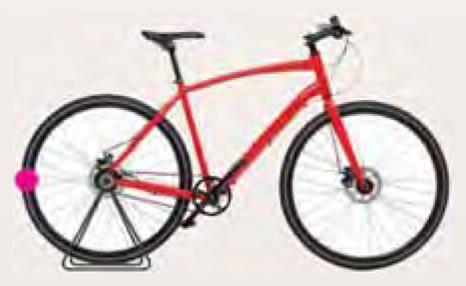
A bicycle with a pink sticker on the front edge of the rear tyre
A sticker on the tyre of a bicycle: as the wheel turns, the sticker traces a circle.

Figure: Mathematics Form 3 (DLP) textbook, p. 200.

In two dimensions, a locus can be a straight line, an arc or a curve.

Moving pointShape of its locus
A durian falling from a tree, a rocket launched upwardsstraight line
A sticker on a turning wheel, the tip of a fan bladecircle
The tip of a windscreen wiperarc (part of a circle)
A ball kicked across a field, a leaping frogcurve
Example 1 (textbook p. 202): the locus of a point on a fan blade
Point C is on one blade of a revolving fan. C is always the same distance from the centre of the fan, so its locus is a circle centred at the middle of the fan.
To find a locus, ask two questions: what is the point moving around? (a fixed point, a line) and what stays the same? (its distance from it).

Loci in three dimensions

If a flat shape is rotated 360° about a line (the pole), the shape sweeps out a solid. The pole is the axis of the solid.
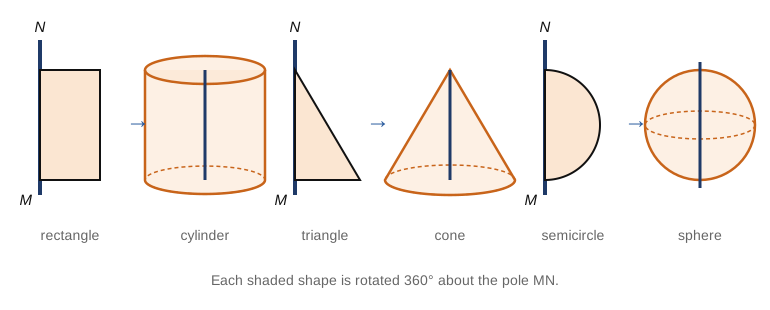
A rectangle becomes a cylinder, a right-angled triangle becomes a cone, a semicircle becomes a sphere when rotated 360 degrees about the pole MN
Examples 2 and 3 (textbook p. 203), with the cone added. The side that lies on the pole stays where it is.
2D shapeRotated 360° about the side on the pole
Rectangle (one side on the pole)Right cylinder
Right-angled triangle (one of the two sides next to the right angle on the pole)Cone
Semicircle (diameter on the pole)Sphere
The shape must touch the pole along one side. Rotating a semicircle about its diameter gives a sphere; the curved edge makes the surface, the diameter is the axis.
Which solid is formed when a right-angled triangle is rotated 360° about one of the two sides next to its right angle?
Show answerHide answer
A cone. The side on the pole is the height of the cone and the other short side is the radius of its base.

8.2Loci in two dimensions

There are five basic loci. Each one has a rule, a shape and a way to construct it.

1. Constant distance from a fixed point
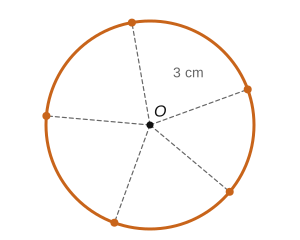
The locus of a point that is always the same distance from a fixed point is a circle with the fixed point as its centre and the distance as its radius.
A circle of radius 3 cm centred at O with five points marked on it, each joined to O by a dashed line of equal length
Every point on the circle is 3 cm from O.
Example 4 (textbook p. 205): construct the locus of P, always 3 cm from O
  1. Mark point O.
  2. Set the compasses to 3 cm.
  3. Place the point of the compasses on O and draw a complete circle. The circle is the locus of P.
The radius of the circle is the given distance (3 cm), not the diameter.

2. Equidistant from two fixed points

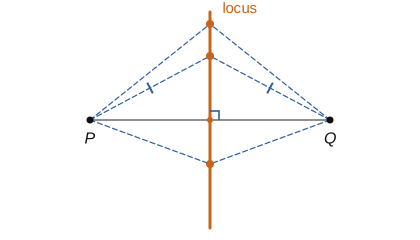
The locus of a point that is equidistant (the same distance) from two fixed points P and Q is the perpendicular bisector of the line PQ. It is a straight line that cuts PQ at its midpoint at 90°.
Points P and Q with a vertical line through the midpoint of PQ; three points on that line are joined to P and Q by dashed lines of equal length
Any point on the locus is as far from P as it is from Q.
Example 5 (textbook p. 207): construct the locus of P equidistant from M and N
  1. Set the compasses to more than half of MN. Draw one arc above and one below MN from point M.
  2. Keep the same setting. Draw two arcs from point N so that they cross the first two.
  3. Join the two points where the arcs cross with a straight line. This line is the locus.
If the compasses are set to half of MN or less, the arcs from M and N never cross (or only touch), so you cannot find the line.
Example 6 (textbook p. 208): equilateral triangle PQR
The locus of X, equidistant from P and R, is the perpendicular bisector of the line PR. In an equilateral triangle this line also goes through Q.

3. Constant distance from a straight line
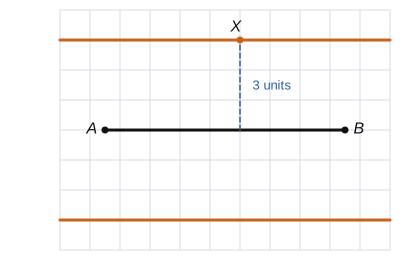
The locus of a point that is always the same distance from a straight line is a pair of parallel straight lines, one on each side of it, at that distance.
Line AB on a grid with two orange lines parallel to AB, three squares above and three squares below
Example 7 (textbook p. 209): X is always 3 units from AB, so the locus is the two orange lines.
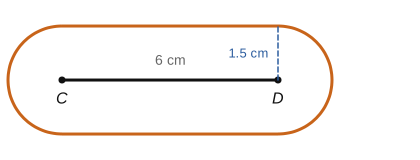
A line segment has ends. The locus of a point at a fixed distance from a segment is two parallel lines joined by a semicircle at each end, like a running track. For a long line that goes on in both directions, the pair of parallel lines is the whole locus.
Line segment CD of 6 cm with a track-shaped outline 1.5 cm from it: two straight sides and a semicircle at each end
The locus of T, 1.5 cm from segment CD.

4. Equidistant from two parallel lines
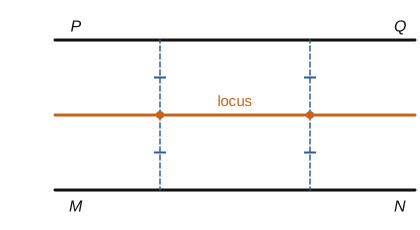
The locus of a point that is equidistant from two parallel lines is a straight line parallel to both, halfway between them.
Two parallel lines PQ and MN with an orange line halfway between them; two dashed pairs of equal distances are marked
The locus is the same distance from PQ as from MN.
Example 8 (textbook p. 210): rectangle ABCD
The locus of X, equidistant from AB and DC, is a line parallel to AB and DC halfway between them. If the rectangle is 6 units from AB to DC, the line is 3 units from each side.

5. Equidistant from two intersecting lines
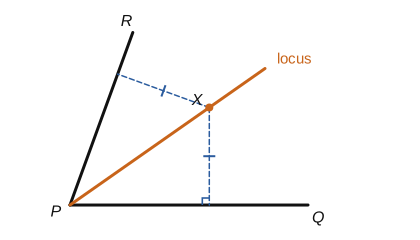
The locus of a point that is equidistant from two intersecting lines is the angle bisector of the angles formed by the lines.
Lines PQ and PR meeting at P with an orange bisector; a point X on the bisector has equal dashed perpendicular distances to both lines
Each half of the angle is equal, so every point on the bisector is the same distance from PQ and PR.
Example 9 (textbook p. 211): construct the locus of X equidistant from PQ and PR meeting at P
  1. With the compasses on P, draw an arc that cuts PQ at A1 and PR at A2.
  2. From A1 and then A2, with the same setting, draw two arcs that cross.
  3. Join P to the point where the arcs cross. This line is the locus.
Check: if ∠QPR = 70°, the bisector makes 35° with each line. Example 10 (textbook p. 212): in square ABCD, the locus of a point equidistant from AB and AD bisects ∠BAD (it is the diagonal AC).
Two parallel lines are 12 cm apart. Describe the locus of a point equidistant from both.
Show answerHide answer
A straight line parallel to the two lines, 6 cm from each of them (halfway between).

Two or more conditions

Often a point must obey two rules at once. Draw the locus for each rule on the same diagram. The point(s) where the loci cross satisfy both rules. Mark each crossing with a cross (×).

SymbolMeaning for a point X and a fixed point A
AX = 3 cmX is on the circle of radius 3 cm
AX < 3 cmX is inside the circle
AX > 3 cmX is outside the circle
Worked example (like textbook Example 11, p. 214)
ABCD is a square of side 8 units. X moves so that it is always 6 units from A. Y moves so that it is equidistant from AB and DC. Find where the two loci meet.
Locus of X: an arc of the circle with centre A and radius 6 units.
Locus of Y: the line parallel to AB and DC, 4 units from each.
Crossing: the arc meets the line at one point inside the square.
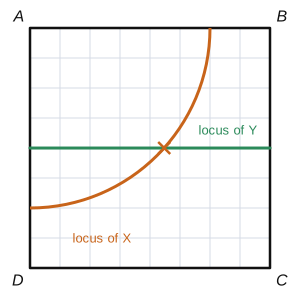
Square ABCD with an orange arc of radius 6 units centred at A and a green line halfway between AB and DC; they cross at the point marked with a cross
Check by calculation: the point is 4 units below AB (half of 8), and 6 units from A, so its distance from AD is √(6² − 4²) = √20 ≈ 4.5 units.
Use the pencil lightly for the working lines. Draw each locus in full inside the shape, then mark only the points that lie on both loci.

Solving problems with loci

Use four steps: understand the problem, plan a strategy, carry it out, then conclude in words.

Example 13 (textbook p. 216): where should the clinic go?
A clinic must be equidistant from house P and house Q and 600 m from the highway AB (scale 1 cm = 600 m).
  1. Equidistant from P and Q: the perpendicular bisector of PQ.
  2. 600 m from the highway: a pair of lines parallel to AB, 1 cm from it on each side.
  3. Draw both loci on the map. The bisector crosses the pair of lines at two points.
  4. There are two possible places for the clinic.
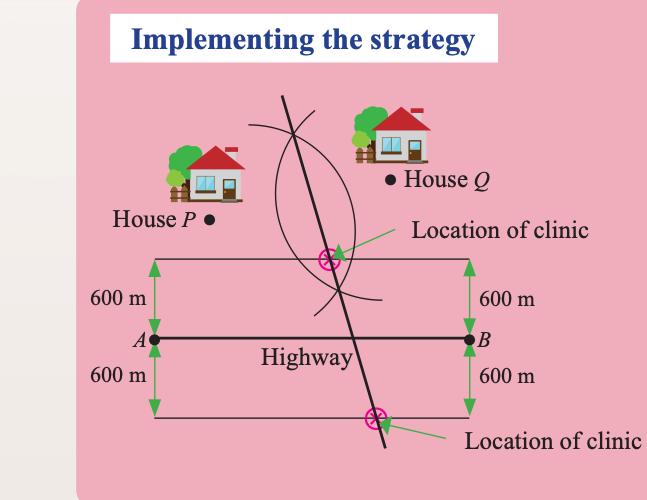
Map with house P and house Q, the highway AB, the perpendicular bisector of PQ and two parallel lines 600 m from the highway; the two crossings are marked as clinic locations
The two crossing points are the possible locations of the clinic. (Textbook p. 217)

Figure: Mathematics Form 3 (DLP) textbook, p. 217.

Do not forget a pair of parallel lines means two lines. Count every crossing that is inside the area allowed.
A map has the scale 1 cm to 200 m. A shop must be 400 m from a straight road. How far from the road is the shop on the map?
Show answerHide answer
400 m ÷ 200 m per cm = 2 cm, on either side of the road.

Summary

Rule for the moving pointLocusHow to draw
Fixed distance from a fixed pointCircle (centre = the point)Compasses set to the distance
Equidistant from two fixed pointsPerpendicular bisector of the line joining themEqual arcs from both ends, radius more than half
Fixed distance from a straight linePair of parallel lines, one on each sideMeasure the distance on both sides
Equidistant from two parallel linesParallel line halfway betweenMark the middle and draw parallel
Equidistant from two intersecting linesAngle bisectorArc from the vertex, then equal arcs from the two cuts
Two or more rulesThe crossing point(s) of the lociDraw all loci on one diagram, mark ×

Content and examples follow Mathematics Form 3 (DLP) textbook, Chapter 8, pp. 198–223.