myUASARevision for UASA
Mathematics notes, chapter 9

Straight Lines

Textbook Mathematics Form 3 (DLP), pages 224–251

What this chapter covers

  • Make the connection between the equation y = mx + c, the gradient and the y-intercept, and describe lines parallel to the x-axis and the y-axis (9.1.1)
  • Interpret straight line equations in the forms ax + by = c and x/a + y/b = 1, and change them to y = mx + c and back (9.1.2)
  • Decide whether a point lies on a straight line by checking that its coordinates satisfy the equation (9.1.3)
  • Show that straight lines with the same gradient are parallel and use this to find unknown values (9.1.4)
  • Determine the equation of a straight line from its gradient and a point, from two points, or when it is parallel to a given line (9.1.5)
  • Find the point of intersection of two straight lines by the graphical, substitution and elimination methods (9.1.6)
  • Solve problems involving straight lines, including parallelograms and trapeziums on a Cartesian plane (9.1.7)

Normally every building is built upright, but the Leaning Tower of Teluk Intan, built in 1885, leans because of the soil underneath. Its sloping edge is a good picture of a straight line with a gradient. Straight lines are used in engineering, architecture, construction, mapping and sport. In this chapter you will describe a straight line with an equation, and use the equation to find its gradient, intercepts, points on it, parallel lines and where two lines meet.

Context: Mathematics Form 3 (DLP) textbook, p. 224. Content and examples follow Chapter 9, pp. 224–251.

EnglishBahasa Melayu
straight line, parallel linegaris lurus, garis selari
gradientkecerunan
vertical distance, horizontal distancejarak mencancang, jarak mengufuk
axis, interceptpaksi, pintasan
equation, simultaneous equationspersamaan, persamaan serentak
point of intersectiontitik persilangan

9.1Straight lines

The equation y = mx + c

In Form 2 you drew graphs from a table of values. A linear function always gives a straight line. A non-linear function (a curve such as a parabola or a reciprocal graph) does not.

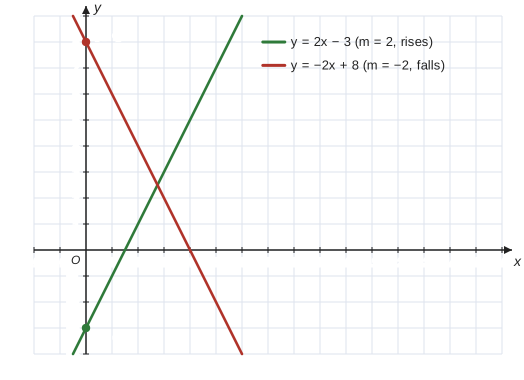
A straight line with equation y = mx + c has gradient m (the number in front of x) and y-intercept c (the value of y where the line crosses the y-axis, when x = 0).
Value of mShape of the line
m > 0slopes upwards from left to right
m < 0slopes downwards from left to right
m = 0horizontal, parallel to the x-axis (y = h)
Two lines on a grid: y = 2x − 3 rises from left to right and crosses the y-axis at −3; y = −2x + 8 falls and crosses the y-axis at 8
Two lines: the sign of m decides whether the line rises or falls, and c is where it meets the y-axis.
Example 1 (textbook p. 229): gradient and y-intercept
Find the gradient and y-intercept of (a) y = 2x + 9 (b) 3y = −2x + 12.
(a) Compare with y = mx + c: m = 2 and c = 9. Gradient = 2, y-intercept = 9.
(b) The coefficient of y must be +1, so divide every term by 3: y = −23x + 4.
Gradient = −23, y-intercept = 4.
Always make the coefficient of y equal to +1 before reading m and c. In 3y = −2x + 12 the gradient is not −2 and the y-intercept is not 12.
A line through the origin has y-intercept 0, so its equation is y = mx. For example y = x has gradient 1 and y = −x has gradient −1.

Lines parallel to the axes

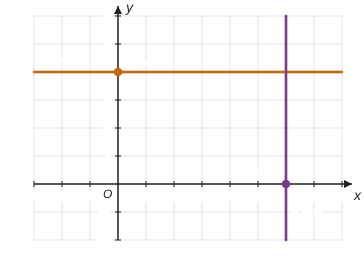
Horizontal line y = 4 through (0, 4) and vertical line x = 6 through (6, 0)
y = 4 is horizontal, x = 6 is vertical.
The graph of y = h is a straight line parallel to the x-axis, always h units from it. The graph of x = h is a straight line parallel to the y-axis, always h units from it.
Example 2 (textbook p. 229): find h
A horizontal line passes through (−2, 6), (0, 6) and (3, 6). Every point has y = 6, so the line is y = 6 and h = 6.
A vertical line passes through (4, 0), (4, 4) and (4, 8). Every point has x = 4, so the line is x = 4 and h = 4.
A horizontal line has gradient 0. A vertical line has an undefined gradient (the horizontal distance is 0 and we cannot divide by 0), so it cannot be written as y = mx + c.
(a) State the gradient and y-intercept of y = −4x + 9 and of 5y = 15x − 10. (b) Write the equation of the line parallel to the x-axis through (5, −3), and of the line parallel to the y-axis through (−2, 7).
Show answerHide answer
(a) m = −4, c = 9. 5y = 15x − 10 gives y = 3x − 2, so m = 3, c = −2.
(b) y = −3 and x = −2.

Other forms of the equation

The same line can be written in three forms.

FormWhat you can read off
y = mx + cgradient m, y-intercept c
ax + by = cfind intercepts by putting x = 0 or y = 0
xa + yb = 1 (a ≠ 0, b ≠ 0)x-intercept a, y-intercept b
The x-intercept is the value of x where the line meets the x-axis (put y = 0). The y-intercept is the value of y where the line meets the y-axis (put x = 0). The gradient is m = −y-interceptx-intercept.
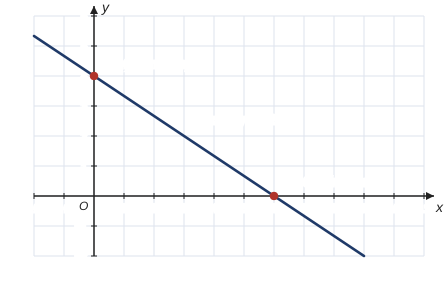
The line 2x + 3y = 12 crossing the x-axis at (6, 0) and the y-axis at (0, 4)
2x + 3y = 12 has x-intercept 6 and y-intercept 4, so m = −46 = −23.
Example 3 (textbook p. 231): from ax + by = c to the other two forms
Write 2x + 3y = 12 in the form xa + yb = 1 and in the form y = mx + c.
In the form xa + yb = 1: divide by 12 so that the right side is 1: 2x12 + 3y12 = 1, so x6 + y4 = 1.
In the form y = mx + c: 3y = −2x + 12, so y = −23x + 4.
Both show x-intercept 6 and y-intercept 4.
Example 4 (textbook p. 232): from intercept form
Write x6 + y3 = 1 in the forms ax + by = c and y = mx + c.
Multiply by the common denominator 6: x + 2y = 6.
Make y the subject: 2y = −x + 6, so y = −12x + 3.
Example 5 (textbook p. 232): from y = mx + c
Write y = −2x + 8 in the forms ax + by = c and xa + yb = 1.
Move the x term: 2x + y = 8.
Divide by 8: 2x8 + y8 = 1, so x4 + y8 = 1.
To get the intercept form, the right side of ax + by = c must be 1, so divide every term by c (c ≠ 0). Then simplify each fraction. A negative intercept gives a negative denominator, for example 3x − 5y = 15 becomes x5 − y3 = 1, so a = 5 and b = −3.
In xa + yb = 1 the denominators are the intercepts. Keep the sign: in x5 − y3 = 1 the y-intercept is −3, not 3. Check by putting x = 0, which gives y = −3.
Write 4x + 3y = 24 in the forms xa + yb = 1 and y = mx + c.
Show answerHide answer
Divide by 24: x6 + y8 = 1. Then 3y = −4x + 24 gives y = −43x + 8. (Check: −86 = −43.)

Points on a straight line

A point lies on a straight line only if its coordinates satisfy the equation. Substitute x and y into the left side and the right side: if they are equal, the point is on the line.
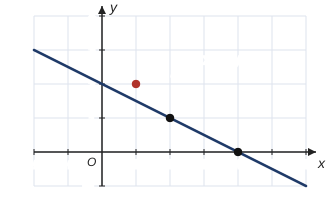
The line x + 2y = 4 passes through P(4, 0) and Q(2, 1) but R(1, 2) is above the line
On x + 2y = 4: P(4, 0) gives 4 and Q(2, 1) gives 4, so both are on the line. R(1, 2) gives 5, so it is not.
Example 6 (textbook p. 234): does P lie on the line?
(a) y = 3x + 2, P(2, 8): right side 3(2) + 2 = 8 = left side 8. Yes.
(b) 3x − 2y = 12, P(−4, 2): left side 3(−4) − 2(2) = −16, not 12. No.
(c) x3 + y2 = 1, P(6, −2): 63 + −22 = 2 − 1 = 1. Yes.
Example 7 (textbook p. 235): find missing values
The line 3x + 5y = 15 meets the x-axis at (h, 0), the y-axis at (0, k) and passes through P(2, q).
(a) y = 0: 3h = 15, so h = 5. (b) x = 0: 5k = 15, so k = 3.
(c) x = 2: 6 + 5q = 15, so q = 95. (d) Gradient = −35 (that is, −kh).
A point on the x-axis has y = 0, and a point on the y-axis has x = 0. Do not swap them when finding intercepts. Take care with negative signs when you substitute: use brackets, as in 3(−4).
Does (−1, −5) lie on y = 3x − 2? Does (2, 5)?
Show answerHide answer
x = −1: 3(−1) − 2 = −5, equal to y, so (−1, −5) is on the line. x = 2: 3(2) − 2 = 4, not 5, so (2, 5) is not on the line.

Parallel lines

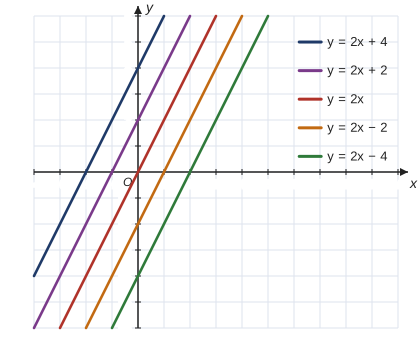
Five parallel lines y = 2x + 4, y = 2x + 2, y = 2x, y = 2x − 2 and y = 2x − 4, all sloping upwards at the same steepness
Same gradient 2, different y-intercepts: the lines never meet.
Straight lines that have the same gradient are parallel, and parallel lines have the same gradient. They make the same angle θ with the x-axis, where tan θ = vertical distancehorizontal distance (for m = 2, θ = 63.43°).

To compare gradients, first change each equation to y = mx + c.

Examples 8 and 9 (textbook pp. 237–238): are the lines parallel?
y = 3x + 5 and 6x − 2y = 9: the second gives y = 3x − 92. Both gradients are 3, so they are parallel.
y = 3x + 8 and 6y = 3x − 9: the second gives y = 12x − 32. Gradients 3 and 12 differ, so they are not parallel.
Example 10 (textbook p. 238): find h
4x + 3y = 18 is parallel to 2x + hy = 20. Find h.
First line: y = −43x + 6, gradient −43. Second line: y = −2hx + 20h, gradient −2h.
Equal gradients: 43 = 2h, so h = 32.
Do not compare the numbers in front of x in the original equations. 6x − 2y = 9 and y = 3x + 5 look different, but their gradients are both 3.
Are 2y = 4x + 6 and y − 2x = 9 parallel? Are they the same line?
Show answerHide answer
y = 2x + 3 and y = 2x + 9 both have gradient 2, so they are parallel. The y-intercepts (3 and 9) differ, so they are different lines.

Finding the equation of a straight line

  1. Find the gradient m.
  2. Find a point (x, y) that the line passes through.
  3. Substitute m, x and y into y = mx + c and solve for c.
  4. Write the equation y = mx + c with the values of m and c.
Example 11 (textbook p. 239): gradient and a point
Gradient 12, passes through P(6, 8). Then 8 = 12(6) + c, so c = 5.
The equation is y = 12x + 5.

Two points. The gradient is the vertical distance divided by the horizontal distance: m = y₂ − y₁x₂ − x₁. Then use step 3 with either point.
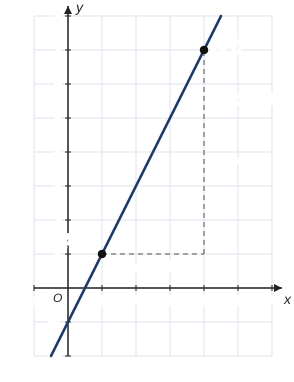
A line through (1, 1) and (4, 7) with a dashed right-angled triangle showing run 3 and rise 6
Points (1, 1) and (4, 7): rise 6, run 3, so m = 2 and y = 2x − 1.
Example 12 (textbook p. 240): two points
Line through P(−1, 5) and Q(2, −7).
m = −7 − 52 − (−1) = −123 = −4.
Use P: 5 = (−4)(−1) + c, so c = 1. The equation is y = −4x + 1.
Example 13 (textbook p. 240): horizontal and vertical lines
PQ passes through M(0, 4) and A(2, 4): m = 4 − 42 − 0 = 0, so y = 4.
RS passes through A(2, 4) and N(2, 0): m = 4 − 02 − 2 = 40, which is undefined, and the line is always 2 units from the y-axis, so x = 2.

A line through a point, parallel to a given line

Parallel lines have the same gradient. Find the gradient of the given line, then use the point to find c.

Examples 14 and 15 (textbook p. 241)
Parallel to y = −2x + 6 through P(5, 4): m = −2, so 4 = (−2)(5) + c and c = 14. The equation is y = −2x + 14.
Parallel to 2x + 3y = 12 through G(6, 8): first y = −23x + 4, so m = −23. Then 8 = −23(6) + c gives c = 12. The equation is y = −23x + 12.
If the point given is the y-intercept, c is already known. If the line is vertical or horizontal, do not use y = mx + c: write x = h or y = h directly.
(a) Find the equation of the line with gradient 3 through (2, −1). (b) Find the equation of the line through (−1, 4) and (3, −4).
Show answerHide answer
(a) −1 = 3(2) + c, c = −7, so y = 3x − 7.
(b) m = −4 − 43 − (−1) = −2. Then 4 = (−2)(−1) + c, c = 2, so y = −2x + 2.

Point of intersection of two straight lines

Two lines that are not parallel meet at exactly one point. Its coordinates satisfy both equations, so it is the solution of the simultaneous equations. There are three methods.

MethodWhat you do
GraphicalDraw both lines on the same Cartesian plane (a table of values or the two intercepts) and read the point where they cross.
SubstitutionMake one variable the subject of one equation and substitute it into the other.
EliminationMake the coefficients of one variable equal, then add or subtract the equations.
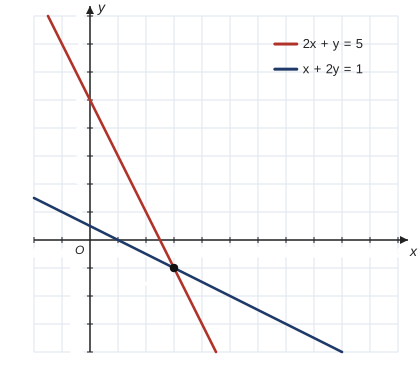
The lines 2x + y = 5 and x + 2y = 1 cross at the point (3, −1)
Example 16: 2x + y = 5 and x + 2y = 1 cross at (3, −1).
Example 16 (textbook pp. 242–243): 2x + y = 5 and x + 2y = 1
Substitution. From 2x + y = 5, y = 5 − 2x. Put into x + 2y = 1: x + 2(5 − 2x) = 1, so x + 10 − 4x = 1, −3x = −9, x = 3. Then y = 5 − 2(3) = −1.
Elimination. Multiply the first equation by 2: 4x + 2y = 10. Subtract x + 2y = 1: 3x = 9, so x = 3. Then 2(3) + y = 5 gives y = −1.
Point of intersection: (3, −1). Check in both equations.
Find the point of intersection of x + y = 7 and x − y = 1.
Show answerHide answer
Add the equations: 2x = 8, x = 4. Then y = 7 − 4 = 3. Point of intersection (4, 3).

Solving problems with straight lines

Use the four steps: understand the problem, plan a strategy, carry it out, then conclude and check.

Example 17 (textbook p. 245): parallelogram PQRS
P(−4, 6) and Q(0, h) are vertices. The gradient of SR is 12, and PS has y-intercept −4. Find h, the equation of PS and its x-intercept.
Understand and plan: PQ is parallel to SR, so the gradient of PQ is 12. PS passes through P(−4, 6) and T(0, −4).
(a) h − 60 − (−4) = 12, so h − 6 = 2 and h = 8.
(b) Gradient of PS = −4 − 60 − (−4) = −52, y-intercept −4: y = −52x − 4.
(c) Put y = 0: 52x = −4, so x-intercept = −85.
In problems about parallelograms and trapeziums, opposite sides that are parallel have equal gradients. A side parallel to the y-axis has an equation of the form x = h.
When drawing a line from ax + by = c, find the two intercepts (x = 0, then y = 0) and join them. Two points are enough, but a third point helps you check.
Example 18 (textbook p. 246): graphical method with intercepts
y = −13x + 3 has y-intercept 3 and x-intercept 9. 2x − y = 4 has y-intercept −4 and x-intercept 2. Draw both lines: they cross at A(3, 2).
Check: −13(3) + 3 = 2 and 2(3) − 2 = 4.

Quick reference

To findDo this
Gradient and y-interceptWrite as y = mx + c (coefficient of y is +1)
x-interceptPut y = 0
y-interceptPut x = 0
Gradient from the interceptsm = −y-interceptx-intercept
Is a point on the line?Substitute; both sides must be equal
Are two lines parallel?Same gradient m
Equation from gradient and a pointSubstitute into y = mx + c, find c
Equation from two pointsm = y₂ − y₁x₂ − x₁, then find c
Intersection of two linesGraph, substitution or elimination