Science questions, chapter 4
Nama / NameKelas / ClassTarikh / Date
Reactivity of metals
44 marks. Use Practice to check each answer as you go, or Exam to answer everything against the clock first.
Section A: objective questions
12 marksChoose the best answer for each question.
1
Question 1
Which statement describes a mineral?
Show answerHide answer
B
Minerals are solid elements or compounds that occur naturally with a definite crystalline structure and chemical composition (textbook p. 125).
2
Question 2
Galena is a natural compound that is the ore of lead. Which elements are combined in galena?
Show answerHide answer
D
Galena is plumbum(II) sulphide, a compound of lead and sulphur (textbook Table 4.1, p. 125). Plumbum is lead and sulphide means sulphur.
3
Question 3
Calcium carbonate is heated strongly and the gas released is passed through limewater. The limewater turns cloudy. Which gas is released?
Show answerHide answer
A
Limewater turns cloudy only with carbon dioxide. Calcium carbonate decomposes to calcium oxide and carbon dioxide.
4
Question 4
Which of the following minerals is an element?
Show answerHide answer
C
Gold is found in the Earth's crust as an element. Hematite (iron oxide), quartz (silicon dioxide) and calcite (calcium carbonate) are compounds.
5
Question 5
The reactivity series of metals arranges metals according to their reactivity towards
Show answerHide answer
B
The reactivity series is a list of metals arranged by how vigorously they react with oxygen (textbook p. 129).
6
Question 6
Four metals are heated in oxygen. Metal W burns very brightly, X glows dimly, Y burns slowly and Z glows brightly. Which is the correct order from the most reactive to the least reactive?
Show answerHide answer
D
The more vigorous the reaction, the more reactive the metal: burns very brightly (W) > burns slowly (Y) > glows brightly (Z) > glows dimly (X).
7
Question 7
When a mixture of zinc oxide and carbon is heated strongly, zinc is formed. What does this show?
Show answerHide answer
A
Carbon removed oxygen from zinc oxide, so carbon is more reactive than zinc (carbon is placed above zinc in the series).
8
Question 8
Hydrogen reduces copper(II) oxide and lead(II) oxide, but does not reduce zinc oxide or aluminium oxide. Which arrangement shows the position of hydrogen?
Show answerHide answer
C
Hydrogen cannot reduce zinc oxide, so it is less reactive than zinc. It reduces the oxides of lead and copper, so it is more reactive than they are. It sits between zinc and lead.
9
Question 9
How is aluminium extracted from its ore?
Show answerHide answer
B
Aluminium is higher than carbon in the reactivity series, so carbon cannot reduce its oxide. It is extracted by electrolysis of the molten compound.
10
Question 10
In a blast furnace used to extract iron, which substance floats on the molten iron and is tapped off separately?
Show answerHide answer
A
Slag is less dense than molten iron and floats on top of it, so it is tapped off separately from the molten iron.
11
Question 11
Carbon reduces the oxide of metal R but cannot reduce the oxide of metal Q. Which statement is correct?
Show answerHide answer
C
Carbon cannot take oxygen from Q's oxide, so Q is more reactive than carbon. Carbon can reduce R's oxide, so R is less reactive than carbon. Q is therefore the most reactive of the three.
12
Question 12
A company plans to extract iron near a town. Which action would best reduce air pollution from the blast furnace?
Show answerHide answer
D
Filtering the gases removes pollutants before they are released. A taller chimney only spreads them, burning more fuel adds pollution, and washing ore in a river pollutes the water.
Section B: structured questions
32 marksAnswer all questions. Write your answers in the spaces provided.
13
Question 13
A student heats calcium carbonate strongly in a boiling tube and passes the gas released through limewater.
[1 mark]
(a)Name the gas released.
Show answerHide answer
Tick each point you got.
[1 mark]
(b)State the change in the limewater.
Show answerHide answer
Tick each point you got.
[1 mark]
(c)Complete the word equation: calcium carbonate → ______ + carbon dioxide
Show answerHide answer
Tick each point you got.
[3 marks]
(d)Name the three elements combined in calcium carbonate.
Show answerHide answer
Tick each point you got.
14
Question 14
Four metals, W, X, Y and Z, are heated in oxygen. The table shows the observations. One of the metals is iron.
| Metal | Observation |
|---|---|
| W | Burns very quickly and brightly |
| X | Glows dimly |
| Y | Glows brightly |
| Z | Burns slowly |
[1 mark]
(a)Arrange the metals in order of decreasing reactivity towards oxygen.
Show answerHide answer
Tick each point you got.
[1 mark]
(b)Which metal is iron?
Show answerHide answer
Y
Iron glows brightly when heated in oxygen.
[1 mark]
(c)Write the word equation for the reaction of iron with oxygen.
Show answerHide answer
Tick each point you got.
[1 mark]
(d)State the relationship between the vigour of the reaction and the reactivity of the metal.
Show answerHide answer
Tick each point you got.
15
Question 15
Metal oxides were each mixed with carbon powder and heated strongly. The table shows the results.
| Mixture | Observation |
|---|---|
| Zinc oxide and carbon | Shiny grey metal formed; gas turned limewater cloudy |
| Aluminium oxide and carbon | No change |
| Lead(II) oxide and carbon | Shiny grey bead formed; gas turned limewater cloudy |
[1 mark]
(a)Write the word equation for the reaction between zinc oxide and carbon.
Show answerHide answer
Tick each point you got.
[2 marks]
(b)Name the metal oxide that carbon cannot reduce and explain why.
Show answerHide answer
Tick each point you got.
[1 mark]
(c)Arrange aluminium, carbon and zinc in order of increasing reactivity.
Show answerHide answer
Tick each point you got.
[1 mark]
(d)State one use of this result in industry.
Show answerHide answer
Tick each point you got.
16
Question 16
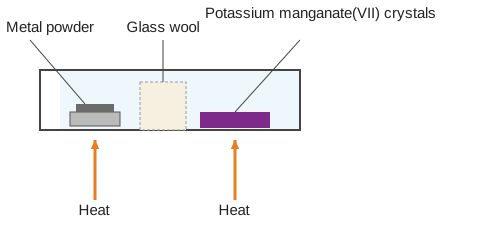
Diagram 1 shows the apparatus used to find out how a metal powder reacts with a gas released by heating potassium manganate(VII) crystals.
[1 mark]
(a)Name the gas released by the potassium manganate(VII) crystals.
Show answerHide answer
Tick each point you got.
[1 mark]
(b)Why is glass wool placed between the metal powder and the crystals?
Show answerHide answer
Tick each point you got.
[1 mark]
(c)State the correct order of heating.
Show answerHide answer
Tick each point you got.
[1 mark]
(d)State the aim of this activity.
Show answerHide answer
Tick each point you got.
17
Question 17
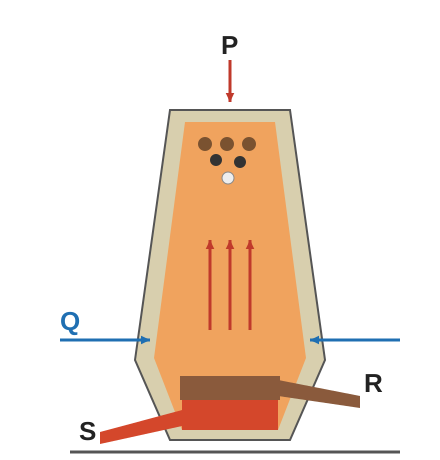
Diagram 2 shows a blast furnace used to extract iron.
[2 marks]
(a)Name two substances added at P.
Show answerHide answer
Any 2 points
Tick each point you got.
[1 mark]
(b)What is blown in at Q?
Show answerHide answer
Tick each point you got.
[2 marks]
(c)Name the substances tapped off at R and at S.
Show answerHide answer
Tick each point you got.
[1 mark]
(d)Why does the substance at R float on the substance at S?
Show answerHide answer
Tick each point you got.
18
Question 18
A company wants to open a bauxite mine on a hillside near a river and a village.
[2 marks]
(a)State two problems that the mine may cause.
Show answerHide answer
Any 2 points
Tick each point you got.
[2 marks]
(b)Suggest two ways to reduce the harm to the environment.
Show answerHide answer
Any 2 points
Tick each point you got.
19
Question 19
Lead(II) oxide is a yellow powder. Plan a simple activity to show that carbon is more reactive than lead.
[3 marks]
(a)State the materials and apparatus, the steps you will follow and the result you expect.
Show answerHide answer
Tick each point you got.