Reactivity of metals
What this chapter covers
- Explain with examples the minerals found in the Earth's crust and identify the elements in natural compounds (4.1)
- Describe the characteristics and uses of natural minerals in daily life (4.1)
- Construct a reactivity series of metals from their reactions with oxygen and write the word equations (4.2)
- Determine the positions of carbon and hydrogen in the reactivity series (4.2)
- Relate the position of a metal in the series to the way it is extracted from its ore (4.3)
- Explain how iron is extracted in a blast furnace and suggest solutions to the problems of poorly planned mining (4.3)
4.1Variety of minerals
Each ore looks different in colour, structure, shape and texture because it contains different minerals. Minerals in the Earth's crust are of two kinds.
Made of one kind of atom only.
Examples: gold and silver (metals); diamond and graphite (non-metals)
Two or more elements combined chemically.
Examples: bauxite, hematite, galena, cassiterite
Natural compounds and the elements in them
| Common name | Scientific name | Elements combined |
|---|---|---|
| Hematite (iron ore) | Ferrum(III) oxide | Iron, oxygen |
| Cassiterite (tin ore) | Stanum(IV) oxide | Tin, oxygen |
| Quartz | Silicon dioxide | Silicon, oxygen |
| Bauxite (aluminium ore) | Aluminium oxide | Aluminium, oxygen |
| Galena (lead ore) | Plumbum(II) sulphide | Lead, sulphur |
| Pyrite | Ferrum(II) sulphide | Iron, sulphur |
| Calcite | Calcium carbonate | Calcium, carbon, oxygen |
Names of natural compounds: textbook Table 4.1, p. 125.
Showing that a compound is made of several elements (Activity 4.1)
Calcium carbonate (found as limestone, marble, chalk, calcite, coral and shells) gives carbon dioxide in two different ways. Carbon dioxide turns limewater cloudy.
| Treatment | Word equation |
|---|---|
| Add dilute hydrochloric acid | Calcium carbonate + hydrochloric acid → calcium chloride + carbon dioxide + water |
| Heat strongly | Calcium carbonate → calcium oxide + carbon dioxide |
The gas contains carbon and oxygen, and the solid left behind contains calcium, so calcium carbonate is a compound of three elements: calcium, carbon and oxygen.
Properties and uses of minerals
- Limestone (calcium carbonate): used for roads, buildings and table tops.
- Calcium oxide is basic, so it neutralises acidic soil.
- Silicon dioxide has a high melting point, so it is used to make glass laboratory apparatus.
- Lithium and cobalt minerals make long-lasting batteries for electric cars.
Show answerHide answer
4.2Reactivity series of metals
Magnesium burns in air with a bright flame (a vigorous reaction). Iron only glows or changes colour slowly (a less vigorous reaction). Metal + oxygen always gives a metal oxide.
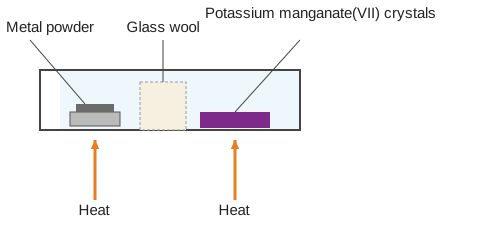
Activity 4.3: metals heated with oxygen
Oxygen is supplied by heating potassium manganate(VII) crystals. The metal powder sits on a porcelain plate in a boiling tube, separated from the crystals by glass wool.
| Metal | Observation | Word equation |
|---|---|---|
| Magnesium | Burns very quickly and brightly | Magnesium + oxygen → magnesium oxide |
| Aluminium | Burns quickly and brightly | Aluminium + oxygen → aluminium oxide |
| Zinc | Burns slowly | Zinc + oxygen → zinc oxide |
| Iron | Glows brightly | Iron + oxygen → iron oxide |
| Lead | Glows dimly | Lead + oxygen → lead(II) oxide |
Order of decreasing reactivity from this activity: magnesium > aluminium > zinc > iron > lead.
Position of carbon and hydrogen in the series
Carbon and hydrogen are non-metals, but they also react with oxygen (carbon + oxygen → carbon dioxide; hydrogen + oxygen → water). They are placed in the series by testing whether they can take oxygen away from a metal oxide. Removing oxygen from an oxide is reduction.
| Oxide heated with carbon | Result | Meaning |
|---|---|---|
| Zinc oxide | Zinc and carbon dioxide formed | Carbon is more reactive than zinc |
| Lead(II) oxide | Lead and carbon dioxide formed | Carbon is more reactive than lead |
| Aluminium oxide | No change | Carbon is less reactive than aluminium |
Hydrogen reduces iron(III) oxide, lead(II) oxide and copper(II) oxide, but cannot reduce aluminium oxide or zinc oxide. So hydrogen is more reactive than iron, lead and copper, and less reactive than aluminium and zinc.
Potassium (most reactive) to gold (least reactive). Carbon sits between aluminium and zinc; hydrogen sits between zinc and iron.
Keeping reactive metals
Potassium and sodium react with oxygen and water vapour in the air, so they are kept under paraffin oil. Lithium batteries can explode when heated, so passengers are not allowed to keep them in luggage placed in aircraft.
Show answerHide answer
4.3Extraction of metals from their ores
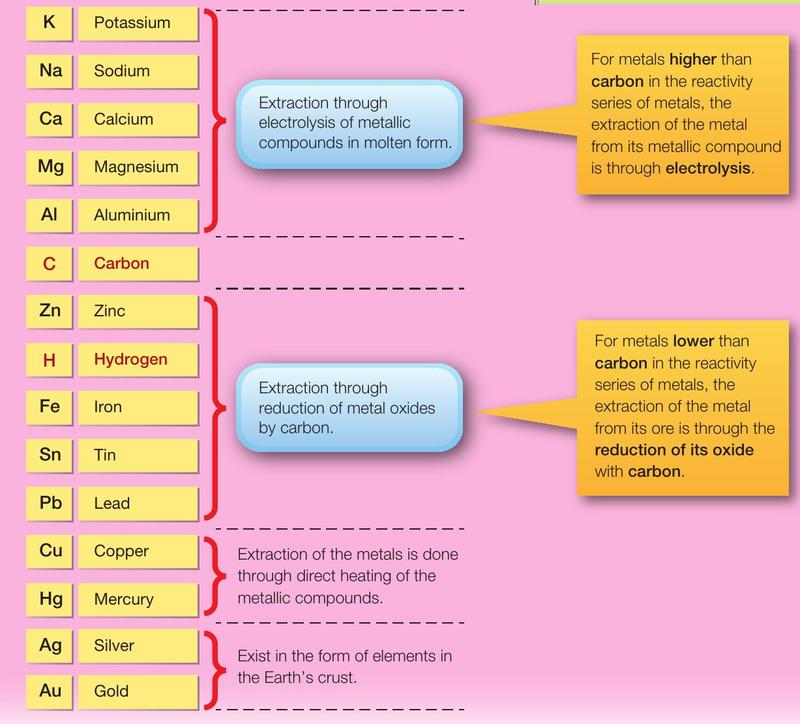
| Metals | Method | Why |
|---|---|---|
| K, Na, Ca, Mg, Al (above carbon) | Electrolysis of the molten compound | Carbon is not reactive enough to remove their oxygen |
| Zn, Fe, Sn, Pb (below carbon) | Heating the oxide with carbon (reduction) | Carbon is more reactive, so it takes the oxygen |
| Cu, Hg | Direct heating of the compound | Very unreactive |
| Ag, Au | None needed | Exist as elements in the Earth's crust |
Tin, which Malaysia has mined for a long time, lies below carbon, so tin ore (tin(IV) oxide) is heated with carbon: tin(IV) oxide + carbon → tin + carbon dioxide.
Extraction of iron in a blast furnace
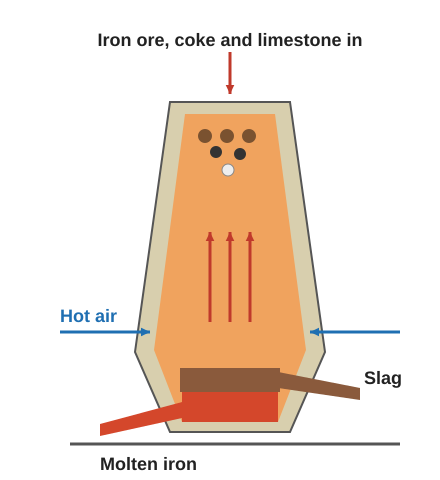
- A mixture of concentrated iron ore (iron oxide), coke and limestone is fed in at the top.
- A blast of very hot air is pumped in at the bottom.
- Reactions at high temperature:
- Coke burns: carbon + oxygen → carbon dioxide (and heat).
- Carbon dioxide + carbon → carbon monoxide, a strong reducing agent.
- Iron oxide is reduced: iron(III) oxide + carbon monoxide → iron + carbon dioxide (carbon works too).
- Limestone decomposes: calcium carbonate → calcium oxide + carbon dioxide.
- Calcium oxide removes the sand impurity: calcium oxide + silicon dioxide → calcium silicate (slag).
- Both iron and slag are molten and run to the bottom. Slag is less dense, so it floats on the iron. Iron is tapped off into moulds, where it freezes as cast iron. The slag is used for the base of buildings and roads.
Show answerHide answer
Mining issues in Malaysia
| Issue | Possible solution |
|---|---|
| Soil erosion from mining of ore | Replant trees on the mined land |
| Water pollution from washing ore | Treat waste water and use settling ponds before release |
| Air pollution from burning fuels and from gases of blast furnaces | Filter the gases before releasing them |
| Noise from mining machinery | Use quieter machines; keep mines away from homes |
| Habitat destruction when mines are built | Plan mining carefully and restore the area afterwards |
| Large amount of electrical energy used | Recycle metals, which saves energy and ore |
Poorly planned mining harms life locally and globally. Creative, innovative ideas support sustainable development. Coal, a mineral found in Malaysia, is mostly in Sarawak (about 80%).
Summary
| Remember | Key fact |
|---|---|
| Mineral | Natural solid element or compound with a definite crystal structure and composition |
| Reactivity series | K, Na, Ca, Mg, Al, C, Zn, H, Fe, Sn, Pb, Cu, Hg, Ag, Au |
| Metal + oxygen | Metal oxide; the more vigorous, the more reactive |
| Carbon can reduce | Oxides of metals below carbon (Zn, Fe, Sn, Pb) |
| Above carbon | Electrolysis of the molten compound |
| Blast furnace | Ore + coke + limestone in; hot air in; molten iron and slag out |