Thermochemistry
What this chapter covers
- Define thermochemistry, exothermic reactions and endothermic reactions (5.1.1)
- Relate heat released or absorbed in a chemical reaction to temperature change and to exothermic and endothermic reactions (5.1.2)
- Carry out an experiment to compare and contrast exothermic and endothermic reactions (5.1.3)
- Explain, with examples from daily life, exothermic and endothermic reactions (5.1.4)
- Design materials that use exothermic and endothermic reactions to solve problems in daily life (5.1.5)
5.1Endothermic and exothermic reactions
Every chemical reaction is followed by a change in the form of energy. The chemical energy stored in the reactants is converted into other forms, most often heat energy. Heat is either released into the surroundings or absorbed from them, and this divides reactions into two types.
Definitions (5.1.1)
A chemical reaction that releases heat into the surroundings.
Temperature of the products and surroundings rises.
A chemical reaction that absorbs heat from the surroundings.
Temperature of the products and surroundings drops.
Show answerHide answer
Detecting heat change with a thermometer (5.1.2)
The simplest way to tell the two types apart is to measure the temperature of the mixture with a thermometer. Remember from Form 2 that heat flows from a hotter object to a colder one until they reach thermal equilibrium.
| Exothermic reaction | Endothermic reaction | |
|---|---|---|
| Heat | Released into the surroundings | Absorbed from the surroundings |
| Thermometer reading | Rises | Drops |
| Temperature of the reaction mixture | Higher than before the reaction | Lower than before the reaction |
| Feels like | Hot | Cold |
| Energy change | Chemical energy converted to heat | Heat converted to chemical energy |
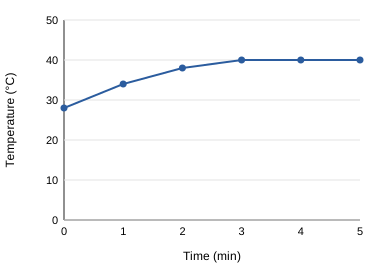 Exothermic
28 °C rises to a maximum of 40 °C (a rise of 12 °C), then stays constant.
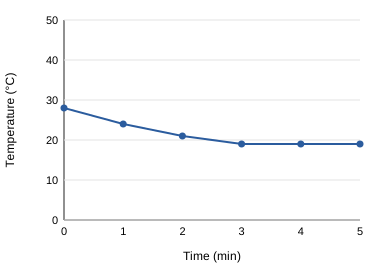 Endothermic
28 °C falls to a minimum of 19 °C (a drop of 9 °C), then stays constant.
Why does the reading stop at a maximum or minimum? When the net rate of heat transfer between the products and the thermometer is zero, they are in thermal equilibrium, so the reading stays steady (textbook p. 151 answers).
Experiment 5.1: compare exothermic and endothermic reactions (5.1.3)
Hypothesis: an exothermic reaction releases heat into the surroundings while an endothermic reaction absorbs heat from the surroundings.
Manipulated variable: type of chemical substance. Responding variable: final (maximum or minimum) temperature. Constant variable: volume of water.
Apparatus: polystyrene cup, thermometer, spatula, measuring cylinder.
Materials: sodium hydroxide, ammonium chloride, sodium hydrogen carbonate, 0.1 M sodium hydroxide solution, 0.1 M hydrochloric acid.
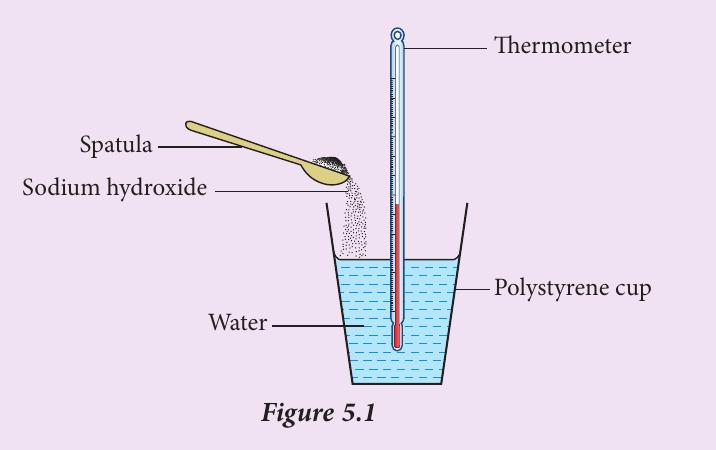
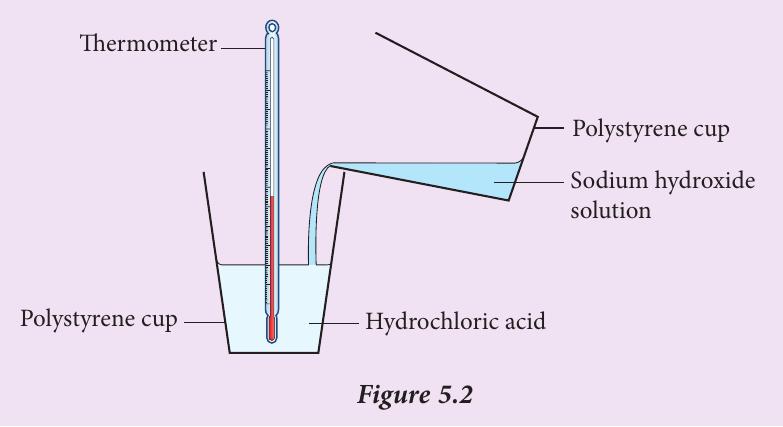
Figures 5.1 and 5.2: Science Form 3 (DLP) textbook, p. 150.
- Pour 50 mL of water into a polystyrene cup, wait 2 minutes and record the initial temperature.
- Add two spatulas of the solid, stir until it dissolves, then record the maximum or minimum temperature.
- For the acid reactions, record the initial temperature of 25 mL of hydrochloric acid, add 25 mL of sodium hydroxide solution (or two spatulas of sodium hydrogen carbonate), stir and record the maximum or minimum temperature.
| Reactants | Temperature | Type of reaction |
|---|---|---|
| Sodium hydroxide and water | Rises | Exothermic |
| Ammonium chloride and water | Drops | Endothermic |
| Hydrochloric acid and sodium hydroxide solution | Rises | Exothermic (neutralisation) |
| Hydrochloric acid and sodium hydrogen carbonate | Drops | Endothermic |
Conclusion: the hypothesis is accepted. Exothermic reactions release heat and the temperature rises; endothermic reactions absorb heat and the temperature falls.
Show answerHide answer
Examples in daily life (5.1.4)
| Exothermic reactions (heat released) | Endothermic reactions (heat absorbed) |
|---|---|
| Burning of paper, wood, candle and petrol (combustion) | Photosynthesis in green plants |
| Fireworks display and bomb explosion | Baking a cake or making bread |
| Respiration in humans and animals | Extraction of iron from iron ore |
| Neutralisation of an acid with an alkali | Dissolving an ammonium salt (e.g. ammonium chloride, ammonium nitrate) in water |
| Rusting of iron; sodium reacting with water | Heating calcium carbonate (thermal decomposition) |
| Thermite reaction; dissolving sodium hydroxide or calcium chloride in water | Hydrochloric acid reacting with sodium hydrogen carbonate |
Examples: textbook Photograph 5.2 (p. 152), Summary (p. 154) and Summative Practice (pp. 155–158).
Why this matters
- Body temperature: respiration is exothermic. During vigorous exercise the rate of respiration increases, so more heat is released and body temperature rises.
- Global warming: burning fossil fuels is exothermic and releases heat and carbon dioxide. Burning less fossil fuel reduces the problem. Replanting trees raises the rate of photosynthesis, which absorbs heat (endothermic), so the surroundings become cooler.
- Thermite reaction: heating iron(II) oxide, aluminium powder and magnesium tape releases so much heat that the iron melts. The molten iron is used to repair or join broken railway tracks.
- Cooking: baking a cake needs a continuous supply of heat because the reaction absorbs heat (endothermic).
Show answerHide answer
Designing materials for daily life (5.1.5)
| Instant hot pack | Instant cold pack |
|---|---|
| Contains a salt such as calcium chloride and a small bag of water. Dissolving the salt is exothermic. | Contains a salt such as ammonium nitrate and a small bag of water. Dissolving the salt is endothermic. |
| Releases heat to relieve muscle cramp and to widen the lumen of blood capillaries so that blood flows faster. | Absorbs heat to reduce swelling and inflammation, and to narrow the lumen of blood capillaries so that blood flows more slowly, which helps to stop bleeding. |
To make a pack: put the powder in a large plastic bag and the water in a small thin bag inside it. Pressing or pricking the small bag releases the water, which mixes with the powder and starts the reaction. Other designs from Activity 5.1 (p. 153) are an emergency lamp for a power failure and a container that keeps a high or low temperature.