Science questions, chapter 10
Nama / NameKelas / ClassTarikh / Date
Space exploration
44 marks. Use Practice to check each answer as you go, or Exam to answer everything against the clock first.
Section A: objective questions
12 marksChoose the best answer for each question.
1
Question 1
Which astronomer built the geocentric model of the Solar System?
Show answerHide answer
B
Ptolemy built the geocentric model, with Earth at the centre. Copernicus built the heliocentric model and Kepler modified it.
2
Question 2
The word 'heliocentric' means that the ______ is at the centre.
Show answerHide answer
D
'Helio' means Sun and 'centric' means centre. 'Geo' means Earth.
3
Question 3
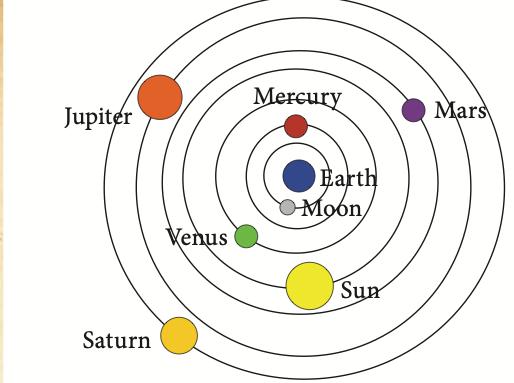
Diagram 1 shows a model of the Solar System. Which statement describes this model?
Show answerHide answer
A
Earth is at the centre and all objects, including the Sun, revolve around it in circular orbits. This is the geocentric model.
4
Question 4
What did Kepler change in the heliocentric model of Copernicus?
Show answerHide answer
C
Kepler kept the Sun at the centre but showed that the planets move in elliptical orbits with the Sun at one common focal point.
5
Question 5
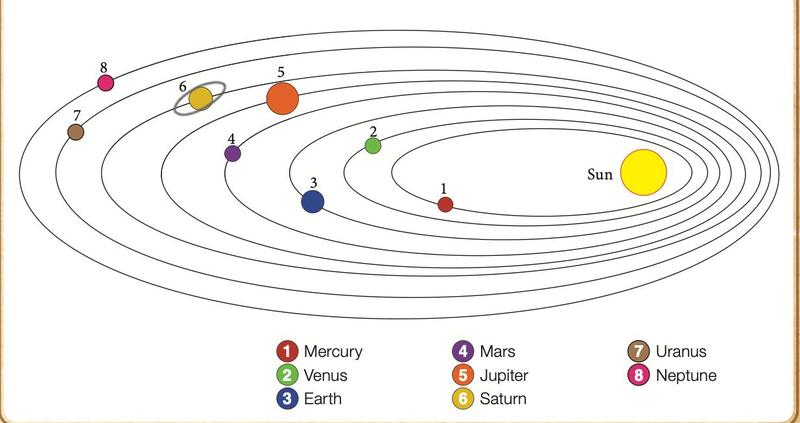
Diagram 2 shows the modified heliocentric model. Which statement about it is correct?
Show answerHide answer
C
All the orbits are ellipses and the Sun sits at one common focal point, as in Kepler's Law. Earth (3) orbits the Sun.
6
Question 6
Which was the first satellite sent into space?
Show answerHide answer
A
Sputnik 1 (USSR, 1957) was the first satellite. TiungSAT-1 was Malaysia's first microsatellite (2000) and Apollo 11 was a mission to the Moon.
7
Question 7
Which sequence lists these events from the earliest to the latest?
I. First human sets foot on the Moon
II. First satellite is launched
III. First human orbits Earth
IV. Hubble Space Telescope is launched
I. First human sets foot on the Moon
II. First satellite is launched
III. First human orbits Earth
IV. Hubble Space Telescope is launched
Show answerHide answer
D
Sputnik 1 (1957), Yuri Gagarin's orbit (1961), Apollo 11 on the Moon (1969), Hubble (1990): II, III, I, IV.
8
Question 8
How does a rocket move upwards?
Show answerHide answer
B
When the fuel burns, hot gases are released at high speed through the bottom of the rocket. This produces a force that pushes the rocket upwards.
9
Question 9
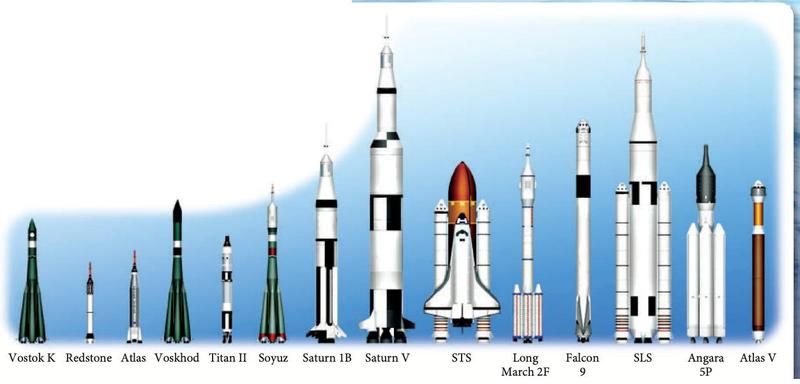
Diagram 3 shows some rockets used to send humans to space. Which rocket was used to send astronauts to the Moon?
Show answerHide answer
C
The Saturn V rocket carried the Apollo astronauts to the Moon.
10
Question 10
How is a space probe different from a satellite?
Show answerHide answer
A
Space probes do not orbit Earth. They travel further into and out of the Solar System, and send information back by radio.
11
Question 11
Which is an example of the use of remote sensing in disaster management?
Show answerHide answer
D
Identifying pollution and forest fires belongs to disaster management. The first is agriculture, the second geology and the third defence.
12
Question 12
The Hubble Space Telescope orbits about 500 km above Earth's surface. Which is the most suitable reason for placing a telescope in space?
Show answerHide answer
B
A space telescope orbiting above Earth observes distant objects more clearly than telescopes on the ground. It stays in orbit around Earth; it does not touch objects or travel to other planets, and it still needs energy to work.
Section B: structured questions
32 marksAnswer all questions. Write your answers in the spaces provided.
13
Question 13
Name the astronomer who built each model of the Solar System.
[1 mark]
(a)The geocentric model
Show answerHide answer
Ptolemy
[1 mark]
(b)The heliocentric model with circular orbits
Show answerHide answer
Copernicus
[1 mark]
(c)The heliocentric model with elliptical orbits (Kepler's Law)
Show answerHide answer
Kepler
14
Question 14
Compare the Solar System models built by Copernicus and Kepler.
[1 mark]
(a)State one similarity.
Show answerHide answer
Any 1 points
Tick each point you got.
[1 mark]
(b)State one difference.
Show answerHide answer
Tick each point you got.
15
Question 15
Diagram 4 shows the geocentric model built by Ptolemy.
[1 mark]
(a)What is at the centre of this model?
Show answerHide answer
Tick each point you got.
[2 marks]
(b)State two ways in which the heliocentric model of Copernicus differs from this model.
Show answerHide answer
Any 2 points
Tick each point you got.
16
Question 16
Answer these questions about the development of space exploration.
[1 mark]
(a)Who first used a telescope in astronomy, in 1609?
Show answerHide answer
Tick each point you got.
[1 mark]
(b)Name the first human to orbit Earth and the spacecraft that carried him.
Show answerHide answer
Tick each point you got.
[1 mark]
(c)Name Malaysia's first microsatellite.
Show answerHide answer
Tick each point you got.
[1 mark]
(d)Which space station was completed in 2011?
Show answerHide answer
Tick each point you got.
17
Question 17
Rockets, satellites and space probes are important technologies in space exploration.
[2 marks]
(a)Explain how a rocket is able to lift off.
Show answerHide answer
Any 2 points
Tick each point you got.
[1 mark]
(b)State one use of a satellite.
Show answerHide answer
Any 1 points
Tick each point you got.
[2 marks]
(c)State two items carried by a space probe.
Show answerHide answer
Any 2 points
Tick each point you got.
18
Question 18
After heavy rain, a river overflows and many villages are flooded. Aerial photographs are taken to find out how far the flood has spread.
[1 mark]
(a)Name the technology used to take these photographs.
Show answerHide answer
Tick each point you got.
[1 mark]
(b)State how the photographs help the rescue team.
Show answerHide answer
Any 1 points
Tick each point you got.
[1 mark]
(c)Which agency is responsible for remote sensing projects in Malaysia?
Show answerHide answer
Tick each point you got.
[1 mark]
(d)In which field is remote sensing used to locate mineral sources?
Show answerHide answer
Geology
19
Question 19
State whether each statement is true or false.
[1 mark]
(a)The Hubble Space Telescope was placed in orbit about 500 km above the surface of Earth.
Show answerHide answer
True
[1 mark]
(b)A space probe orbits Earth in the same way as a satellite.
Show answerHide answer
False
[1 mark]
(c)Radio telescopes detect radio waves from space.
Show answerHide answer
True
[1 mark]
(d)In the heliocentric model, Earth is stationary at the centre.
Show answerHide answer
False
20
Question 20
A class debates whether space exploration should continue.
[1 mark]
(a)Why are space probes, and not astronauts, sent to very far places such as Saturn?
Show answerHide answer
Any 1 points
Tick each point you got.
[2 marks]
(b)Give two reasons to support the continuation of space exploration.
Show answerHide answer
Any 2 points
Tick each point you got.
[1 mark]
(c)State one way in which a rocket can be misused.
Show answerHide answer
Tick each point you got.
21
Question 21
A student builds a model of a spacecraft that will carry life to a distant planet, using cardboard, cellophane tape, black plastic sheet and aluminium foil.
[1 mark]
(a)Which material best represents the covering that shields the spacecraft from ionising radiation in space?
Show answerHide answer
Aluminium foil
[1 mark]
(b)The black plastic sheet is used as the solar panel. State the source of energy for the spacecraft.
Show answerHide answer
Tick each point you got.
[1 mark]
(c)The cardboard cylinder represents a rocket. State the function of the rocket.
Show answerHide answer
Tick each point you got.