Space exploration
What this chapter covers
- Explain the historical development of the Solar System model: the geocentric model (Ptolemy), the heliocentric model (Copernicus) and the modified heliocentric model (Kepler) (10.1)
- Describe the development of technology in space exploration, from early rockets to space stations (10.2)
- Explain the use and importance of space telescopes, rockets, satellites, space probes and remote sensing (10.2)
- Justify the need to continue space exploration (10.2)
10.1Development in astronomy
Our picture of the Solar System has changed over time. Astronomers built models, and the models were improved when new observations and reasoning showed that the old idea did not fit.
Three models of the Solar System
| Astronomer | Model | Centre of the Solar System | Shape of orbits |
|---|---|---|---|
| Ptolemy (Greek, about 90 to 168 A.D.) | Geocentric | Earth | Circular |
| Copernicus (Polish, 1473 to 1543) | Heliocentric | Sun | Circular |
| Kepler (German, 1571 to 1630) | Modified heliocentric (Kepler's Law) | Sun, at one common focal point | Elliptical |
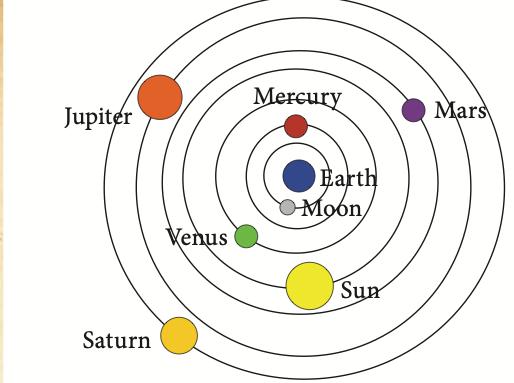 Geocentric model
Earth at the centre
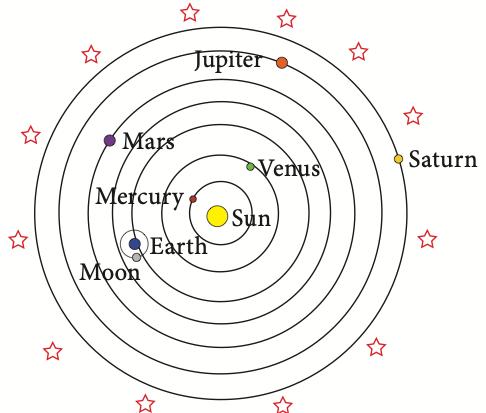 Heliocentric model
Sun at the centre
Models: textbook Figure 10.1, p. 270.
What each model says
- Geocentric: "geo" means Earth and "centric" means centre. Earth is stationary, and the Sun, the Moon and the other planets revolve around Earth in circular orbits.
- Heliocentric: "helio" means Sun. The Sun is at the centre. Earth rotates on its axis and revolves around the Sun in a circular orbit.
- Modified heliocentric: Kepler kept the Sun at the centre but showed that the planets move in elliptical orbits, with the Sun at one common focal point of the ellipses.
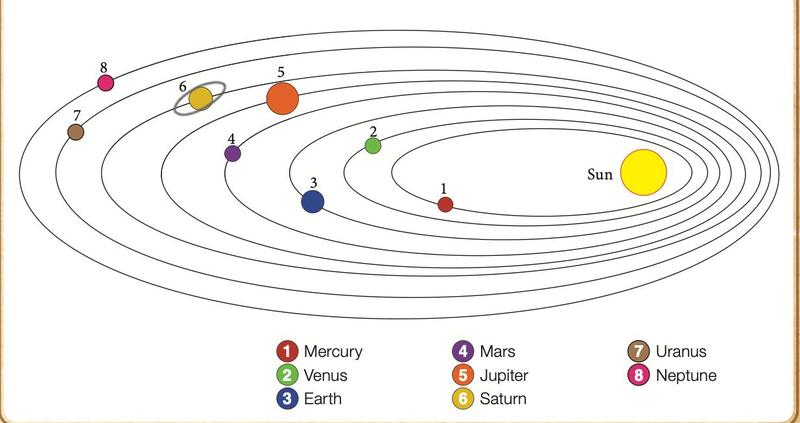
Orbits: textbook p. 271.
| Ptolemy and Copernicus | Copernicus and Kepler | |
|---|---|---|
| Similarity | Objects revolve in circular orbits | Both are heliocentric (Sun at the centre) |
| Difference | Earth at the centre vs Sun at the centre | Circular orbits vs elliptical orbits |
Scientific knowledge like this is the product of human effort to find rational explanations for natural phenomena, and a model can be improved when new evidence appears.
Show answerHide answer
10.2Technology in space exploration
Early history
| Year | Event |
|---|---|
| 11th century | The Chinese invented gunpowder and used primitive rockets in battles |
| 1609 | Galileo Galilei used the first telescope in astronomy |
| 1957 | First satellite, Sputnik 1 (USSR) |
| 1961 | First human to orbit Earth, Yuri Gagarin, aboard Vostok 1 (USSR) |
| 1969 | First human on the Moon, Neil Armstrong, Apollo 11 (US) |
| 1973 | First Jupiter flyby, Pioneer 10 (US) |
| 1981 | First flight of the US space shuttle Columbia |
| 1989 | First Neptune flyby, Voyager 2 (US) |
| 1990 | Hubble Space Telescope launched from the space shuttle Discovery |
| 1996 | Malaysian satellites MEASAT 1 and 2 launched |
| 2000 | Malaysia's first microsatellite, TiungSAT-1, launched |
| 2002 | National Space Agency (Agensi Angkasa Negara) established |
| 2011 | Construction of the International Space Station (ISS) completed |
Timeline: textbook Figure 10.2, p. 273.
Malaysia's first astronaut, Dato' Dr Sheikh Muszaphar Shukor, carried out experiments on the ISS from 10 to 21 October 2007 (textbook p. 269).
Technologies and why they matter
| Technology | What it is | Use and importance |
|---|---|---|
| Space telescope | A telescope placed in orbit above Earth. Hubble orbits about 500 km above the surface; Spitzer detects very distant activity in space. | Observes distant objects in space more clearly than telescopes on the ground |
| Radio telescope | A dish that detects radio waves from space | Studies objects that give out radio waves, not just visible light |
| Rocket | A craft that gets its thrust from a rocket engine. Burning fuel releases hot gases at high speed through the bottom; this produces a force that pushes the rocket upwards. | Sends spacecraft, satellites, space probes and astronauts into space |
| Satellite | An object that orbits Earth. Sputnik 1 was the first. | Gathers information on space weather, remote sensing, telecommunication and defence |
| Space probe | A spacecraft that gathers information and sends it back to Earth. It travels further into and out of the Solar System and does not orbit Earth. It carries cameras, remote sensing instruments and radio transmitters and receivers. | Studies distant bodies in space for a very long time, up to tens of years (Cassini was still orbiting Saturn after 20 years) |
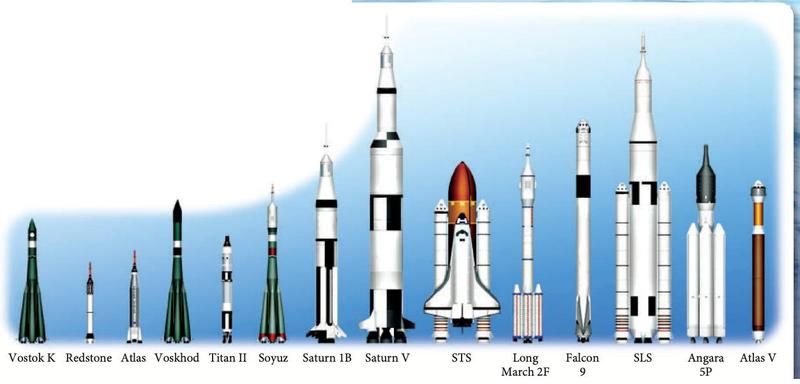
Rockets: textbook Photograph 10.1, p. 274. The Saturn V rocket took the Apollo astronauts to the Moon.
Remote sensing
The remote sensing instruments on TiungSAT-1 receive visible, ultraviolet and infrared light from objects on and below Earth's surface. The data goes to two receiving stations: the National Planetarium in Kuala Lumpur and the Mission Control Station in Bangi, Selangor. In Malaysia, MACRES (the Malaysian Remote Sensing Agency) is responsible for remote sensing projects.
| Field | Use of remote sensing |
|---|---|
| Agriculture | Detect suitable regions for agricultural development; monitor land use and predict crop yield |
| Geology | Locate mineral sources and detect land and mass depletion; map the surface of Earth |
| Disaster management | Identify pollution and forest fires; find flooded areas and safe places to move flood victims |
| Defence | Detect intrusion by enemy ships, aircraft and vehicles |
Answer: The rescue team can locate the flooded areas and choose safe places to move the victims to.
Should we continue space exploration?
The textbook asks you to debate this (Activity 10.3). Reasons for continuing include: better weather forecasts and communication from satellites, remote sensing for farming, mineral search and disaster management, new knowledge about the Sun, planets and space weather, and new technology developed along the way. A reason for caution: rockets can be misused as weapons to carry missiles, and the cost is very high.