Space weather
What this chapter covers
- Describe the structure of the Sun and name the layers that form its atmosphere (9.1.1)
- {"Describe the phenomena on the Sun's surface": 'granules, sunspots, solar cycle, prominences, solar flares, coronal mass ejections and solar wind (9.1.1)'}
- Explain how Earth's magnetosphere is formed and justify its importance (9.1.2)
- Define space weather and explain its effects on Earth (9.2.1)
- Interpret data that relates sunspots and the solar cycle to coronal mass ejections and solar wind (9.2.1)
9.1Activities of the Sun that affect Earth
Structure of the Sun
The Sun has six parts. From the centre outwards they are the core, radiation zone and convection zone (the inside of the Sun), then the photosphere, chromosphere and corona. The last three form the Sun's atmosphere.
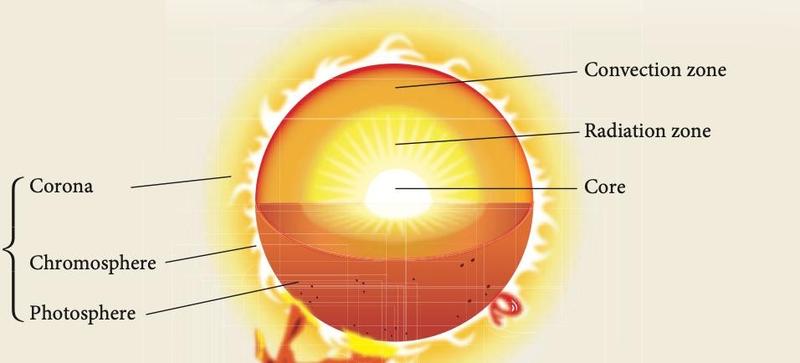
Figure: Science Form 3 (DLP) textbook, Figure 9.1, p. 258.
| Part | Where it is |
|---|---|
| Core | The centre of the Sun |
| Radiation zone | Around the core |
| Convection zone | Around the radiation zone, below the surface |
| Photosphere | Innermost layer of the atmosphere; the visible surface |
| Chromosphere | Middle layer of the atmosphere |
| Corona | Outermost layer of the atmosphere |
Show answerHide answer
Phenomena on the surface of the Sun
| Phenomenon | What it is | Key facts |
|---|---|---|
| Granules | Grainy structures that make up the photosphere; the top of the convection zone of extremely hot plasma | Up to 5 800 °C; average diameter about 1 000 km |
| Sunspots | Dark regions on the photosphere, where very large eruptions occur | Dark because they are cooler than the granules around them; always in pairs or groups; last more than a week |
| Solar cycle | The rise and fall in sunspot activity | One cycle lasts 11 years |
| Prominence | A huge loop or arch of glowing gas above a sunspot | Hundreds of thousands of km high; lasts days to months; throws matter out at 600 to more than 1 000 km s−1 |
| Solar flare | A strong explosion that erupts charged gas, often near sunspots | Brightest within seconds or minutes; light reaches Earth in 8 minutes; charged particles take tens of minutes |
| Coronal mass ejection (CME) | A huge cloud of plasma carrying magnetic particles, often with strong solar flares | Particles take about 3 days to reach Earth |
| Solar wind | Electrons, protons and alpha particles streaming out of the Sun, carrying the interplanetary magnetic field | Supersonic, 250 to 750 km s−1; speed, temperature and density change on the way |
A solar flare erupts at 8.02 am. Its light takes 8 minutes to reach Earth, so we see it at 8.10 am. The charged particles arrive later.
When charged particles from solar flares and CMEs collide with atoms and molecules in Earth's atmosphere, they produce a light display called the aurora. It occurs only in the sky around Earth's poles.
Show answerHide answer
Earth's magnetosphere
- Formation: it forms from the interaction between the magnetic field carried by the solar wind and Earth's magnetic field.
- Shape: it is squeezed on the side facing the Sun and stretched out on the other side. Its shape changes a lot as the number and energy of the solar wind particles change. Earth's own magnetic field lines change only slightly. Its shape is like the tail of a comet.
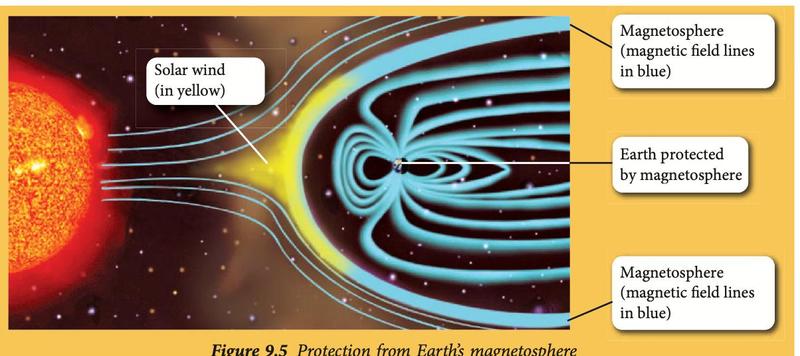
Figure: Science Form 3 (DLP) textbook, Figure 9.5, p. 262.
Importance of the magnetosphere
- It acts as a biological shield that protects life on Earth from the harmful effects of the solar wind.
- It blocks charged particles (electrons, protons, alpha particles). Too many reaching the atmosphere would disrupt telecommunication, navigation systems and electric power lines.
- It reduces the pressure of the solar wind on Earth's atmosphere.
Show answerHide answer
9.2Space weather
Effects on Earth
| Effect | Why |
|---|---|
| Aurora near the poles | Charged particles collide with atoms and molecules in the atmosphere |
| Disturbed telecommunication and radio transmission | Charged particles from solar wind, storms and CMEs interfere with signals |
| Disturbed navigation systems | Too many charged particles in the atmosphere disturb the systems |
| Disturbed electric power lines | Charged particles from storms and CMEs disturb the lines |
In September 2017 a strong solar flare (class X9.3) and coronal mass ejections disturbed telecommunication, navigation and power lines for about an hour.
Interpreting space weather data
Scientists use space weather data to forecast when coronal mass ejections will occur and to find why solar flares and CMEs happen. The data show a pattern: the more sunspots (the more active the solar cycle), the more coronal mass ejections and solar wind. This is why space weather is worse near the peak of an 11-year cycle.
2025, because more sunspots mean more CMEs.
Show answerHide answer
Summary
| Remember | Key fact |
|---|---|
| Sun's gases | Hydrogen and helium |
| Atmosphere layers | Photosphere, chromosphere, corona |
| Sunspots | Dark because cooler; solar cycle 11 years |
| Flare / CME arrival | Light 8 minutes; flare particles tens of minutes; CME particles about 3 days |
| Solar wind | Electrons, protons, alpha particles; 250 to 750 km s−1 |
| Magnetosphere | Shield from solar wind; shape changes with solar wind |
| Space weather effects | Aurora; disturbed telecommunication, navigation, power lines |