Radioactivity
What this chapter covers
- Describe how radioactivity was discovered and who contributed (8.1)
- Define radioactivity and radioactive decay; give examples of radioactive substances (8.1)
- State the units of radioactivity and explain half-life, including calculations and graphs (8.1)
- Explain the formation of positive ions and negative ions (8.2)
- Differentiate ionising and non-ionising radiation, and compare alpha, beta and gamma radiation (8.3)
- Give natural and man-made sources of ionising radiation and explain how to keep the dose safe (8.3)
- Describe the uses of radioactive radiation and the safe handling of radioactive substances and waste (8.4)
8.1Discovery of radioactivity
| Year | Scientist | Discovery |
|---|---|---|
| 1895 | Wilhelm Roentgen (German) | The X-ray; first Nobel Prize in Physics (1901) |
| 1896 | Henri Becquerel (French) | Radioactivity: a uranium compound blackened a photographic plate even in the dark (Nobel Prize 1903) |
| 1897 | Marie and Pierre Curie | Detected radioactive radiation through its ionising power; extracted polonium and radium from pitchblende (uranium ore) |
The nucleus keeps emitting radiation until it becomes more stable. Examples of radioactive substances: carbon-14, radon-222, thorium-234 and uranium-238.
U-238 (92 p, 146 n) emits a helium nucleus (2 p, 2 n) and becomes Th-234 (90 p, 144 n).
Th-234 (90 p, 144 n) emits an electron and becomes Pa-234 (91 p, 143 n).
An unstable Co-60 nucleus (27 p, 33 n) emits a gamma ray and stays Co-60, now more stable.
Units of radioactivity
Radioactivity measures the rate of decay (decays per second).
| Unit | Value |
|---|---|
| Becquerel (Bq), the S.I. unit | 1 Bq = 1 decay per second |
| Curie (Ci), the first unit | 1 Ci = 3.7 × 10¹⁰ decays per second = 3.7 × 10¹⁰ Bq |
Half-life
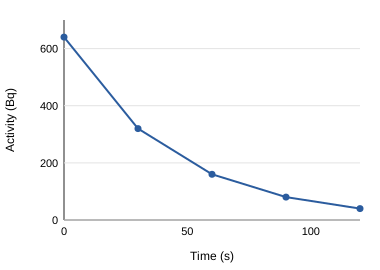
Number of half-lives = 20.8 ÷ 5.2 = 4.
80 g → 40 g → 20 g → 10 g → 5 g. Remaining mass = 5 g.
Show answerHide answer
8.2Atom and nucleus
Dalton's Atomic Theory said the atom is the smallest particle and cannot be divided. Science later found smaller particles: protons (positive) and neutrons (neutral) in the nucleus, and electrons (negative) around it. An atom is neutral when protons = electrons.
| Ion | How it forms | Example |
|---|---|---|
| Positive ion (cation) | Atom loses electrons | Na (11 p, 11 e) loses 1 e → Na+ (11 p, 10 e), charge +1 |
| Negative ion (anion) | Atom gains electrons | Cl (17 p, 17 e) gains 1 e → Cl− (17 p, 18 e), charge −1 |
Show answerHide answer
8.3Ionising and non-ionising radiation
| Non-ionising | Ionising |
|---|---|
| Radio waves, microwaves, infrared, visible light, very low frequency waves | Ultraviolet, X-rays, gamma rays (and alpha and beta particles) |
Alpha, beta and gamma radiation
| Alpha, α | Beta, β | Gamma, γ | |
|---|---|---|---|
| Nature | Helium nucleus | High-speed electron | Electromagnetic wave |
| Charge | Positive | Negative | Neutral |
| Ionising power | High | Moderate | Low |
| Penetration power | Low (stopped by paper) | Moderate (stopped by about 3 mm aluminium) | High (needs about 10 cm lead) |
| Electric field | Bends towards the negative plate | Bends towards the positive plate | Not deflected |
| Magnetic field | Deflected one way (upwards in the textbook figure) | Deflected the opposite way (downwards) | Not deflected (goes straight) |
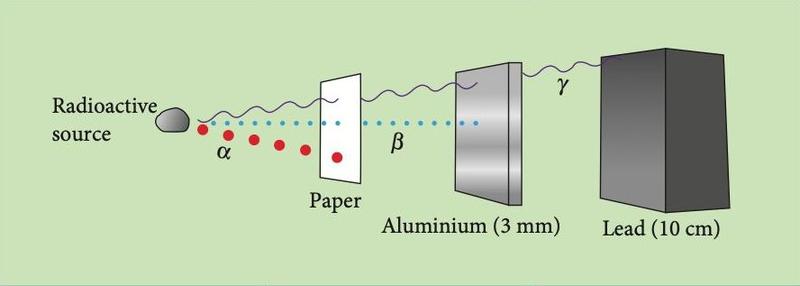
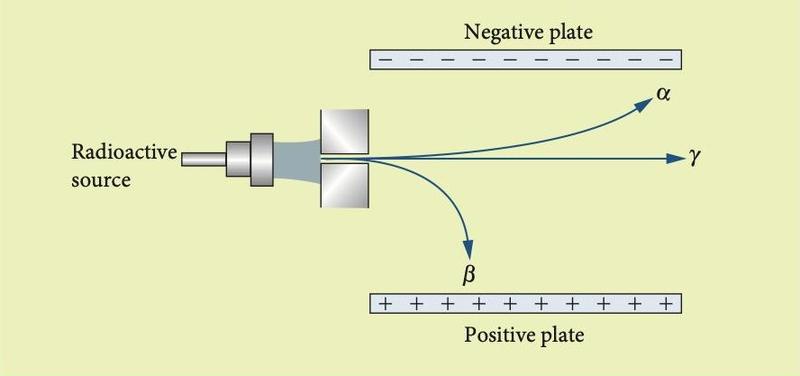
Textbook Table 8.4, p. 241
Sources of ionising radiation
| Natural | Man-made |
|---|---|
| Cosmic rays (high-energy radiation from outside the Solar System); background radiation | Nuclear accidents; nuclear tests; radioisotopes used in medicine; background radiation |
Background radiation and dose
Background radiation is the ionising radiation in the environment. Absorbed radiation damages body cells, so its effect is measured as a dose. 1 sievert (Sv) means 1 joule of radiation energy absorbed by 1 kg of living tissue. The dose rate is measured with a Geiger counter in microsieverts per hour (μSv/h).
| Source of dose | Safety measure |
|---|---|
| Background radiation (UV) | Anti-UV spectacles and umbrellas |
| Medical X-ray | Only with a doctor's prescription |
| Television | Sit at least 2 m away |
| Contaminated food | Do not eat food from contaminated areas |
| Cosmic rays | Limit the flying hours of pilots and aircrew |
| Source (textbook Figure 8.11) | Estimated dose |
|---|---|
| TV or computer | 0.01 mSv/h |
| Flight (cosmic rays) | 0.003 mSv/h |
| Environment (background radiation) | 0.4 to 1.0 mSv/year |
| Medical X-ray | 5.5 mSv per medical test |
Total time = 2 × 5 = 10 h. Dose = 0.01 × 10 = 0.1 mSv.
8.4Uses of radioactive radiation
| Field | Use |
|---|---|
| Archeology and geochronology | Carbon-14 dating: after death, C-14 (half-life 5 700 years, emits beta) is no longer replaced, so its activity shows the age of fossils and artifacts |
| Industry | Beta radiation checks the thickness of metal sheets; too much beta detected means the sheet is too thin |
| Agriculture | P-32 shows how fast plants absorb phosphate fertiliser; radiation kills beetles and sterilises pests |
| Medicine | Gamma rays from Co-60 or Cs-137 kill cancer cells; Na-24 locates blood clots; Tc-99 treats brain tumours; I-131 treats the thyroid |
| Food preservation | Gamma rays kill bacteria in food. The Radura logo labels such food |
| Defence | Nuclear weapons: radiation destroys living things and its effect lasts for generations |
Age = 2 × 5 700 = 11 400 years.
Safe handling of radioactive substances and waste
- Store sources and waste in containers with thick lead walls.
- Shield substances with thick slabs of lead.
- Handle them with robotic hands, and wear protective clothing.
- Wear radiation badges to detect the dose absorbed.
- Dispose of waste safely and properly.
Irene Joliot-Curie made the first artificial radioactive element, phosphorus-30, in 1934. Radioactive radiation brings great benefits, so we should be grateful and use it responsibly.
Summary
| Remember | Key fact |
|---|---|
| Radioactivity | Random, spontaneous decay of an unstable nucleus emitting α, β or γ |
| Units | Bq (1 decay/s) and Ci (3.7 × 10¹⁰ Bq) |
| Half-life | Time for activity or undecayed nuclei to halve |
| Ion | Lose e → positive; gain e → negative |
| Ionising power | α > β > γ; penetration γ > β > α |
| Safe dose rate | Below 0.2 μSv/h |