Science questions, chapter 8
Nama / NameKelas / ClassTarikh / Date
Radioactivity
43 marks. Use Practice to check each answer as you go, or Exam to answer everything against the clock first.
Section A: objective questions
12 marksChoose the best answer for each question.
1
Question 1
Who discovered X-rays in 1895?
Show answerHide answer
B
Wilhelm Roentgen discovered X-rays in 1895. Becquerel discovered radioactivity in 1896.
2
Question 2
Marie and Pierre Curie extracted two radioactive elements from pitchblende. What were the elements?
Show answerHide answer
D
From the uranium ore pitchblende the Curies extracted polonium and radium.
3
Question 3
Which statement describes radioactive decay?
Show answerHide answer
A
Radioactive decay is the random and spontaneous process where an unstable nucleus emits radioactive radiation until it is more stable.
4
Question 4
What is the S.I. unit of radioactivity?
Show answerHide answer
C
The S.I. unit of radioactivity is the becquerel (1 decay per second). The curie is an older unit and the sievert measures dose.
5
Question 5
The half-life of Pa-234 is 5.2 hours. What mass of a 160 g sample remains after 15.6 hours?
Show answerHide answer
B
15.6 ÷ 5.2 = 3 half-lives. 160 → 80 → 40 → 20 g.
6
Question 6
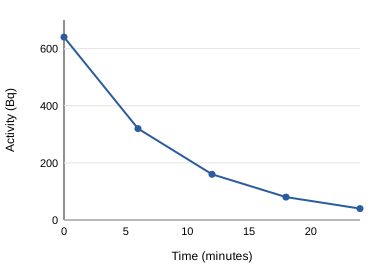
Diagram 1 shows the activity of radioactive substance R against time. What is the half-life of R?
Show answerHide answer
A
Half of 640 Bq is 320 Bq, which is reached at 6 minutes.
7
Question 7
Which particles are found in the nucleus of an atom?
Show answerHide answer
C
The nucleus contains protons (positive) and neutrons (neutral). Electrons move around the nucleus.
8
Question 8
A particle has 13 protons and 10 electrons. Which statement is correct?
Show answerHide answer
D
Charge = +13 − 10 = +3. It has lost three electrons, so it is a positive ion.
9
Question 9
Which of the following is a non-ionising radiation?
Show answerHide answer
A
Radio waves are non-ionising. X-rays, gamma rays and alpha radiation are ionising.
10
Question 10
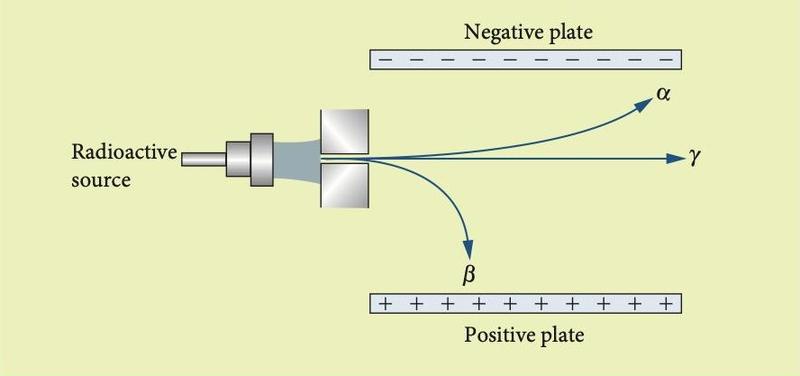
Diagram 2 shows radiation from a source passing between two charged plates. Which statement is correct?
Show answerHide answer
B
Opposite charges attract. Beta bends to the positive plate, so it is negative. Alpha bends to the negative plate, so it is positive. Gamma is not deflected because it is neutral.
11
Question 11
A radioactive source is placed behind a sheet of paper. A detector in front of the paper records almost no radiation. Which radiation does the source emit?
Show answerHide answer
C
Beta and gamma pass through paper, so the detector would still record them. Only alpha is stopped by paper, so the source emits alpha only.
12
Question 12
Which radiation is used to preserve fruits by killing bacteria?
Show answerHide answer
D
Gamma rays are used in food preservation; the food carries the Radura logo.
Section B: structured questions
31 marksAnswer all questions.
13
Question 13
Radioactivity was discovered in 1896 and studied further by Marie and Pierre Curie.
[1 mark]
(a)Name the scientist who first discovered radioactivity.
Show answerHide answer
Tick each point you got.
[1 mark]
(b)Becquerel left a uranium compound near a photographic plate. State what he observed.
Show answerHide answer
Tick each point you got.
[1 mark]
(c)Marie and Pierre Curie detected radioactive radiation by another property. State this property.
Show answerHide answer
Tick each point you got.
14
Question 14
A radioactive substance has a half-life of 4 days. The original mass of the sample is 64 g.
[1 mark]
(a)What is meant by half-life?
Show answerHide answer
Tick each point you got.
[2 marks]
(b)Calculate the mass of the substance that remains after 12 days.
Show answerHide answer
Tick each point you got.
15
Question 15
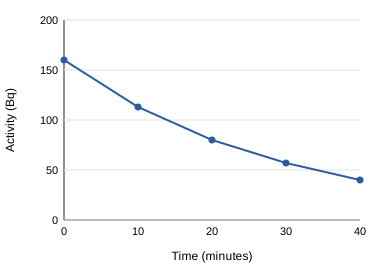
Diagram 3 shows the activity of radioactive substance S against time.
[2 marks]
(a)Use the graph to find the half-life of S. Show how you obtained your answer.
Show answerHide answer
Tick each point you got.
[1 mark]
(b)Predict the activity of S at 60 minutes.
Show answerHide answer
Tick each point you got.
16
Question 16
Table 1 shows the subatomic particles in particle X.
| Particle | Protons | Neutrons | Electrons |
|---|---|---|---|
| X | 8 | 8 | 10 |
[1 mark]
(a)Is X a positive ion or a negative ion?
Show answerHide answer
Tick each point you got.
[2 marks]
(b)Explain your answer in (a).
Show answerHide answer
Tick each point you got.
[1 mark]
(c)State the charge on X.
Show answerHide answer
Tick each point you got.
17
Question 17
Choose the correct radiation for each description.
[1 mark]
(a)The radiation with the highest ionising power.
Show answerHide answer
Alpha
[1 mark]
(b)The radiation that needs thick lead to stop it.
Show answerHide answer
Gamma
[1 mark]
(c)A high-speed electron.
Show answerHide answer
Beta
[1 mark]
(d)The radiation that is not deflected by an electric field.
Show answerHide answer
Gamma
18
Question 18
A television gives a dose rate of ionising radiation of 0.01 mSv/h. Anis watches television for 3 hours every day for 4 days.
[2 marks]
(a)Calculate the total dose she receives from the television.
Show answerHide answer
Tick each point you got.
[1 mark]
(b)A Geiger counter shows a background radiation of 0.15 μSv/h in her garden. Is this safe? Give a reason.
Show answerHide answer
Tick each point you got.
[1 mark]
(c)State one way to reduce the radiation she receives from the television.
Show answerHide answer
Any 1 points
Tick each point you got.
19
Question 19
Archaeologists find a wooden tool. Its carbon-14 activity is one eighth of the activity in a living tree. The half-life of C-14 is 5 700 years.
[1 mark]
(a)How many half-lives have passed?
Show answerHide answer
Tick each point you got.
[2 marks]
(b)Calculate the age of the tool.
Show answerHide answer
Tick each point you got.
[1 mark]
(c)Name the radiation emitted when C-14 decays.
Show answerHide answer
Tick each point you got.
20
Question 20
A hospital stores waste from cancer treatment, which gives out gamma rays.
[1 mark]
(a)Why is the waste kept in containers with thick lead walls?
Show answerHide answer
Tick each point you got.
[2 marks]
(b)A technician suggests using a 3 mm aluminium box instead because it is lighter. Evaluate this suggestion.
Show answerHide answer
Tick each point you got.
21
Question 21
A factory makes thin sheets of aluminium. The sheets must have a fixed thickness. Suggest how beta radiation can be used to monitor the thickness.
[1 mark]
(a)Draw a labelled diagram or describe the arrangement of the source, the sheet and the detector.
Show answerHide answer
Tick each point you got.
[2 marks]
(b)Explain how the device shows that a sheet is too thin.
Show answerHide answer
Tick each point you got.