Science questions, chapter 9
Nama / NameKelas / ClassTarikh / Date
Space weather
40 marks. Use Practice to check each answer as you go, or Exam to answer everything against the clock first.
Section A: objective questions
12 marksChoose the best answer for each question.
1
Question 1
Which two gases make up almost all of the Sun?
Show answerHide answer
B
The Sun consists almost entirely of hydrogen and helium (p. 258).
2
Question 2
Which layer is the outermost layer of the Sun's atmosphere?
Show answerHide answer
D
The atmosphere has three layers: photosphere, chromosphere and corona. The corona is the outermost. The convection zone is inside the Sun, not in its atmosphere.
3
Question 3
Why do sunspots look dark?
Show answerHide answer
A
Sunspots have a lower temperature than the surrounding granules, so they appear dark (p. 259).
4
Question 4
How long is one solar cycle?
Show answerHide answer
C
The rise and fall of sunspot activity repeats in a cycle of 11 years.
5
Question 5
A huge loop of glowing gas is seen arching over a sunspot. What is this phenomenon?
Show answerHide answer
B
A prominence is a huge loop or arched column of glowing gas over a sunspot.
6
Question 6
About how long do the magnetic particles from a coronal mass ejection take to reach Earth?
Show answerHide answer
C
The light from a flare takes 8 minutes, but the particles of a coronal mass ejection take about three days (p. 260).
7
Question 7
Charged particles from the Sun collide with atoms and molecules in Earth's atmosphere near the poles. What is produced?
Show answerHide answer
D
The collisions produce a light display called the aurora, seen only in the sky around Earth's poles.
8
Question 8
Which of the following is carried by the solar wind?
Show answerHide answer
A
The solar wind is made up of plasma particles: electrons, protons and alpha particles.
9
Question 9
Which statement about Earth's magnetosphere is correct?
Show answerHide answer
A
The magnetosphere blocks charged particles such as electrons, protons and alpha particles in the solar wind and shields life on Earth.
10
Question 10
What mainly makes the shape of Earth's magnetosphere change a lot?
Show answerHide answer
C
The magnetosphere forms from the interaction of the solar wind's magnetic field with Earth's field; its shape changes as the number and energy of the solar wind particles change.
11
Question 11
Which of the following is NOT an example of space weather?
Show answerHide answer
D
Space weather refers to phenomena on the Sun's surface and in space. A rainstorm is Earth's weather.
12
Question 12
A graph shows that the number of sunspots rose steadily from 2019 to 2025. What is the most reasonable prediction about the same period?
Show answerHide answer
B
More sunspots (a more active solar cycle) are related to more coronal mass ejections and solar wind.
Section B: structured questions
28 marksAnswer all questions.
13
Question 13
Diagram 1 shows the structure of the Sun. Name the parts labelled A to F.
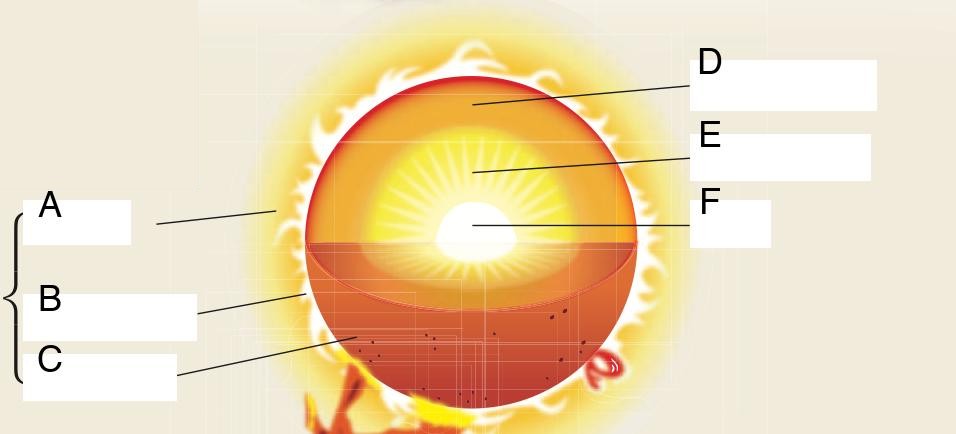
[1 mark]
(a)A (outermost layer of the atmosphere)
Show answerHide answer
Tick each point you got.
[1 mark]
(b)B
Show answerHide answer
Tick each point you got.
[1 mark]
(c)C
Show answerHide answer
Tick each point you got.
[1 mark]
(d)D
Show answerHide answer
Tick each point you got.
[1 mark]
(e)E
Show answerHide answer
Tick each point you got.
[1 mark]
(f)F
Show answerHide answer
Tick each point you got.
14
Question 14
A student compares three phenomena on the Sun: prominence, solar flare and coronal mass ejection.
[1 mark]
(a)Which phenomenon is a huge cloud of plasma containing magnetic particles?
Show answerHide answer
Tick each point you got.
[1 mark]
(b)Which phenomenon is a strong explosion that often occurs near sunspots?
Show answerHide answer
Tick each point you got.
[1 mark]
(c)A solar flare and a coronal mass ejection happen together. State one effect when their particles reach Earth's atmosphere.
Show answerHide answer
Any 1 points
Tick each point you got.
[1 mark]
(d)State the name of the stream of electrons, protons and alpha particles that travels out from the Sun.
Show answerHide answer
Tick each point you got.
[1 mark]
(e)The solar wind travels at 250 to 750 km s⁻¹. State one property of the solar wind that changes as it travels.
Show answerHide answer
Any 1 points
Tick each point you got.
15
Question 15
A solar flare erupts from the Sun at 8.02 am. A coronal mass ejection erupts together with it. The light of the flare takes 8 minutes to reach Earth. The particles of the coronal mass ejection take 3 days.
[1 mark]
(a)At what time is the flare first seen on Earth?
Show answerHide answer
Tick each point you got.
[1 mark]
(b)The coronal mass ejection erupts on Monday at 8.02 am. On which day do its particles reach Earth?
Show answerHide answer
Tick each point you got.
[2 marks]
(c)A prominence throws out matter at 600 km s⁻¹. Calculate the distance travelled in 20 seconds.
Show answerHide answer
Tick each point you got.
16
Question 16
Diagram 2 shows the solar wind meeting Earth's magnetosphere.
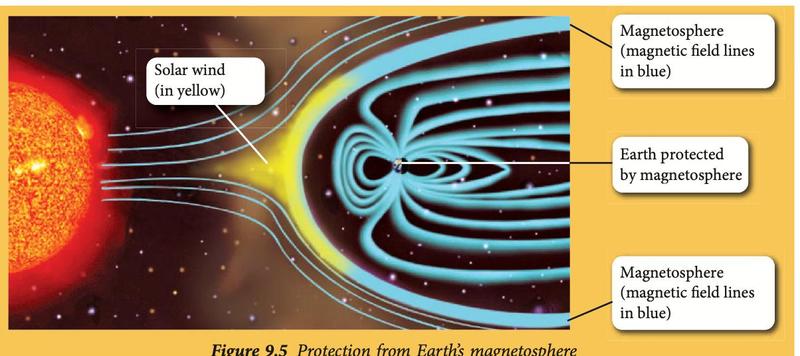
[1 mark]
(a)How is the magnetosphere formed?
Show answerHide answer
Tick each point you got.
[1 mark]
(b)State one importance of the magnetosphere.
Show answerHide answer
Any 1 points
Tick each point you got.
[2 marks]
(c)Explain what would happen to telecommunication on Earth if there were no magnetosphere.
Show answerHide answer
Tick each point you got.
17
Question 17
The table shows the average number of sunspots and the number of coronal mass ejections (CMEs) recorded in a year for one solar cycle.
| Year | Number of sunspots | Number of CMEs |
|---|---|---|
| 1 | 10 | 5 |
| 3 | 60 | 25 |
| 6 | 150 | 70 |
| 9 | 60 | 30 |
| 11 | 10 | 6 |
[1 mark]
(a)State the year with the most coronal mass ejections.
Show answerHide answer
Tick each point you got.
[1 mark]
(b)State the relationship between the number of sunspots and the number of CMEs.
Show answerHide answer
Tick each point you got.
[1 mark]
(c)How many years does one solar cycle last?
Show answerHide answer
Tick each point you got.
[2 marks]
(d)Predict the number of CMEs when the sunspots number about 100, and give a reason.
Show answerHide answer
Tick each point you got.
18
Question 18
A strong coronal mass ejection is forecast to reach Earth in three days.
[1 mark]
(a)Why can scientists forecast this?
Show answerHide answer
Tick each point you got.
[2 marks]
(b)Suggest two ways in which daily life might be disturbed.
Show answerHide answer
Any 2 points
Tick each point you got.
[1 mark]
(c)Suggest one precaution that a country could take.
Show answerHide answer
Any 1 points
Tick each point you got.