Energy and power
What this chapter covers
- Define work and energy, and solve problems on work done in daily life (7.1.1)
- Relate power to work and solve problems on power in daily life (7.1.2)
- Explain gravitational potential energy and calculate it with E = mgh (7.2.1)
- Calculate elastic potential energy with E = ½Fx (7.2.2)
- Explain kinetic energy and calculate it with E = ½mv² (7.2.3)
- State the Principle of Conservation of Energy and explain it with oscillating systems (7.3.1)
- Solve problems on the transformation of kinetic and potential energy in a closed system (7.3.2)
7.1Work, energy and power
Work (J) = Force (N) × Displacement (m), W = Fs
The S.I. unit of work is the joule (J). 1 J of work is done when a force of 1 N moves an object through 1 m in the direction of the force, so 1 J = 1 N m. Larger units are the kilojoule (1 kJ = 1 000 J) and the megajoule (1 MJ = 1 000 000 J).
Displacement is the distance travelled in a specified direction. If the object does not move in the direction of the force, no work is done in that direction.
Mass given. Lifting a box of mass 10 kg through 2 m (take 1 kg = 10 N): weight = 10 × 10 = 100 N, so W = 100 × 2 = 200 J.
Centimetres. Pulling a drawer 30 cm with a force of 2 N: 30 cm = 0.3 m, so W = 2 × 0.3 = 0.6 J.
Energy and power
Power, P, is the rate of doing work.
Power (W) = Work done (J) ÷ Time taken (s), P = W ÷ t
The S.I. unit of power is the watt (W): 1 W = 1 J s−1, meaning 1 J of work is done in 1 s. Two people who do the same work have different power if one does it in a shorter time. An old unit of power is the horsepower (hp).
Box on a ramp: 30 N over 2 m in 5 s. W = 30 × 2 = 60 J; P = 60 ÷ 5 = 12 W.
Weight lifted: 150 N through 1 m in 0.5 s. W = 150 J; P = 150 ÷ 0.5 = 300 W.
Show answerHide answer
7.2Potential energy and kinetic energy
Gravitational potential energy
Ep = mgh (m in kg, g = 10 m s−2 or 10 N kg−1, h in m)
Weight = mass × gravitational acceleration. Lifting the object needs a force equal to its weight, mg, through a height h, so work done = mgh. With no other energy produced, all the work done becomes gravitational potential energy.
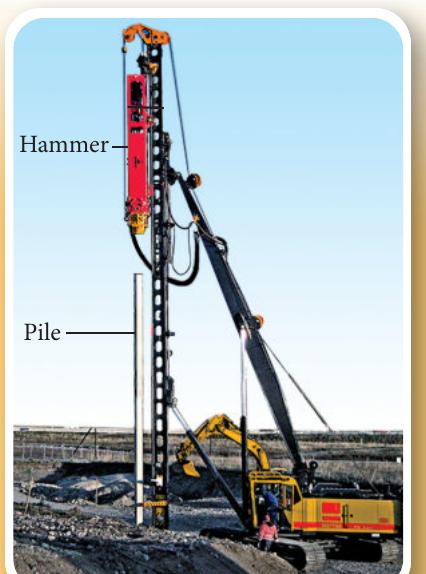
Photograph: Science Form 3 (DLP) textbook, Photograph 7.2, p. 216.
Work done = Ep = mgh = 1 500 × 10 × 30 = 450 000 J.
Time = 0.5 × 60 = 30 s, so P = 450 000 ÷ 30 = 15 000 W = 15 kW.
Elastic potential energy
Ee = ½ Fx (F in N, x in m)
The force on a spring grows from 0 to F as it is stretched, so the average force is ½F. On a force–displacement graph the work done is the area under the graph, which is a triangle with area ½ × F × x.
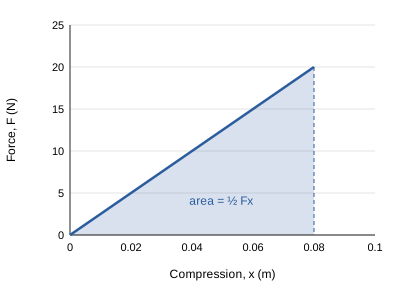
x = 20 − 12 = 8 cm = 0.08 m. Ee = ½ × 20 × 0.08 = 0.8 J.
Kinetic energy
Ek = ½ mv2 (m in kg, v in m s−1)
A stationary object has no kinetic energy. Because v is squared, doubling the speed makes the kinetic energy four times larger. This is why a heavy lorry at low speed and a small bullet at high speed can both have large kinetic energy.
| Quantity | To change units |
|---|---|
| Speed in km h−1 to m s−1 | Divide by 3.6 (× 1 000 m ÷ 3 600 s). 360 km h−1 = 100 m s−1 |
| Height or extension in cm | Divide by 100 to get metres |
| Mass in g | Divide by 1 000 to get kilograms |
Find the speed: a 0.2 kg ball bearing has Ek = 3.6 J. 3.6 = ½ × 0.2 × v2, so v2 = 3.6 ÷ 0.1 = 36 and v = 6 m s−1.
Standard form: an electron of mass 9 × 10⁻³¹ kg at 4 × 10⁶ m s−1: Ek = ½ × 9 × 10−31 × (4 × 106)2 = 7.2 × 10⁻¹⁸ J.
| Form | Formula | What the object has |
|---|---|---|
| Gravitational potential energy | mgh | A raised position above the Earth's surface |
| Elastic potential energy | ½Fx | A stretched or compressed elastic material |
| Kinetic energy | ½mv2 | Motion |
Show answerHide answer
7.3Principle of Conservation of Energy
Oscillating systems such as a simple pendulum and a loaded spring keep transforming energy between potential energy (gravitational or elastic) and kinetic energy. A closed system has no external force such as friction, so no energy is changed to heat: the total of potential and kinetic energy stays constant.
Simple pendulum
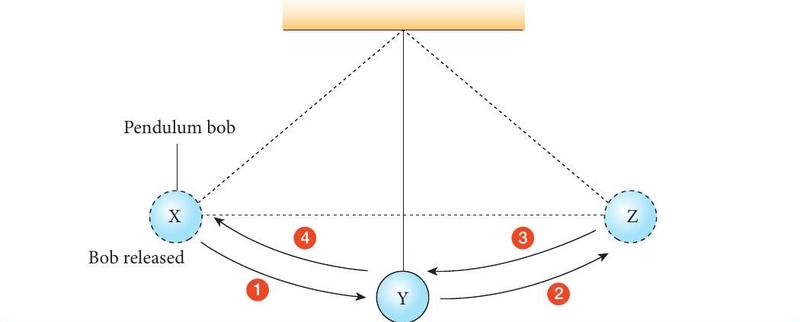
| Position | Gravitational P.E. | K.E. | Why |
|---|---|---|---|
| X or Z (highest) | Maximum | Zero | Highest point, bob momentarily at rest |
| X to Y or Z to Y | Decreasing | Increasing | Bob falls and speeds up |
| Y (lowest) | Minimum | Maximum | Lowest height, greatest speed |
| Y to Z or Y to X | Increasing | Decreasing | Bob rises and slows down |
Loaded spring
| Position of the load | Elastic P.E. | K.E. |
|---|---|---|
| Most stretched or most compressed | Maximum | Zero (at rest) |
| Equilibrium position | Minimum | Maximum |
| Moving towards the equilibrium position | Decreasing | Increasing |
| Moving away from the equilibrium position | Increasing | Decreasing |
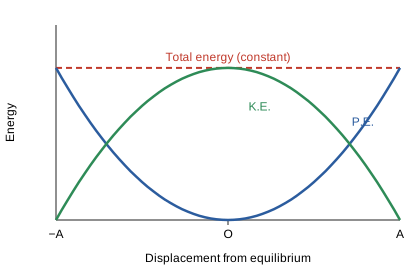
Solving problems by conservation of energy
Elastic P.E. = kinetic energy of the ball: ½ × 5 × 0.25 = ½ × 0.05 × v2.
0.625 = 0.025 v2, so v2 = 25 and v = 5 m s−1.
Assumption: no energy is lost to the surroundings.