Science questions, chapter 7
Nama / NameKelas / ClassTarikh / Date
Energy and power
44 marks. Use Practice to check each answer as you go, or Exam to answer everything against the clock first. Take g = 10 m s⁻² (weight of 1 kg = 10 N).
Section A: objective questions
12 marksChoose the best answer for each question.
1
Question 1
Which statement defines work in science?
Show answerHide answer
B
Work is force × displacement in the direction of the force, W = Fs. The ability to do work is energy; the rate of doing work is power; mass × g is weight.
2
Question 2
Which is the S.I. unit of power?
Show answerHide answer
D
Power is measured in watts. 1 W = 1 J s⁻¹, that is 1 J of work done in 1 s.
3
Question 3
A student pushes a trolley with a force of 50 N over a distance of 4 m in the direction of the force. How much work is done?
Show answerHide answer
C
W = Fs = 50 N × 4 m = 200 J.
4
Question 4
A machine does 600 J of work in 20 s. What is its power?
Show answerHide answer
A
P = W ÷ t = 600 J ÷ 20 s = 30 W.
5
Question 5
In which situation is work done in the scientific sense?
Show answerHide answer
B
Work is done only when the object is displaced in the direction of the force. Holding a bag still, pushing a fixed wall and a resting book all have zero displacement.
6
Question 6
A stone of mass 2 kg is lifted to a height of 5 m above the ground. What is its gravitational potential energy?
Show answerHide answer
C
E = mgh = 2 kg × 10 m s⁻² × 5 m = 100 J.
7
Question 7
A trolley of mass 4 kg moves at 3 m s⁻¹. What is its kinetic energy?
Show answerHide answer
D
E = ½mv² = ½ × 4 × 3² = ½ × 4 × 9 = 18 J. (Not 12 J: the speed must be squared first.)
8
Question 8
A spring is compressed by 5 cm by a final force of 40 N. What is the elastic potential energy stored?
Show answerHide answer
A
x = 5 cm = 0.05 m. E = ½Fx = ½ × 40 × 0.05 = 1 J.
9
Question 9
A simple pendulum bob swings in a closed system. What is true when the bob is at the lowest point?
Show answerHide answer
D
At the lowest point the height is least, so P.E. is minimum, and the speed is greatest, so K.E. is maximum.
10
Question 10
A car of mass 1 000 kg travels at 72 km h⁻¹. What is its kinetic energy?
Show answerHide answer
B
72 km h⁻¹ = 72 ÷ 3.6 = 20 m s⁻¹. E = ½ × 1 000 × 20² = 200 000 J.
11
Question 11
A ball moves at speed v and has kinetic energy E. The speed of the ball is then doubled. What is its new kinetic energy?
Show answerHide answer
C
E = ½mv². If v becomes 2v, then (2v)² = 4v², so the kinetic energy becomes 4E.
12
Question 12
A real pendulum swings a little lower each time and finally stops. Which explanation obeys the Principle of Conservation of Energy?
Show answerHide answer
A
Energy cannot be destroyed. In a real system some energy changes into heat (wasted energy) through friction and air resistance. A closed system has no such loss.
Section B: structured questions
32 marksAnswer all questions. Show your working and include units.
13
Question 13
Write the formula for each form of energy. m is mass, g is gravitational acceleration, h is height, F is force, x is displacement and v is velocity.
[1 mark]
(a)Gravitational potential energy
Show answerHide answer
Tick each point you got.
[1 mark]
(b)Elastic potential energy
Show answerHide answer
Tick each point you got.
[1 mark]
(c)Kinetic energy
Show answerHide answer
Tick each point you got.
14
Question 14
An electric motor lifts a load of weight 3 000 N through a vertical height of 5 m in 40 s.
[2 marks]
(a)Calculate the work done by the motor.
Show answerHide answer
Tick each point you got.
[1 mark]
(b)How much energy is used by the motor to lift the load?
Show answerHide answer
Tick each point you got.
[2 marks]
(c)Calculate the power of the motor.
Show answerHide answer
Tick each point you got.
15
Question 15
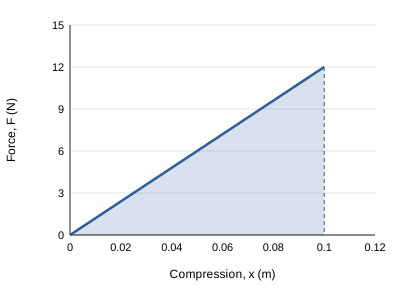
Diagram 1 shows a graph of the force against the compression of a spring.
[2 marks]
(a)Calculate the elastic potential energy stored in the spring when it is compressed by 0.10 m.
Show answerHide answer
Tick each point you got.
[2 marks]
(b)The spring is released and pushes a ball of mass 0.3 kg. Calculate the maximum speed of the ball.
Show answerHide answer
Tick each point you got.
[1 mark]
(c)State one assumption made in part (b).
Show answerHide answer
Tick each point you got.
16
Question 16
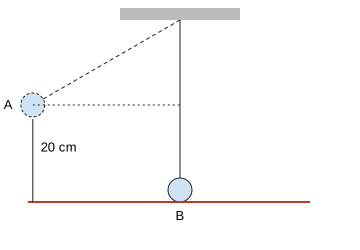
Diagram 2 shows a pendulum bob of mass 100 g released from A, 20 cm above its lowest point B. Take the oscillation as a closed system.
[2 marks]
(a)Calculate the gravitational potential energy of the bob at A relative to B.
Show answerHide answer
Tick each point you got.
[1 mark]
(b)State the form of energy that is greatest at B.
Show answerHide answer
Tick each point you got.
[2 marks]
(c)Calculate the maximum speed of the bob.
Show answerHide answer
Tick each point you got.
[2 marks]
(d)In a real pendulum the bob does not return to the height of A after many swings. Explain why, using the Principle of Conservation of Energy.
Show answerHide answer
Tick each point you got.
17
Question 17
Aina weighs 450 N and Bala weighs 600 N. Each climbs the same flight of stairs of vertical height 4 m. Aina takes 12 s and Bala takes 20 s.
[2 marks]
(a)Calculate the work done by each student.
Show answerHide answer
Tick each point you got.
[2 marks]
(b)Calculate the power of each student.
Show answerHide answer
Tick each point you got.
[1 mark]
(c)Bala does more work. Explain why Aina still has the higher power.
Show answerHide answer
Tick each point you got.
18
Question 18
A load hangs on a spring and oscillates up and down. X is the position where the spring is most stretched and Y is the equilibrium position.
[1 mark]
(a)At X, the elastic potential energy of the system is
Show answerHide answer
Maximum
The spring is most stretched, so elastic P.E. is maximum.
[1 mark]
(b)At X, the kinetic energy of the load is
Show answerHide answer
Zero
The load is momentarily at rest at the end of its motion.
[1 mark]
(c)At Y, the kinetic energy of the load is
Show answerHide answer
Maximum
At the equilibrium position the load moves fastest.
19
Question 19
You are asked to build a working model of a roller coaster using a rubber hose, a ball bearing and retort stands.
[1 mark]
(a)State where the starting point of the ball bearing should be placed, and why.
Show answerHide answer
Tick each point you got.
[2 marks]
(b)Describe the energy changes of the ball bearing as it rolls down the first slope and then up a second hill.
Show answerHide answer
Tick each point you got.
[1 mark]
(c)Explain why, in the real model, the second hill must be lower than the starting point.
Show answerHide answer
Tick each point you got.