Systems of Equations
What this chapter covers
- Describe systems of linear equations in three variables, and recognise when a set of equations is one (3.1.1)
- Solve systems of linear equations in three variables using the elimination and substitution methods, and identify one, infinite or no solution (3.1.2)
- Solve problems by forming and solving systems of linear equations in three variables (3.1.3)
- Solve simultaneous equations involving one linear and one non-linear equation by substitution, elimination or graphs (3.2.1)
- Solve problems involving simultaneous equations with one linear and one non-linear equation (3.2.2)
3.1Systems of linear equations in three variables
On a graph, a linear equation in two variables (ax + by = c) is a straight line. A linear equation in three variables is a flat plane in three dimensions, with an x-axis, y-axis and z-axis.
(b) p + 8q − 4r = 2, 2(p + 6r) + 7q = 0, 10r + p = 5q
(a) No. One equation has z², so the power is not 1.
(b) Yes. Each equation has the variables p, q and r with power 1 (after expanding the brackets).
Show answerHide answer
How many solutions can there be?
The solution is the set of values that satisfy all the equations. It is where the three planes meet.
| Planes | Solutions | What you get when you eliminate |
|---|---|---|
| Meet at one point | One solution | Values for x, y and z |
| Meet along a straight line | Infinite solutions | 0 = 0 |
| Do not meet at any point | No solution | 0 = a non-zero number, such as 0 = 12 |
Elimination method
- Pick two equations and eliminate one variable, giving a new equation in two variables.
- Pick a different pair and eliminate the same variable.
- Solve the two equations in two variables.
- Substitute back to find the third variable, then check in all three equations.
(1) + (3): 2x + 3y = 8 … (4)
(2) + (3): 3x + y = 5 … (5)
(5) × 3: 9x + 3y = 15 … (6)
(6) − (4): 7x = 7, so x = 1
From (5): y = 5 − 3 = 2. From (1): z = 6 − 1 − 2 = 3.
Check (2): 2 − 2 + 3 = 3. Correct. x = 1, y = 2, z = 3.
Substitution method
Make one variable the subject of one equation, then substitute it into the other two. This works well when one equation is simple, such as z = x + y.
Put (1) into (3): x + y + (x + y) = 12, so x + y = 6 … (4)
Put (1) into (2): 3x − y + x + y = 12, so 4x = 12 and x = 3
From (4): y = 3. From (1): z = 6. x = 3, y = 3, z = 6.
Show answerHide answer
No solution and infinite solutions
(1) × 2: 2x − 2y + 6z = 6. Add to (2): 0 = 12, which is false.
The system has no solution. The planes never meet.
(1) × 2 − (2): 11x + 12y = 6. (1) + (3): −11x − 12y = −6.
Adding these gives 0 = 0, which is always true. There are infinite solutions.
Word problems with three unknowns
Use the four steps: understand the problem, plan (define a, b, c and write three equations), carry out, then conclude and check.
Multiply the savings equation by 10: a + 2b + 3c = 2 760. Subtract 2 × the first equation: −a + c = 280.
With c = 2a: a = 280, c = 560, so b = 400. The rents are RM280, RM400 and RM560 per day.
Check: 0.1(280) + 0.2(400) + 0.3(560) = 276.
3.2Simultaneous equations: one linear and one non-linear
Substitution is the main method
- From the linear equation, make one variable the subject.
- Substitute into the non-linear equation to get a quadratic equation.
- Solve it by factorisation, the formula or completing the square.
- Put each value back into the linear equation to find its partner.
From (1): y = x − 2. Put in (2): x(x − 2) = 15, so x² − 2x − 15 = 0.
(x − 5)(x + 3) = 0, so x = 5 or x = −3.
y = 5 − 2 = 3 or y = −3 − 2 = −5.
x = 5, y = 3 and x = −3, y = −5.
Show answerHide answer
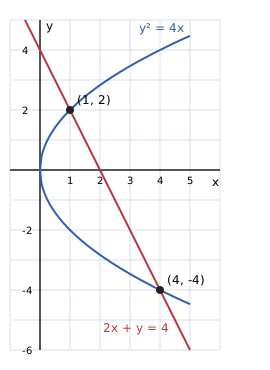
Graphical method
Draw both graphs on the same axes. The points where they cross are the solutions. Read the coordinates from the graph, so the answer is only as accurate as the drawing.
Word problems
Perimeter and area, or sides of a right-angled triangle, give one linear and one non-linear equation.
l + w = 17 and lw = 72. Then w = 17 − l, so l(17 − l) = 72, l² − 17l + 72 = 0, (l − 8)(l − 9) = 0.
The sides are 8 cm and 9 cm.