Additional Mathematics notes, chapter 4
Indices, Surds and Logarithms
Textbook Additional Mathematics Form 4 KSSM (DLP), pages 88–125
What this chapter covers
- Simplify expressions with indices and solve equations involving indices using the laws of indices, including negative and rational indices (4.1)
- Distinguish rational and irrational numbers, use the laws of surds, rationalise denominators and solve problems (4.2)
- Relate logarithms to indices, use the laws of logarithms and change of base, and solve equations with logarithms (4.3)
- Solve real-life problems of growth and decay using indices, surds and logarithms (4.4)
4.1Laws of indices
In an, a is the base and n is the index (power). The laws below hold for any non-zero base and are used to simplify algebraic expressions too.
| Law | Example |
|---|---|
| am × an = am + n | t2 × t3 = t5 |
| am ÷ an = am − n | x7 ÷ x4 = x3 |
| (am)n = amn | (y3)2 = y6 |
| a0 = 1 | 70 = 1 |
| a−n = 1an | 2−3 = 18 |
| a1n = n√a | 813 = 3√8 = 2 |
| amn = (n√a)m = n√(am) | 823 = 22 = 4 |
Simplify (x3y−2)2x y−1
Numerator: x6y−4. Divide: x6−1y−4−(−1) = x5y−3 = x5y3.For a rational index, take the root first, then the power: 2723 = (3√27)2 = 32 = 9. The numbers stay small.
(a + b)n is not an + bn, and 23 × 33 cannot be combined by adding indices because the bases differ.
Equations involving indices
Write both sides with the same base, then equate the indices: if ax = ay then x = y.
Solve 4x+1 = 32
22(x+1) = 25, so 2x + 2 = 5 and x = 32.When a sum appears, factorise: 3x+1 + 3x = 36 gives 3x(3 + 1) = 36, 3x = 9, x = 2.
Simplify (a) 16−34 (b) solve 9x = 27x−1
Show answerHide answer
(a) 16−3/4 = 1 ÷ 23 = 18
(b) 32x = 33x−3, so 2x = 3x − 3 and x = 3
(b) 32x = 33x−3, so 2x = 3x − 3 and x = 3
4.2Laws of surds
A rational number can be written as ab with a, b integers, b ≠ 0 (its decimal ends or recurs). An irrational number cannot. A surd is an irrational root such as √2 or 3√5.
√9 = 3 is rational, so it is not a surd. √7 and √12 are surds.
| Law of surds | Example |
|---|---|
| √a × √b = √(ab) | √2 × √8 = √16 = 4 |
| √a ÷ √b = √(ab) | √30 ÷ √5 = √6 |
| (√a)2 = √(a2) = a | (√7)2 = 7 |
| m√a + n√a = (m + n)√a | 3√5 + 2√5 = 5√5 |
| √(a2b) = a√b | √48 = √(16 × 3) = 4√3 |
√a + √b is not √(a + b). For example √9 + √16 = 3 + 4 = 7, but √(9 + 16) = √25 = 5.
Rationalising the denominator
Remove the surd from the denominator by multiplying top and bottom by the right factor.
| Denominator | Multiply by | Example |
|---|---|---|
| √a | √a√a | 6√3 = 6√33 = 2√3 |
| a + √b | conjugate a − √ba − √b | 13 + √5 = 3 − √59 − 5 = 3 − √54 |
| √a − √b | conjugate √a + √b√a + √b | 2√5 − √3 = 2(√5 + √3)5 − 3 = √5 + √3 |
The conjugate of a + √b is a − √b. Their product (a + √b)(a − √b) = a2 − b is always rational.
Express 2 + √32 − √3 in the form p + q√3
(2 + √3)(2 + √3)(2 − √3)(2 + √3) = 4 + 4√3 + 34 − 3 = 7 + 4√3.Simplify (a) √50 − √18 (b) rationalise 4√2 + 1
Show answerHide answer
(a) 5√2 − 3√2 = 2√2
(b) 4(√2 − 1)2 − 1 = 4√2 − 4
(b) 4(√2 − 1)2 − 1 = 4√2 − 4
4.3Laws of logarithms
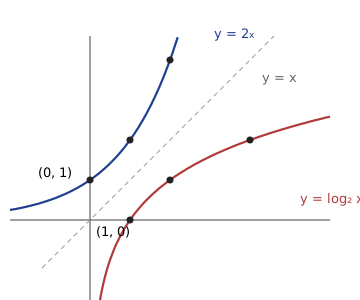
Logarithm. ax = N is the same statement as loga N = x, with a > 0, a ≠ 1 and N > 0. A logarithm is an index.
| Index form | Logarithm form |
|---|---|
| 25 = 32 | log2 32 = 5 |
| 10−2 = 0.01 | log10 0.01 = −2 |
Special values: loga 1 = 0, loga a = 1. log10 is written lg (or log), and loge is the natural logarithm ln, where e ≈ 2.718. Note ln e = 1 and eln x = x.
The three basic laws (a, x, y > 0 and a ≠ 1)
| Law | Rule |
|---|---|
| Product | loga xy = loga x + loga y |
| Division | loga xy = loga x − loga y |
| Power | loga xn = n loga x |
loga(x + y) cannot be split, and loga xloga y is not loga x − loga y. Also, all the logs in a law must have the same base.
Given log2 3 = 1.585 and log2 5 = 2.322, find log2 15 and log2 0.6
log2 15 = log2 3 + log2 5 = 3.907.log2 0.6 = log2 35 = 1.585 − 2.322 = −0.737.
Change of base
loga b = logc blogc a. Special case: loga b = 1logb a.
Find log4 8 without a calculator, and log30 4 with one
log4 8 = log2 8log2 4 = 32.log30 4 = lg 4lg 30 = 0.60211.4771 = 0.408.
Equations involving indices and logarithms
Solve 5x = 12 and log3(x − 1) = 2
Take lg of both sides: x lg 5 = lg 12, so x = 1.07920.6990 = 1.544.log3(x − 1) = 2 means x − 1 = 32 = 9, so x = 10.
Equations with several logs: combine them with the laws, then convert to index form, and reject any answer that makes a log argument zero or negative.
Given loga 2 = p and loga 3 = q, express loga 18 in terms of p and q
Show answerHide answer
loga 18 = loga(2 × 32) = p + 2q
4.4Applications
Growth, decay and compound interest use quantities such as P(1 + r)n. To find an unknown index n, take logarithms.
When will RM2 000 at 7% a year exceed RM4 000?
2 000(1.07)n > 4 000, so 1.07n > 2 and n > lg 2lg 1.07 = 0.301030.02938 = 10.24.Years are whole numbers, so the minimum is 11 years.
When you divide both sides by a log, check its sign: if it is negative the inequality sign reverses. For growth, lg 1.07 > 0, so it stays.
Mr Chong has RM4 000(1.1)n after n years. Find the first whole n so that it exceeds RM5 100.
Show answerHide answer
1.1n > 1.275, n > lg 1.275 ÷ lg 1.1 = 0.10551 ÷ 0.04139 = 2.55, so n = 3 years