Additional Mathematics notes, chapter 5
Progressions
Textbook Additional Mathematics Form 4 KSSM (DLP), pages 126–151
What this chapter covers
- Identify arithmetic progressions, state the common difference and justify (5.1.1)
- Derive and use the formula Tn = a + (n − 1)d for the n-th term of an arithmetic progression (5.1.2)
- Derive and use Sn = n/2 [2a + (n − 1)d] for the sum of the first n terms, and Tn = Sn − Sn−1 (5.1.3)
- Solve problems involving arithmetic progressions (5.1.4)
- Identify geometric progressions, state the common ratio and justify (5.2.1)
- Derive and use Tn = ar^(n−1) for the n-th term of a geometric progression (5.2.2)
- Derive and use the sum of the first n terms of a geometric progression (5.2.3)
- Find the sum to infinity S∞ = a / (1 − r) for |r| < 1 and write recurring decimals as fractions (5.2.4)
- Solve problems involving geometric progressions (5.2.5)
5.1Arithmetic progressions
Identifying an arithmetic progression (5.1.1)
A sequence is a list of numbers in a pattern. Each number is a term: T1 is the first term, T2 the second, and Tn the n-th term. An arithmetic progression (AP) is a sequence in which each term is found by adding a constant to the term before it. The constant is the common difference, d.
d = T2 − T1 = T3 − T2 = … = Tn − Tn−1
Example 1 (like textbook p. 129): is it an AP?
(a) 358, 350, 342, … : d1 = 350 − 358 = −8 and d2 = 342 − 350 = −8. The differences are equal, so it is an AP.(b) 1, 3, 9, … : d1 = 2 but d2 = 6. The differences are not equal, so it is not an AP.
Check at least two differences. Always subtract in the same direction: later term minus earlier term. A decreasing AP has a negative d.
Two equal differences from a short list do not prove an AP if a third difference is different. Check every difference you are given.
Is 0.1, 0.01, 0.001, … an arithmetic progression? Give a reason.
Show answerHide answer
No. d1 = 0.01 − 0.1 = −0.09 but d2 = 0.001 − 0.01 = −0.009. The differences are not equal.
The n-th term of an AP (5.1.2)
Start with first term a and common difference d. T1 = a, T2 = a + d, T3 = a + 2d. Each term has one fewer d than its position number, so:
Tn = a + (n − 1)d, where a = first term, d = common difference, n = number of terms.
Example 3 and 4 (textbook p. 131)
(a) 15th term of −4, 2, 8, … : a = −4, d = 2 − (−4) = 6. T15 = −4 + (15 − 1)(6) = 80.(b) a = −6, d = 11 and Tn = 126: −6 + (n − 1)(11) = 126, so 11(n − 1) = 132 and n = 13.
Two terms given? Write two equations in a and d, subtract them. For Tm and Tk the difference gives (m − k)d directly.
Use n − 1, not n, in the bracket. Always check that n comes out as a positive whole number.
Find the 20th term of the AP 5, 8, 11, … and say which term equals 80.
Show answerHide answer
a = 5, d = 3. T20 = 5 + 19(3) = 62. For 80: 5 + (n − 1)(3) = 80, so n − 1 = 25 and n = 26.
The sum of the first n terms, Sn (5.1.3)
Write the terms forwards and backwards and add: each pair adds up to a + Tn, and there are n pairs, which counts every term twice. So
Sn = n2[2a + (n − 1)d] or Sn = n2(a + l), where l = Tn is the last term.
| You know | Use |
|---|---|
| a, d and n | Sn = n2[2a + (n − 1)d] |
| a, last term l and n | Sn = n2(a + l) |
| Sn as a formula in n, and you want the n-th term | Tn = Sn − Sn−1 |
Example 6 (textbook p. 134): 4, 7, 10, …
a = 4, d = 3. S35 = 352[2(4) + 34(3)] = 352(110) = 1 925.Sn = n2[8 + 3(n − 1)] = n2(3n + 5).
Example 7 (textbook p. 134): two sums given
S10 = 120 and S20 = 440. Then 5(2a + 9d) = 120, so 2a + 9d = 24 … (1). And 10(2a + 19d) = 440, so 2a + 19d = 44 … (2). (2) − (1): 10d = 20, d = 2, and a = 3.Do not confuse S20 with "the next ten terms". If the first ten terms add to 120 and the next ten add to 320, then S20 = 120 + 320 = 440.
An inequality such as Sn > 1 000 becomes a quadratic in n. Solve the equation, then pick the next whole number above the root (and ignore a negative root). If Sn equals 1 000 exactly, that n does not satisfy "more than".
Find S12 for the AP 2, 5, 8, …
Show answerHide answer
a = 2, d = 3. S12 = 122[4 + 11(3)] = 6 × 37 = 222.
Problems involving APs (5.1.4)
Follow the four steps used in the textbook (p. 137): understand the problem, plan a strategy (decide AP, Tn or Sn), carry it out, and conclude with a sentence in context.
Example 9 (textbook p. 137): chickens
1 500 chickens, 200 sold each day: 1 500, 1 300, …, 300. 300 = 1 500 + (n − 1)(−200) gives n = 7. The daily food bill is RM0.50 per chicken, so total = S7 × 0.50 = 72[2(1 500) + 6(−200)] × 0.50 = 6 300 × 0.50 = RM3 150.Decide first: "which term" or "the term" asks for Tn; "total", "altogether" or "sum" asks for Sn.
5.2Geometric progressions
Identifying a geometric progression (5.2.1)
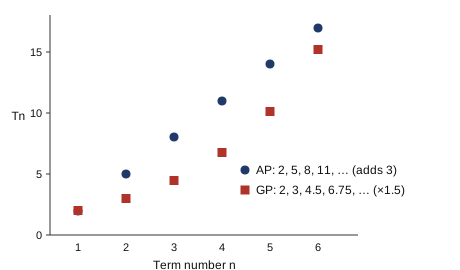
A geometric progression (GP) is a sequence in which each term is found by multiplying the term before it by a constant. The constant is the common ratio, r = T2T1 = T3T2 = … = TnTn−1.
Example 10 (textbook p. 140)
(a) 5, 15, 45, 135, … : r = 15 ÷ 5 = 3, 45 ÷ 15 = 3, 135 ÷ 45 = 3. A GP.(b) 0.1, 0.2, 0.3, … : 0.2 ÷ 0.1 = 2 but 0.3 ÷ 0.2 = 32. Not a GP (it is an AP with d = 0.1).
If three numbers x, y, z are consecutive terms of a GP then yx = zy, so y² = xz. For an AP, 2y = x + z.
r can be negative (the signs alternate) or a fraction (the terms shrink). r = 1 gives a constant sequence, and r cannot be 0.
Is 12, 4, 43, … a GP? What is r?
Show answerHide answer
Yes. 4 ÷ 12 = 13 and 43 ÷ 4 = 13. r = 13.
The n-th term of a GP (5.2.2)
Tn = arn−1, where a = first term, r = common ratio, n = number of terms.
Example 11 and 12 (textbook p. 142)
(a) 4, −20, 100, … : r = −5. T5 = 4(−5)4 = 2 500.(b) 2, 23, 29, … : r = 13. T7 = 2(13)6 = 2729.
Example 13 (textbook p. 143): finding n with logarithms
Chairs: 20 in row 1, each row 1.5 times the one before. Which row has at least 505 chairs? 20(1.5)n−1 ≥ 505 so (1.5)n−1 ≥ 25.25. Take logarithms: (n − 1) log 1.5 ≥ log 25.25, n − 1 ≥ 7.96, n ≥ 8.96. The 9th row is the first with at least 505 chairs.When n is in the power, take log of both sides (Chapter 4). Because the answer must be a whole number, round to the next whole number up for "at least", and check by substitution.
When dividing by a negative number or by log of a number between 0 and 1 (such as log 0.6), the inequality sign flips.
Find T6 of the GP 2, 6, 18, …
Show answerHide answer
r = 3. T6 = 2 × 35 = 486.
The sum of the first n terms of a GP (5.2.3)
Write Sn = a + ar + ar² + … + arn−1, multiply by r, and subtract. Almost every term cancels and Sn(1 − r) = a(1 − rn).
Sn = a(rn − 1)r − 1 (convenient when |r| > 1) or Sn = a(1 − rn)1 − r (convenient when |r| < 1), with r ≠ 1. Also Tn = Sn − Sn−1.
Example 14 and 15 (textbook p. 144-145)
1 + 5 + 25 + … : a = 1, r = 5. S10 = 1(510 − 1)5 − 1 = 2 441 406. If Sn = 3 906 then 5n − 1 = 15 624, 5n = 15 625 and n = 6.A marketing plan where each member recruits 2 downlines gives 1, 2, 4, 8, … (r = 2). With 9 levels the total is S9 = 29 − 12 − 1 = 511.
Use the form with a positive denominator: r > 1 use rn − 1 over r − 1; r < 1 use 1 − rn over 1 − r. The answers are the same, but there are fewer sign errors.
Find S5 of 3, 6, 12, …
Show answerHide answer
a = 3, r = 2. S5 = 3(25 − 1)2 − 1 = 3 × 31 = 93.
The sum to infinity (5.2.4)
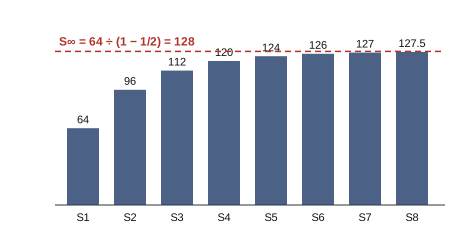
When −1 < r < 1, rn gets closer and closer to 0 as n grows, so Sn gets closer and closer to a fixed number.
S∞ = a1 − r, only when |r| < 1 (that is, −1 < r < 1).
Example 16 and 17 (textbook p. 146-147)
45, 9, 1.8, … : r = 15, S∞ = 451 − 15 = 5614.Sum to infinity 3112 = 632, first two terms add to 28: a = 632(1 − r) and a(1 + r) = 28, so (1 + r)(1 − r) = 89, r² = 19, r = ±13.
Example 18 (textbook p. 147): recurring decimals
0.5636363… = 0.5 + (0.063 + 0.00063 + …). The bracket is a GP with a = 0.063 and r = 0.01, so its sum is 0.0631 − 0.01 = 7110. Total = 12 + 7110 = 3155.Check |r| < 1 before using S∞. For 2, 6, 18, … there is no sum to infinity because the terms keep growing.
A recurring decimal: keep the non-repeating part separate, then treat the repeating digits as a GP whose r is 0.1 (one digit repeating), 0.01 (two digits), and so on.
Express 0.7777… as a fraction using S∞.
Show answerHide answer
0.7 + 0.07 + 0.007 + …: a = 0.7, r = 0.1. S∞ = 0.70.9 = 79.
Problems involving GPs (5.2.5)
Example 19 (textbook p. 148): sales increasing by 4% a year
0.5 million phones in 2015, rising 4% each year. a = 0.5 and r = 1.04. Sales from 2015 to 2020 (6 years): S6 = 0.5(1.046 − 1)0.04 = 3.316 million. Sales from 2017 to 2020 are S6 − S2 = 3.316 − 1.02 = 2.296 million."Increases by 4%" means r = 1.04. "Decreases by 5%" means r = 0.95. Percentage growth each period is a GP; a fixed amount each period is an AP.
| AP | GP | |
|---|---|---|
| Each term | adds d | multiplies by r |
| n-th term | a + (n − 1)d | arn−1 |
| Sum of n terms | n2[2a + (n − 1)d] | a(rn − 1)r − 1 or a(1 − rn)1 − r |
| Sum to infinity | none | a1 − r when |r| < 1 |