Additional Mathematics questions, chapter 9
Nama / NameKelas / ClassTarikh / Date
Solution of Triangles
44 marks. Use Practice to check each answer as you go, or Exam to answer everything first. Show your working for Section B. A scientific calculator in degree mode is needed.
Section A: objective questions
12 marksChoose the correct answer. Each question carries 1 mark.
1
Question 1
Which statement is the sine rule for triangle ABC?
Show answerHide answer
A
Each side is divided by the sine of the angle opposite it. The last option is the cosine rule.
2
Question 2
In triangle ABC, ∠A = 40°, ∠B = 65° and a = 12 cm. Find b, correct to 2 decimal places.
Show answerHide answer
B
b = 12 sin 65° ÷ sin 40° = 16.92 cm. 8.51 cm comes from turning the ratio upside down.
3
Question 3
In triangle ABC, ∠A = 50°, a = 9 cm and b = 7 cm. Find ∠B.
Show answerHide answer
C
sin B = 7 sin 50° ÷ 9 = 0.5958, so B = 36.6°. Since b < a, angle B is smaller than angle A, so only the acute value fits.
4
Question 4
The ambiguous case exists when two sides and a non-included angle are given, and
Show answerHide answer
D
Two triangles fit only when h < a < c with an acute given angle. If a = h there is one right-angled triangle.
5
Question 5
In triangle ABC, ∠A = 30°, AB = 10 cm and BC = 6 cm. How many different triangles can be formed?
Show answerHide answer
B
h = 10 sin 30° = 5 cm. Since 5 < 6 < 10, two triangles exist.
6
Question 6
A calculator gives ∠C = 52° from the sine rule in an ambiguous case. What is the other possible value of ∠C?
Show answerHide answer
C
The other angle with the same sine is 180° − 52° = 128°.
7
Question 7
Which is the cosine rule for finding side a?
Show answerHide answer
D
Square the sides, add the two adjacent ones and subtract 2bc cos A.
8
Question 8
In triangle ABC, b = 7 cm, c = 9 cm and ∠A = 60°. Find a.
Show answerHide answer
A
a² = 49 + 81 − 2(7)(9)cos 60° = 67, so a = 8.19 cm. 11.40 cm forgets the cosine term.
9
Question 9
A triangle has sides 5 cm, 7 cm and 8 cm. Find its largest angle.
Show answerHide answer
C
The largest angle is opposite 8 cm: cos C = (25 + 49 − 64) ÷ 70 = 1/7, so C = 81.8°.
10
Question 10
Triangle ABC has AB = 8 cm, BC = 11 cm and ∠B = 42°. Find its area.
Show answerHide answer
D
Area = ½(8)(11) sin 42° = 29.4 cm². The second option forgets the half.
11
Question 11
Find the area of a triangle with sides 5 cm, 6 cm and 7 cm.
Show answerHide answer
A
s = 9. Area = √(9 × 4 × 3 × 2) = √216 = 14.70 cm².
12
Question 12
Triangle PQR has PQ = 6 cm, QR = 9 cm and ∠P = 70°. Which method finds ∠R first?
Show answerHide answer
B
The known angle P is opposite QR (9 cm) and side PQ is opposite R, so sin R ÷ 6 = sin 70° ÷ 9. No side is between two known angles for the cosine rule.
Section B: structured questions
32 marksAnswer all questions. Show your working. Give answers to the stated accuracy.
13
Question 13
In triangle ABC, ∠A = 35°, AB = 12 cm and BC = 8 cm.
[2 marks]
(a)Show that two different triangles can be drawn.
Show answerHide answer
Tick each point you got.
[2 marks]
(b)Find the two possible values of ∠C.
Show answerHide answer
Tick each point you got.
[2 marks]
(c)Find the two possible values of ∠B.
Show answerHide answer
Tick each point you got.
14
Question 14
The diagram shows triangle PQR with PQ = 8 cm, PR = 11 cm and ∠QPR = 65°.
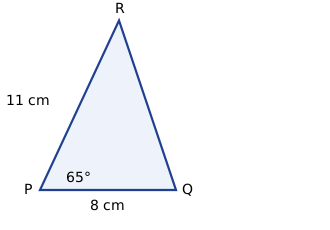
[3 marks]
(a)Find QR, correct to 2 decimal places.
Show answerHide answer
Tick each point you got.
[2 marks]
(b)Find ∠PQR, correct to 1 decimal place.
Show answerHide answer
Tick each point you got.
15
Question 15
A triangular plot has sides 13 m, 14 m and 15 m.
[3 marks]
(a)Use Heron's formula to find the area of the plot.
Show answerHide answer
Tick each point you got.
[2 marks]
(b)Find the shortest distance from the opposite corner to the 14 m side.
Show answerHide answer
Tick each point you got.
16
Question 16
Two walkers leave the same gate. Ali goes 12 km on a bearing of 075° and Mei Ling goes 9 km on a bearing of 160°.
[1 mark]
(a)Find the angle between their paths.
Show answerHide answer
Tick each point you got.
[3 marks]
(b)Find how far apart they are, correct to 1 decimal place.
Show answerHide answer
Tick each point you got.
17
Question 17
A farmer's land ABCD is split by the diagonal AC. AB = 9 m, BC = 12 m, ∠ABC = 70°, CD = 10 m and DA = 7 m.
[2 marks]
(a)Find AC, correct to 2 decimal places.
Show answerHide answer
Tick each point you got.
[2 marks]
(b)Find the area of triangle ABC.
Show answerHide answer
Tick each point you got.
[2 marks]
(c)Find the area of triangle ACD using Heron's formula, with AC from part (a).
Show answerHide answer
Tick each point you got.
[1 mark]
(d)Find the total area of the land.
Show answerHide answer
Tick each point you got.
18
Question 18
Create your own ambiguous case. In triangle ABC, ∠A = 30° and AB = 10 cm, and you choose the length of BC.
[2 marks]
(a)State the range of values of BC that gives two triangles.
Show answerHide answer
Tick each point you got.
[3 marks]
(b)Choose BC = 7 cm and find both possible values of ∠C.
Show answerHide answer
Tick each point you got.